How the Cybertruck's Interior Design Blends Functionality with Aesthetics
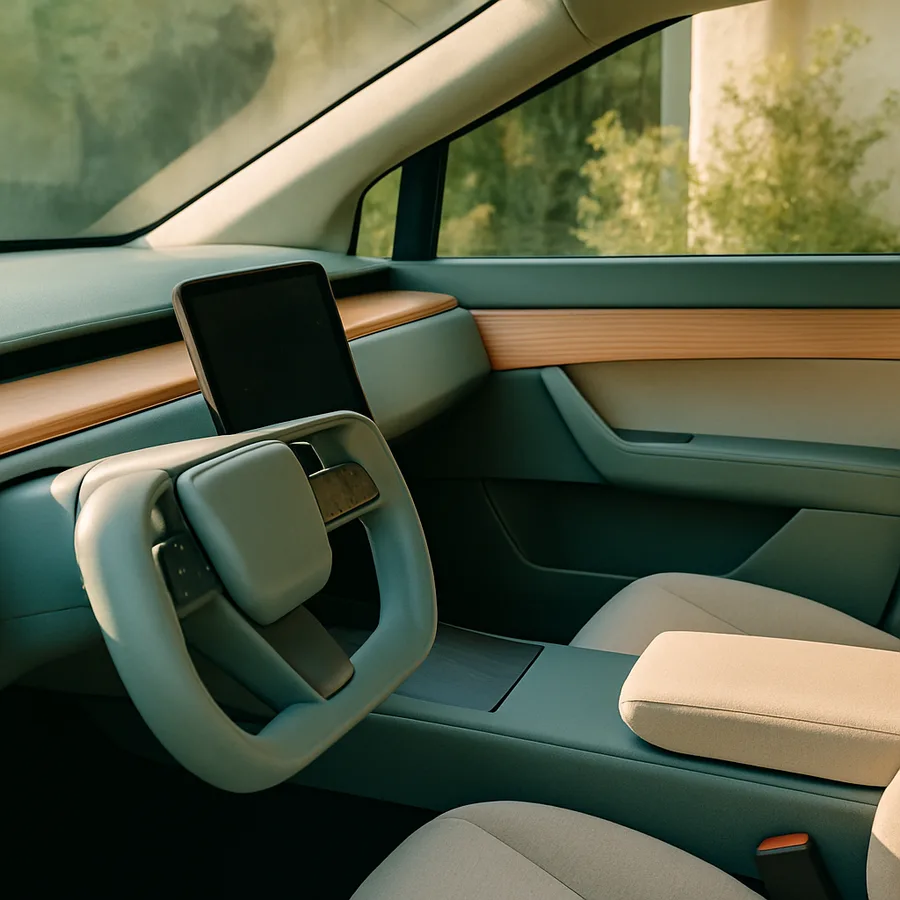
Where Function Meets Form in Vehicle Cabin Design
The enduring tension between functionality and aesthetics has defined interior design debates for more than a century, from the Arts and Crafts movement through Bauhaus modernism to the current era of technology-integrated spaces. The Tesla Cybertruck enters this conversation with a cabin that refuses to compromise on either side, delivering an interior where every aesthetic choice enhances function and every functional element contributes to the visual composition. The American Society of Interior Designers (ASID) has long advocated for this synthesis, arguing that the most successful interiors are those where beauty and utility are inseparable rather than competing priorities.
Traditional vehicle interiors typically resolve the function-aesthetics tension through layered compromise. Functional elements like switches, vents, and gauges are dressed in decorative housings that attempt to make them attractive, while purely aesthetic elements like trim strips, accent lighting, and decorative stitching are added to compensate for the visual clutter that functional components create. The result is an interior that is neither fully functional nor fully beautiful but occupies an awkward middle ground. The Cybertruck breaks this cycle by eliminating decorative elements entirely and demanding that every visible component earn its place through functional contribution.
This uncompromising approach produces an interior that divides opinion but never fails to provoke thought. Occupants either appreciate the intellectual clarity of the design or find themselves missing the familiar comfort of decorative cues. Both reactions validate the design's power to engage people meaningfully with their built environment, a quality that the International Interior Design Association (IIDA) identifies as the hallmark of significant design work. Indifference is the only failure in design, and the Cybertruck interior has never been accused of provoking indifference.
Surfaces That Work as Hard as They Look
Every interior surface in the Cybertruck performs a measurable function beyond visual presentation, a principle that elevates the cabin from simple minimalism to functional minimalism. The flat dashboard is not merely a visual plane; it serves as the mounting surface for the central touchscreen, the distribution plenum for the concealed climate system, and the acoustic boundary between cabin and windshield. The door panels are not just covers; they integrate speakers, storage pockets, window mechanisms, and structural reinforcement into a single molded component. The floor is not just a walking surface; it provides acoustic isolation, thermal insulation, and a drainage-ready material that channels spilled liquids to collection points rather than allowing them to soak into absorbent padding.
This multi-function approach to surfaces reflects principles that the National Council for Interior Design Qualification (NCIDQ) tests rigorously in professional certification examinations. Certified designers are expected to specify materials and systems that serve multiple purposes simultaneously, reducing redundancy and improving the efficiency of built environments. The Cybertruck applies this professional standard with unusual consistency, ensuring that no surface exists solely for decoration and no functional system is added without considering its visual impact on the overall composition.
The practical benefit for occupants is an interior that contains fewer total components than a conventional truck while offering equivalent or superior functionality. Fewer components mean fewer things that can break, fewer materials that need maintenance, and fewer visual elements that compete for attention. According to reliability data compiled by Consumer Reports, vehicles with fewer mechanical interior components consistently demonstrate lower rates of owner-reported problems over the first five years of ownership, a correlation that supports the Cybertruck's reductive design approach. The cabin proves that removing things can be more innovative than adding them.
This surface philosophy extends to the seats, which integrate heating, cooling, and position adjustment mechanisms within a structure that presents clean, uninterrupted upholstery to the occupant. There are no visible adjustment levers on the seat sides, no exposed heating element outlines beneath the fabric, and no mechanical tracks visible at floor level. Every functional mechanism is concealed within the seat structure, preserving the visual simplicity of the overall cabin design while delivering full adjustability. Houzz has documented the same trend in residential furniture design, where mechanized recliners, storage beds, and adjustable desks hide their mechanisms within clean exterior forms.
The Touchscreen as Functional Art
The 18.5-inch central touchscreen deserves examination as both a functional interface and an aesthetic object that anchors the cabin composition. Its proportions, placement, and visual weight have been calibrated to serve as the focal point of the interior, a role that Architectural Digest compares to the function of a signature artwork in a well-designed living room. The screen's landscape orientation creates a horizontal emphasis that complements the linear dashboard, while its centered position establishes symmetry that organizes the visual field for both driver and passenger.
Functionally, the screen delivers information density that would require multiple separate displays, instrument clusters, and heads-up projections in conventional vehicles. Navigation, media, climate, vehicle diagnostics, camera feeds, and settings all occupy a single visual plane that the driver can scan without shifting focus between multiple screen locations. This consolidation reduces the cognitive load associated with information seeking, a benefit that human factors research at institutions like the Massachusetts Institute of Technology has quantified through eye-tracking studies comparing single-screen and multi-screen instrument layouts.
The aesthetic contribution of the screen shifts throughout the day as its content changes and its brightness adapts to ambient conditions. During daylight hours, the screen serves as a dark rectangle against the light dashboard, providing visual weight that anchors the otherwise monochromatic surface. After dark, it becomes the primary light source in the cabin, casting illumination across the surrounding surfaces and creating an atmosphere that ranges from focused and task-oriented to relaxed and ambient depending on the displayed content. This dual character, solid object by day and light source by night, gives the screen a dynamic presence that static design elements cannot match.
How Material Honesty Serves Both Beauty and Function
The Cybertruck interior practices material honesty, a design principle that presents materials as what they are rather than disguising them as something else. The metal surfaces are visibly metal, the synthetic textiles are recognizably synthetic, and the glass is clearly glass. There are no plastic panels molded to look like wood, no vinyl surfaces textured to imitate leather, and no painted finishes designed to simulate brushed aluminum. This honesty creates an interior where every surface communicates its actual properties, a quality that ASID design guidelines identify as essential to creating environments that feel authentic and trustworthy.
Material honesty serves function directly by setting accurate expectations about how surfaces will perform. Occupants who see metal know they are touching a surface that resists scratching and cleaning chemicals. Occupants who see synthetic textile know they are sitting on a material engineered for specific performance characteristics rather than cut from an animal hide whose properties vary across its surface. This transparency eliminates the disappointment that often accompanies imitation materials, where surfaces that look like one thing but behave like another erode trust in the overall design. Do you find yourself more confident interacting with a space when you understand what its surfaces are actually made of?
The aesthetic benefit of material honesty is a visual environment with inherent depth and variety. Because each material reflects light, accumulates wear, and responds to temperature differently, the monochromatic Cybertruck interior contains subtle visual complexity that imitation materials cannot reproduce. Brushed stainless steel develops a patina over time that genuine leather might envy, synthetic textiles maintain their color and texture through conditions that would destroy natural fibers, and glass surfaces provide reflections and transparency that no other material can match. The IIDA has published research demonstrating that interiors using authentic materials consistently score higher in occupant satisfaction surveys than those using convincing imitations, even when the imitations are virtually indistinguishable to the eye.
This material strategy also supports environmental sustainability goals by avoiding the complex layered constructions that decorative finishes require. A plastic panel molded to look like wood involves multiple material layers, adhesives, and surface treatments that complicate recycling at end of life. The Cybertruck's honest materials, being what they appear to be, present simpler recycling profiles that align with circular economy principles. The sustainability dimension of material honesty is receiving increasing attention from design certification bodies, including the NCIDQ, which now includes lifecycle material assessment in its examination content.
Spatial Flow and the Elimination of Visual Barriers
The Cybertruck interior achieves a sense of spatial flow that makes the cabin feel continuous and unified rather than divided into separate zones. The flat dashboard creates an uninterrupted visual horizon from door to door, the minimal center console preserves a sense of openness between driver and passenger, and the glass roof eliminates the overhead boundary that conventional headliners impose. These design choices combine to create a cabin that reads as a single coherent volume rather than a collection of separate compartments, a quality that Architectural Digest identifies as essential to successful open-plan residential design.
The elimination of visual barriers has measurable effects on occupant perception of space. Research conducted by the Environmental Design Research Association found that enclosed environments with fewer internal partitions are consistently perceived as larger than equivalent spaces with multiple visual subdivisions, even when the actual volume is identical. The Cybertruck exploits this perceptual principle by removing the instrument cluster binnacle, reducing the center console height, and replacing the solid roof with transparent glass, each change adding perceived volume without altering the cabin's physical dimensions.
This spatial openness also facilitates social interaction within the cabin, making conversation between front and rear occupants more natural and comfortable. In conventional trucks, the tall center console, elevated instrument panel, and solid headliner create a series of visual and acoustic barriers that isolate occupants in separate compartments. The Cybertruck's open design allows sightlines between all seating positions and permits sound to travel freely across the cabin, creating a more connected social environment for families, work teams, and groups traveling together. Have you ever felt isolated from someone sitting just a few feet away in a vehicle? The Cybertruck addresses that disconnection through deliberate spatial design.
The flow extends longitudinally when the rear seats fold flat and the bed pass-through opens, creating a continuous spatial experience from the windshield to the tailgate. This extended configuration dissolves the traditional boundary between cabin and cargo area, producing a unified space that can accommodate occupants, equipment, and activities that no conventional truck configuration supports. The architectural concept of enfilade, a sequence of rooms aligned along a single axis to create a vista through multiple spaces, finds an automotive expression in this extended Cybertruck configuration.
Lessons for Every Interior From the Cybertruck Philosophy
The Cybertruck interior offers a masterclass in the synthesis of functionality and aesthetics that extends well beyond automotive design into every category of built environment. Its core lesson is that beauty and utility are not opposing forces to be balanced through compromise but complementary qualities that reinforce each other when a designer commits fully to both. The ASID, IIDA, and NCIDQ all champion this principle in their professional standards and educational programs, recognizing that the most enduring interiors are those where every element serves both the eye and the hand.
For residential designers and homeowners, the Cybertruck demonstrates the power of honest materials, concealed technology, and adaptive spaces in creating environments that age gracefully and serve their occupants without demanding constant maintenance or careful handling. These principles apply to a kitchen renovation, a home office redesign, or a living room reorganization with the same validity they bring to an automotive cabin. A study by the Joint Center for Housing Studies at Harvard University found that homeowners who apply professional design principles to their renovations report significantly higher satisfaction with the results compared to those who make purely intuitive decisions, suggesting that the structured thinking behind the Cybertruck interior has broad applicability.
The vehicle also demonstrates that design courage, the willingness to question established conventions and accept the controversy that follows, produces work that advances the entire field. The Cybertruck interior was criticized heavily at its unveiling, but its influence on subsequent vehicle designs, residential interiors, and product design has been substantial and continuing. This trajectory confirms that designs which challenge expectations often take time to be appreciated but ultimately shape the aesthetic landscape more profoundly than those that conform to existing preferences. Every important interior design movement in history has followed this pattern, from Modernism to Minimalism to the current technology-integrated approach that the Cybertruck exemplifies.
Challenge yourself to blend function and aesthetics in one area of your space this month. Choose a room, a wall, or even a single surface, and redesign it so that every visible element serves a genuine purpose while contributing to a unified visual composition. Remove what is purely decorative, conceal what is purely functional, and celebrate the elements that are both. That is the Cybertruck lesson, and it applies everywhere.
More Articles You May Like



Comments
Post a Comment