Crown Molding in Bathrooms: Moisture-Safe Materials and Finishes
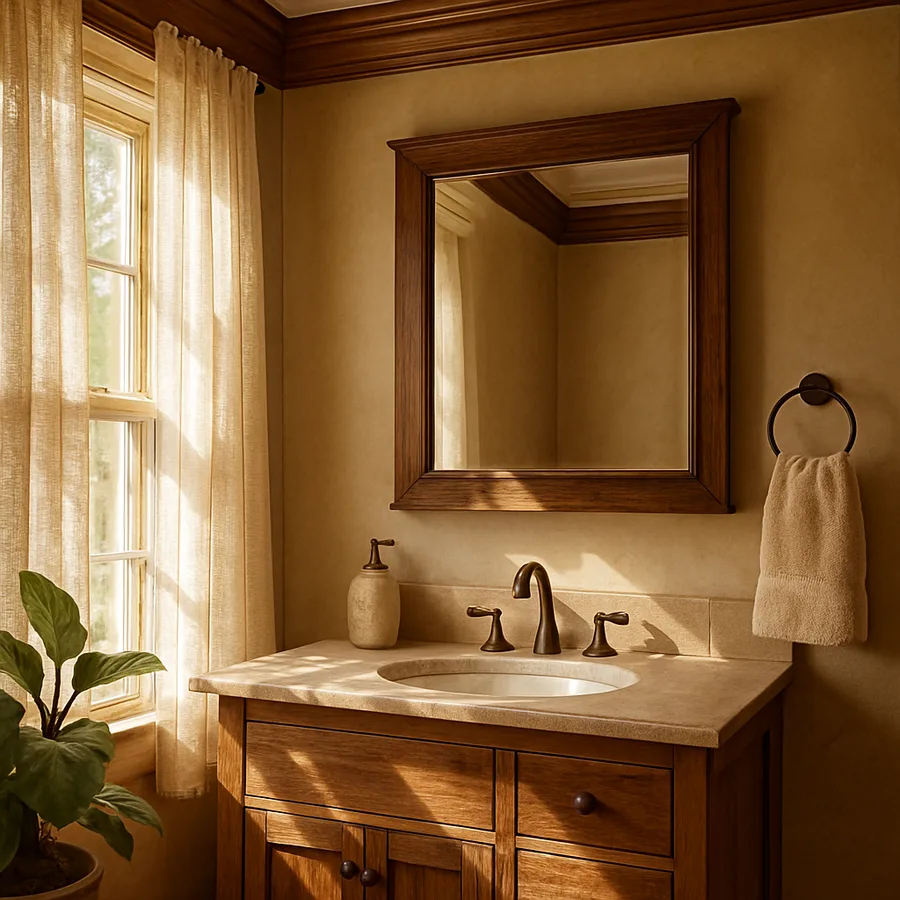
Bathrooms chew up building materials. Relative humidity during a long shower can exceed 85%, condensation forms on any surface below the dew point, and the combination of warm-wet and warm-dry cycling over years of use punishes anything that absorbs water. Traditional wood crown molding and primed MDF, both excellent choices in living rooms and bedrooms, will fail in a bathroom given enough time. The failure mode is rarely dramatic: swollen joints, peeling paint, crumbling corners, and mildew staining all emerge gradually and become obvious only after the damage is significant. Avoiding that outcome requires specifying materials and finishes engineered for wet environments, then backing them up with adequate ventilation.
A 2023 technical bulletin from the U.S. Environmental Protection Agency (EPA) Indoor Air Quality program recommends keeping bathroom relative humidity below 60% within an hour of shower use to prevent microbial growth on finish surfaces. The same bulletin notes that 47% of residential mold remediation claims originate in bathrooms, a statistic that should reframe any bathroom-renovation material decision. Crown molding sits at the wall-ceiling junction where warm moist air collects first, so it is among the most moisture-stressed trim locations in the home.
Why Bathroom Crown Fails: The Failure Modes Explained
Understanding how bathroom crown fails is the foundation of specifying something that will not. The four primary failure modes are absorption swelling, paint film failure, mildew colonization, and adhesive breakdown. Each is driven by a slightly different environmental factor, and each argues for a specific material characteristic in the replacement specification.
Absorption swelling occurs when porous substrates like standard MDF or untreated softwood take up atmospheric moisture, expanding against adjacent surfaces and opening gaps at miters and copes. Standard MDF can gain 4% to 7% in linear dimension at saturation, according to the U.S. Forest Service Forest Products Laboratory, which translates to visible joint separation within the first two winters. Paint film failure follows swelling: as the substrate moves, the paint film loses adhesion, cracks, peels, and finally flakes away. Mildew colonization begins in the resulting damaged surface, accelerating the damage into a feedback loop that only replacement can stop.
Adhesive breakdown affects both wood and foam crown when installation adhesives degrade in chronic moisture. Standard carpenter's glue loses strength above 70% relative humidity, and even some polyurethane construction adhesives lose shear strength over time in bathroom conditions. The This Old House archive includes several forensic investigations of bathroom trim failures that trace the collapse back to adhesive selection rather than substrate.
Material Option One: Cellular PVC Trim
The gold standard for bathroom crown is cellular PVC trim, manufactured under brand names like Azek, Versatex, and Kleer Lumber. Cellular PVC is a rigid polyvinyl chloride foam that looks, cuts, and installs much like wood but is completely impervious to water absorption. It will not swell, rot, delaminate, or support mildew, and its dimensional stability rivals polyurethane foam while offering better impact resistance.
Cellular PVC accepts paint exceptionally well when properly prepped. The surface needs cleaning with a mild solvent (denatured alcohol works) to remove mold-release residue, followed by a bonding primer formulated for low-surface-energy plastics, then two coats of 100% acrylic latex finish paint in a satin or semi-gloss sheen. The American Society for Testing and Materials (ASTM) specifications for cellular PVC (ASTM D6662) describe a material essentially immune to bathroom humidity cycling, which is why it dominates exterior trim on coastal homes and why the same properties recommend it indoors wherever moisture is chronic.
Cost runs $3 to $8 per linear foot for standard profiles, placing cellular PVC between MDF and hardwood in price. Installation uses stainless steel finish nails or hot-dipped galvanized fasteners (never plain steel, which can bleed rust stains), plus a polyurethane adhesive compatible with PVC. The one drawback is thermal expansion: cellular PVC moves roughly twice as much as wood under temperature swings, which matters in long runs but is usually invisible in typical bathroom geometry.
Material Option Two: Polyurethane Foam Molding
High-density polyurethane foam crown, sold under brands like Focal Point Architectural Products and Fypon, is the second most reliable bathroom specification. Polyurethane foam is a closed-cell rigid foam that absorbs essentially no moisture, maintains dimensional stability across the full range of bathroom conditions, and ships pre-primed for immediate painting. Compared to cellular PVC, polyurethane foam is slightly softer to impact but significantly lighter and easier to handle during solo installation.
Installation uses specialty polyurethane adhesives designed specifically for foam trim (often sold by the same manufacturer as the trim itself), supplemented by small 18-gauge brad nails used only to hold the piece in position during cure. Cutting uses a fine-tooth blade on a compound miter saw, and joints are typically mitered rather than coped because foam does not accept cope cuts cleanly.
Cost runs $2.50 to $7 per linear foot, overlapping with cellular PVC at the low end. The appearance advantage goes to foam for ornate profiles with deep decorative detail (dentils, egg-and-dart, rope moldings), which foam reproduces at a fraction of the carved-wood price. Cellular PVC shines in simpler, more rectilinear profiles where its crisper edges are more visible. The Architectural Digest renovation archives feature many bathroom case studies using both materials interchangeably with equally convincing results.
Material Option Three: Marine-Grade MDF and Extruded Alternatives
A third category worth considering is moisture-resistant MDF (sometimes marketed as "green" MDF for its distinctive tinted core) and marine-grade plywood milled to crown profiles. These products use waterproof resins or phenolic adhesives that resist swelling better than standard MDF, though not with the complete immunity of cellular PVC or polyurethane foam. For well-ventilated bathrooms with limited direct splash exposure, moisture-resistant MDF performs acceptably and costs roughly 20% more than standard MDF.
Extruded thermoplastic profiles are a newer entrant, manufactured from materials like HIPS (high-impact polystyrene) and ABS. These products are often sold at flooring suppliers rather than traditional trim suppliers, and their profile selection is limited to simple geometries. They paint well and install with adhesive, but their specification documentation is less established than cellular PVC or polyurethane foam, so warranty claims in the event of failure can be harder to pursue. The National Association of Home Builders (NAHB) Research Center has published evaluations of some of these products, and those evaluations are worth reading before committing.
A fourth option some homeowners ask about is stained hardwood crown finished with marine varnish. Does this work in bathrooms? In theory, yes; in practice, the maintenance burden is high. Marine varnish needs recoating every two to three years in high-humidity service, and any crack in the finish film opens a pathway for water into the wood substrate. The American Institute of Architects (AIA) durability guidelines generally discourage solid hardwood in chronic-moisture interior applications, and most specifying architects route bathroom clients toward engineered alternatives.
Finish Selection: Sheen, Chemistry, and Mildew Resistance
Material choice sets the floor for moisture durability; finish choice sets the ceiling. For painted bathroom crown, specify a 100% acrylic latex paint in a satin or semi-gloss sheen. Higher-sheen finishes shed water more readily, resist stain absorption, and clean more easily with mild detergents. Flat and matte finishes, conversely, absorb moisture readily and stain permanently.
Mildew-resistant additives in paint make a measurable difference. Major manufacturers including Benjamin Moore, Sherwin-Williams, and Behr all offer bathroom-specific paint lines with in-can mildewcides and surfactant packages designed for humid environments. These paints typically cost 20% to 35% more than standard acrylic latex, a premium that pays for itself the first time you avoid having to repaint. The American Society of Interior Designers (ASID) specification guides routinely recommend these products for bathrooms, utility rooms, and laundry spaces.
Primer selection matters as much as topcoat selection. On cellular PVC, use a bonding primer designed for low-surface-energy plastics. On polyurethane foam, the factory primer is usually sufficient and can be topcoated directly. On moisture-resistant MDF, use a stain-blocking acrylic primer to seal the cut edges, which are the weakest moisture-entry points on any MDF product. Never use an oil-based primer on cellular PVC; the chemistry is incompatible and the primer will eventually fail.
Ventilation: The Specification Nobody Wants to Hear
No crown molding material survives a poorly ventilated bathroom indefinitely. The American Society of Heating, Refrigerating and Air-Conditioning Engineers (ASHRAE) Standard 62.2 calls for bathroom exhaust fans sized to provide at least 50 cubic feet per minute of intermittent exhaust or 20 CFM of continuous exhaust. Many older bathrooms have undersized fans or no fan at all, and in those rooms even the best crown material will eventually show moisture damage.
Upgrade the exhaust fan before or during any bathroom trim renovation. A properly sized fan costs $120 to $400 depending on features (timer switches, humidity sensors, low-noise designs), and installation by a licensed electrician typically adds $200 to $500 to the project budget. The payoff is not just crown longevity; reduced bathroom humidity extends the life of paint, caulk, grout, cabinetry, and drywall throughout the room. The EPA IAQ program estimates that adequate bathroom ventilation reduces mold remediation costs by roughly 60% over a twenty-year ownership horizon.
Is your current exhaust fan moving enough air? A quick test: tape a single-ply tissue over the fan grille with the fan running. A correctly operating fan will hold the tissue firmly against the grille; a failing or undersized fan will let the tissue droop or fall. Would you rather find out before or after you install $600 worth of crown molding? The test takes ten seconds, and the answer informs the entire project.
Caulking, Sealing, and Critical Detail Work
Crown molding in bathrooms lives or dies at its caulk lines. Standard acrylic latex caulk is inadequate for bathroom service because it absorbs water, supports mildew growth, and loses adhesion over time. Specify a siliconized acrylic caulk (labeled for bathroom or kitchen use) or a pure silicone caulk for the wall-crown and crown-ceiling joints. Silicone excels in wet service but cannot be painted; siliconized acrylic is paintable and nearly as durable.
Seal every cut end of crown molding before installation, especially on moisture-resistant MDF. A quick coat of primer on the bare end grain reduces moisture wicking into the core. Seal around fasteners with a small dab of caulk before filling with wood filler. These small details add perhaps an hour to the installation time and dramatically extend the molding's service life.
Pay particular attention to the junction between crown and any adjacent wet materials: shower surround tile, window casing around shower windows, and the top of wainscoting if present. These transitions accumulate water and should be over-sealed rather than under-sealed. The National Association of the Remodeling Industry publishes bathroom detail standards that describe best practice sealing sequences.
Conclusion: A Durable Bathroom Trim Specification
Bathroom crown molding can last the life of the home when specified and installed correctly. The recipe is not complicated: choose a moisture-immune substrate (cellular PVC or polyurethane foam), apply a bathroom-rated topcoat (satin or semi-gloss acrylic latex with mildewcide), caulk the junctions with a silicone or siliconized acrylic product, and back the whole system up with adequate exhaust ventilation. Every element of that recipe addresses a specific failure mode, and skipping any one element compromises the durability of the others.
Resist the temptation to specify the same material you would use in a living room just because the bathroom is small or the runs are short. The economic penalty for using wood or standard MDF in a bathroom is not the upfront cost but the eventual replacement cost, which includes not just new molding but also paint touch-up, possible drywall repair, and the disruption of re-accessing a finished room. Data from NAHB, NARI, EPA, and ASHRAE all converge on the same recommendation.
Have you walked your bathrooms recently and checked the condition of existing trim? Small signs of paint failure, hairline cracks at miters, or faint dark staining near the ceiling are early warnings that often go unaddressed for years. Addressing those signs with a proper renovation, using moisture-safe materials and finishes, typically costs less than $800 per bathroom and prevents the much larger cost of remediation after visible mold appears. The ASID bathroom-renovation cost guides support this math across most U.S. regional markets.
Planning a bathroom trim renovation? Download the Interior Bliss bathroom-crown specification checklist, our printable ventilation-assessment worksheet, and a product-by-product material comparison chart. Share your bathroom photos in our reader forum for free specification advice from designers and contractors who have worked through these exact problems in hundreds of homes.
More Articles You May Like



Comments
Post a Comment