Best Vanity Mirror Lighting for Putting On Makeup at Home
Why Lighting Matters More Than the Mirror Itself
Most people spend considerable time choosing the perfect vanity mirror, comparing shapes, sizes, and frame styles, while giving almost no thought to the lighting that surrounds it. This is a fundamental mistake. The mirror only reflects what light reveals, and if that light is poorly positioned, overly warm, or coming from a single overhead source, the reflection will mislead rather than assist. Vanity mirror lighting determines whether your foundation blends seamlessly or whether you walk out the door with visible demarcation lines that only become apparent in natural daylight.
The American Lighting Association (ALA) emphasizes that task lighting at the vanity is the single most important lighting layer in a bathroom. General ambient light from a ceiling fixture is insufficient for detail work like makeup application because it casts shadows under the brow bone, nose, and chin. These shadows hide the very areas where precise blending matters most. Dedicated vanity lighting positioned at face height eliminates those shadows and provides the even illumination that makeup application demands.
Professional makeup artists have understood this principle for decades. Film and theater dressing rooms feature lights surrounding the mirror on all four sides specifically to remove directional shadows. While a residential bathroom does not need a full ring of bulbs, applying the same logic at a smaller scale produces dramatically better results. The goal is to illuminate your face uniformly so that what you see in the mirror closely matches what others see in a variety of real-world lighting conditions.
Color accuracy is the second critical factor that separates good vanity lighting from poor vanity lighting. A bulb with a low Color Rendering Index (CRI) distorts how colors appear, making it impossible to judge whether your blush, lipstick, and eyeshadow look natural. Have you ever applied makeup at home and then been startled by how different it looked in your car's rearview mirror? That discrepancy almost certainly came from low-CRI lighting at your vanity rather than from any mistake in your technique.
Understanding Color Temperature and CRI
Color temperature, measured in Kelvin, describes whether light appears warm and yellowish or cool and bluish. Bulbs at 2700K produce a cozy amber glow that flatters skin but obscures color accuracy. Bulbs at 5000K and above mimic daylight and reveal colors more truthfully but can feel clinical in a residential setting. For makeup application, lighting professionals and the International Association of Lighting Designers (IALD) generally recommend a color temperature between 3500K and 4500K, which balances accuracy with a pleasant ambiance.
The Color Rendering Index is a separate measurement that rates a bulb's ability to reveal the true colors of objects compared to a reference light source. The scale runs from 0 to 100, with 100 being perfect color rendition. For makeup application, a CRI of 90 or above is considered essential. Many inexpensive LED bulbs fall in the 80 to 85 range, which is adequate for general illumination but inadequate for judging subtle color differences between a nude lip and a mauve lip. Always check the CRI rating on the bulb packaging before purchasing.
Some manufacturers have introduced tunable white vanity lights that allow you to adjust the color temperature with a dimmer or a smartphone app. These fixtures are particularly useful because you can set the light to match the environment you are preparing for. Getting ready for an office day under fluorescent lights? Set the vanity to 4000K. Preparing for a candlelit dinner? Shift to 3000K. This adaptability makes tunable fixtures the most versatile option available, though they typically cost two to three times more than fixed-temperature alternatives.
A study published by the Lighting Research Center at Rensselaer Polytechnic Institute found that subjects performed detail-oriented visual tasks with 15 percent greater accuracy under high-CRI lighting compared to standard-CRI lighting at the same brightness level. While that study examined general task performance rather than makeup specifically, the implication is clear: investing in high-CRI bulbs at your vanity is not a luxury but a functional upgrade that measurably improves outcomes.
Comparing Vanity Lighting Configurations
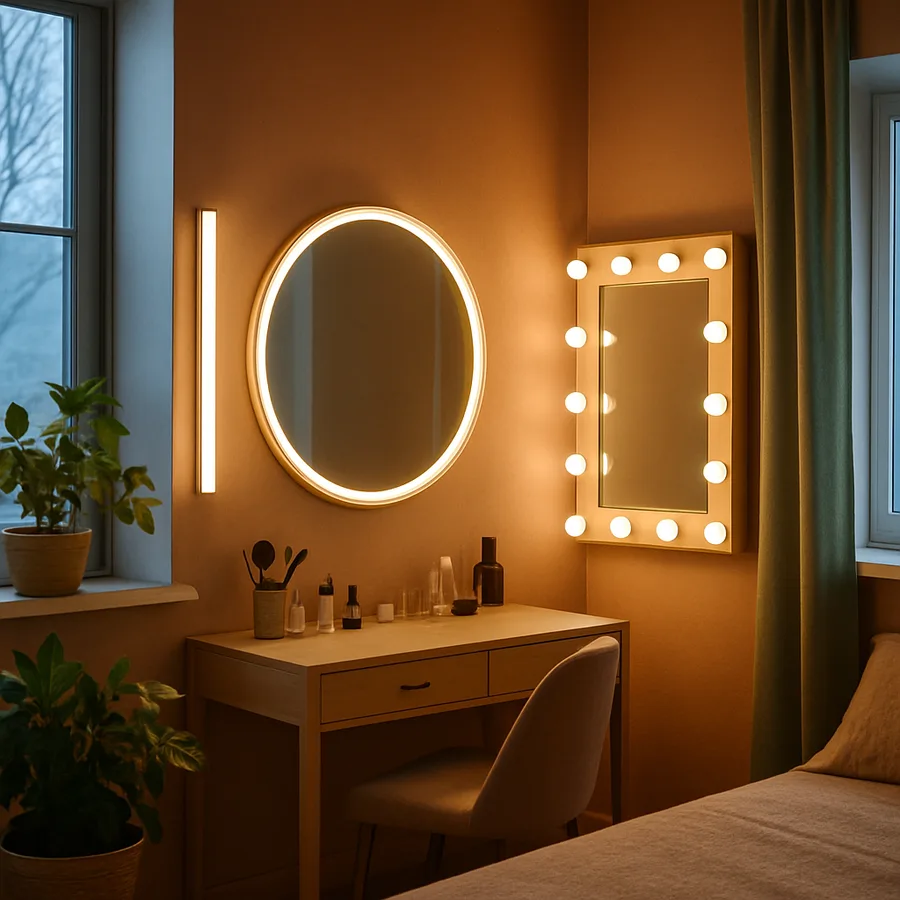
The Hollywood-style mirror with exposed round bulbs along the top and sides remains one of the most effective configurations for even facial illumination. This arrangement places light sources at multiple heights and angles, which prevents the shadow pockets that single-source lighting creates. Modern versions use frosted LED globes rather than incandescent bulbs, reducing heat output and energy consumption while maintaining the classic aesthetic. A full-perimeter Hollywood mirror with 10 to 14 bulbs provides the most shadow-free result.
Vertical LED light bars mounted on either side of the mirror represent the most practical option for most bathrooms. Positioned at face height with their centers roughly 60 inches from the floor, a pair of 24- to 30-inch bars produces even, cross-illuminating light that minimizes shadows under the chin and along the sides of the nose. This configuration is recommended by the lighting guides on Houzz and is the standard approach used by most interior designers for residential vanity areas.
Backlit mirrors with integrated LED strips behind the glass have surged in popularity because of their clean, floating appearance. However, they have a significant limitation for makeup application: the light comes from behind and around the mirror rather than from beside your face. This produces a soft ambient glow that looks beautiful but does not provide the direct facial illumination needed for detail work. If you choose a backlit mirror for its aesthetic appeal, supplement it with additional side-mounted fixtures to ensure adequate task lighting.
Overhead bar lights, the most common bathroom fixture in older homes, are the least effective option for makeup application. A single light source above the mirror throws harsh shadows downward across the eye sockets, nose, and chin, creating exactly the uneven illumination that makes color matching and blending so difficult. If an overhead fixture is your only option, replace the exposed bulbs with a frosted LED bar that diffuses the light more broadly, and consider adding a portable lighted mirror on the countertop as a dedicated makeup station.
Selecting Bulbs and Fixtures That Perform
When shopping for vanity light bulbs, three specifications matter above all others: a CRI of 90 or higher, a color temperature between 3500K and 4500K, and a frosted or diffused lens that softens the light output. Frosting is essential because bare LED chips produce intense point-source light that creates sharp shadows and can cause eye discomfort during the extended close-up focus that makeup application requires. A frosted globe or a diffusing cover spreads the light evenly across your face.
Brightness, measured in lumens, needs to be sufficient without being overwhelming. For a vanity area, the ALA recommends a combined output of 1,600 to 2,400 lumens from all sources. If you use two side-mounted fixtures, each should deliver 800 to 1,200 lumens. Many decorative vanity fixtures sacrifice brightness for style, producing as little as 400 lumens per unit, which is inadequate for serious makeup work. Check the lumen rating on the fixture specification sheet, not just the wattage, since LED wattage does not correlate directly with brightness the way incandescent wattage once did.
Dimming capability is a worthwhile feature because it allows you to reduce brightness for nighttime bathroom visits without removing the fixture's ability to run at full power during makeup application. However, not all LED bulbs and fixtures are compatible with all dimmer switches. Pairing an incompatible bulb with a dimmer can cause flickering, buzzing, or premature bulb failure. Look for bulbs labeled "dimmable" and pair them with a dimmer switch rated for LED loads. Lutron and Leviton both publish compatibility lists on their websites.
The fixture's finish and mounting style should complement the bathroom's overall design without becoming a visual distraction. Matte black, brushed nickel, and brushed gold are currently the most popular finishes according to the National Kitchen and Bath Association (NKBA). Does your bathroom lean toward modern minimalism, traditional warmth, or transitional balance? Matching the vanity light finish to the faucet and cabinet hardware creates a cohesive look that ties the room together.
Placement and Installation Best Practices
The vertical center of side-mounted vanity lights should align with the user's face, which means installing them with their midpoint approximately 60 to 66 inches above the finished floor. This measurement assumes an average standing height and should be adjusted if the primary user is significantly taller or shorter. The lights should be mounted as close to the mirror edges as possible without overlapping the glass, typically leaving a gap of 2 to 4 inches between the fixture and the mirror frame.
If the mirror is wider than 36 inches, side-mounted lights alone may not illuminate the center of the face adequately, particularly if the lights are positioned near the outer edges of a wide mirror. In this case, adding a horizontal fixture above the mirror as a supplement fills in the center without creating the harsh downward shadows associated with overhead-only lighting. The combination of side and top lighting, sometimes called three-point vanity lighting, is the gold standard recommended by the lighting design experts at Architectural Digest.
Electrical code in most jurisdictions requires bathroom light fixtures within a certain distance of the shower or bathtub to carry a damp or wet location rating. Even if your vanity lights are well away from the shower zone, a damp-rated fixture is a wise choice in any bathroom because humidity levels fluctuate significantly. A fixture rated for damp locations has sealed internal components that resist moisture infiltration, extending the life of both the fixture and its bulbs.
For renters or anyone who cannot modify existing wiring, plug-in vanity light bars and rechargeable LED strip lights offer a no-installation alternative. These attach to the wall or mirror with adhesive or suction cups and provide surprisingly effective task lighting. While they lack the polished look of hardwired fixtures, they can transform a poorly lit rental bathroom into a functional makeup station at minimal cost. Some rechargeable options even offer adjustable color temperature, bringing tunable-white functionality without any electrical work.
Portable and Countertop Lighted Mirrors
A dedicated countertop lighted mirror with built-in magnification is an excellent complement to overhead or wall-mounted vanity lighting, particularly for precision tasks like eyeliner application, brow grooming, and spot concealing. These mirrors typically feature a ring of LEDs around the perimeter and offer 5x to 10x magnification on one side. The close proximity of the lights to the magnified surface creates an ideal micro-environment for detail work that even the best wall-mounted fixtures cannot fully replicate at arm's length.
The best countertop mirrors include adjustable color temperature settings, a high CRI rating, and a stable base that does not tip when you adjust the angle. Models from Simplehuman and Fancii consistently rank well in professional makeup artist reviews because they use tru-lux light systems with CRI values above 95. A rechargeable battery is preferable to a plug-in cord because it keeps the countertop uncluttered and allows you to move the mirror to different locations as needed.
Travel-size lighted mirrors serve the same function in a compact form factor and are worth keeping in a toiletry bag for hotel stays where bathroom lighting is unpredictable. Many frequent travelers consider a small LED mirror their single most important grooming accessory because it ensures consistent makeup application regardless of the venue. The investment is modest, typically between $25 and $60 for a quality compact mirror, and the consistency it provides is significant.
How much time do you currently spend adjusting your makeup after arriving at your destination because it looked different at home? A high-CRI countertop mirror paired with properly positioned wall lighting can reduce or eliminate that corrective step entirely, saving time and product while ensuring you present your intended look from the moment you leave the house.
Building a Complete Vanity Lighting Plan
The ideal vanity lighting plan layers multiple sources to create even, color-accurate, and adjustable illumination. Start with two side-mounted LED fixtures at face height as the primary task lights. Add a horizontal fixture above the mirror if the mirror exceeds 36 inches in width. Install all fixtures on a dimmer rated for LED loads. Choose bulbs with a CRI of 90 or above and a color temperature between 3500K and 4500K. This combination addresses 90 percent of makeup lighting needs and serves equally well for shaving, skincare, and general grooming.
Supplement the wall-mounted fixtures with a high-quality countertop magnifying mirror for detail work. Position it where the wall lighting illuminates your face from the sides while the mirror's built-in LEDs provide close-range fill light. This two-tier approach, wall fixtures for overall illumination and a countertop mirror for precision tasks, replicates the setup used in professional makeup studios at a fraction of the cost.
Consider the rest of the bathroom's lighting as well. A recessed ceiling fixture on a separate dimmer provides ambient light that fills the room without interfering with the vanity task lighting. If the bathroom has a window, take advantage of natural light during daytime application by positioning the mirror to face the window rather than placing the window behind you. Natural light remains the ultimate reference standard for color accuracy, and designing your vanity area to incorporate it when available is the smartest free upgrade you can make.
Ready to transform your morning routine with professional-quality vanity lighting? Begin by measuring your mirror width and the distance from the floor to your face while standing at the vanity. These two measurements determine the ideal fixture size and mounting height, and having them in hand before you shop will narrow your options to the fixtures that actually fit your space and serve your needs.
More Articles You May Like



Comments
Post a Comment