Stone Veneer Manufactured Versus Natural Stone Comparison
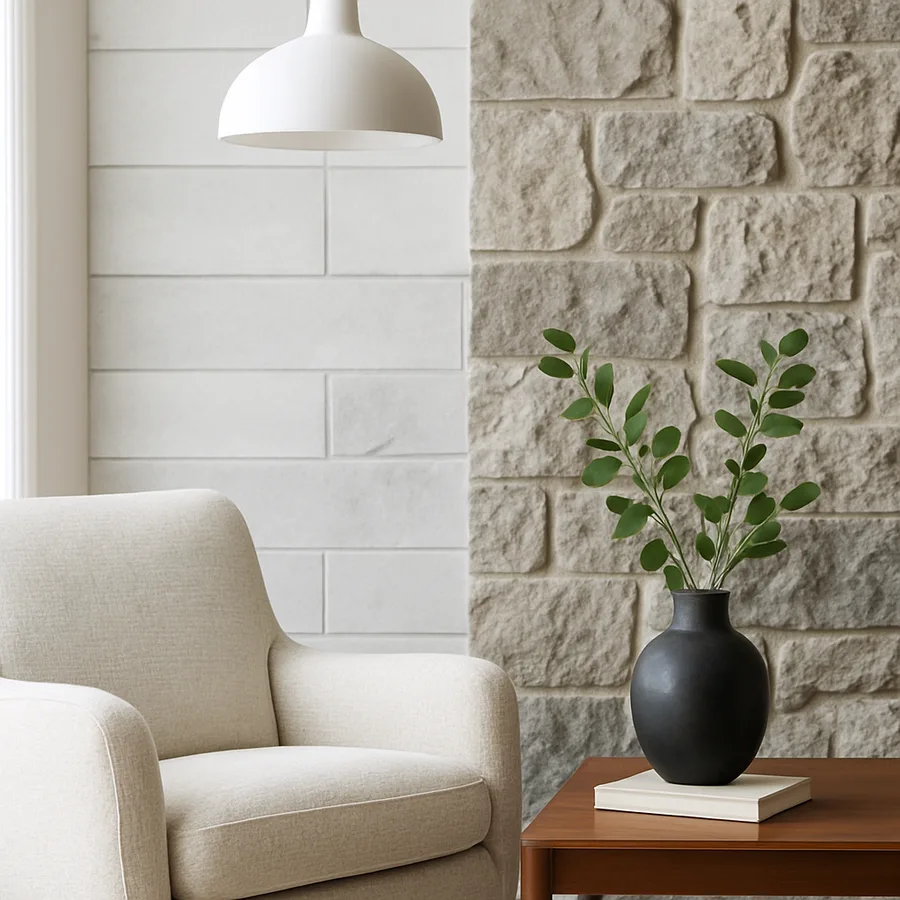
Stand ten feet away from a well-installed manufactured stone wall and a natural stone wall and you will struggle to tell them apart. Stand two feet away and the differences become obvious. Stand twenty years away, after both walls have weathered through real seasons, and the differences become very obvious indeed. The choice between manufactured and natural stone veneer is not a fake-versus-real argument. It is a thoughtful trade-off between cost, weight, performance, longevity, and the look you actually want.
I get this question constantly from homeowners working on a fireplace surround, an exterior accent wall, or a full chimney reface. The honest answer rarely matches what the showroom told them. Let me walk through what each material actually is, how each behaves over time, and where I have seen each succeed and fail.
What Manufactured Stone Veneer Actually Is
Manufactured stone veneer, sometimes called adhered concrete masonry veneer, is a cast lightweight concrete product. The mix is typically portland cement, lightweight aggregates such as expanded shale, and iron oxide pigments. It is poured into rubber molds taken from natural stones, vibrated to release air, and cured in a controlled environment. The result weighs roughly 8 to 12 pounds per square foot, which is about a third of natural stone veneer.
The light weight is the engineering breakthrough that made manufactured stone a residential staple. Because the product is under 15 pounds per square foot, it qualifies under IRC R703.12 for installation without the engineered support that heavier cladding requires. You can adhere it directly to a properly prepared substrate with scratch coat and bonding mortar, and the framing behind does not need to be specially reinforced. That code provision is what made the entire market category economically viable.
Performance-wise, the better manufacturers test to ASTM C1670, which is the standard specification for adhered manufactured stone masonry veneer units. The spec covers compressive strength, freeze-thaw durability, water absorption, and dimensional tolerance. Look for products that explicitly cite ASTM C1670 compliance. Plenty of cheap product on the market is not tested to any spec at all and will fail in cold-climate freeze-thaw within five to ten years.
The ASTM International spec is meaningful, but the installation matters more than the product spec. Manufactured stone failures are almost always installation failures, not product failures.
What Natural Stone Veneer Actually Is
Natural stone veneer is real stone, cut or split to a thickness of 1 to 2 inches, designed to be adhered to a wall as cladding rather than stacked as structural masonry. The common varieties include split-face limestone, fieldstone, river rock, quartzite, and various sandstones. Weight runs 30 to 55 pounds per square foot depending on stone density and thickness, which is well above the 15-pound threshold and triggers the IRC R703.12 requirement for an anchored stone veneer assembly with positive mechanical attachment.
"Anchored" is the key word. Natural stone veneer over 15 pounds per square foot needs steel lath, scratch coat, and either ties or wire mesh embedded in the mortar setting bed to mechanically connect the stone to the structural backup wall. This is substantially more labor-intensive than the adhered installation that manufactured stone allows.
The performance characteristics of natural stone are exceptional when correctly installed. Compressive strength runs 10,000 to 30,000 PSI depending on stone type, freeze-thaw resistance is generally excellent for properly selected stones, and the service life is effectively unlimited within human time scales. Stone walls built in 1850 are still functioning as designed. No manufactured product has yet demonstrated comparable longevity, although the better products may eventually.
The Real Cost Comparison Including Installation
Manufactured stone material costs run roughly $8 to $15 per square foot depending on quality. Natural stone material costs run $15 to $40 per square foot for common varieties, with premium stones running considerably higher. The material price gap is significant but not as dramatic as people assume.
The installation cost gap is more significant than the material gap. Manufactured stone installs for roughly $10 to $14 per square foot of labor on standard residential work. Natural stone installs for $18 to $30 per square foot of labor, largely because of the weight, the cutting required to fit a real-stone pattern, and the structural attachment requirements. Total installed cost looks roughly like this for a typical 400 square foot accent wall:
- Manufactured stone: $7,200 to $11,600 total installed.
- Natural stone: $13,200 to $28,000 total installed.
The gap is real and it is the reason manufactured stone has taken about 70 percent of the residential stone veneer market according to industry data summarized by the National Association of Home Builders. For most residential applications, the price differential is the determining factor and the aesthetic difference is small enough at typical viewing distances that the trade-off makes sense.
Where Each Material Fails, and Why It Matters
Manufactured stone fails in three predictable ways. First, the color pigments fade under UV exposure, particularly the iron oxide reds and the carbon blacks. A wall installed today will visibly differ from the same product installed ten years from now, which makes matching for a repair or extension challenging. Natural stone does not fade in any meaningful way.
Second, manufactured stone is sensitive to moisture entry from behind. Because it is a concrete product adhered to a substrate, water that gets behind the veneer can saturate both the substrate and the back of the stones, leading to freeze-thaw delamination. The infamous "moisture intrusion lawsuits" of the early 2000s, particularly in the Pacific Northwest, were largely about manufactured stone installations without proper drainage planes and weep details. International Code Council guidance and current installation standards from the Cast Stone Institute now require a drainage plane behind manufactured stone, but a substantial number of existing installations predate or ignore those requirements.
Third, manufactured stone fails at horizontal surfaces where water can pond, at the bottom termination where splash-back occurs, and at any penetration that has not been carefully flashed. The Journal of Light Construction has covered these failure modes in depth and the consensus is that manufactured stone is forgiving of nothing except a textbook installation.
Natural stone has fewer failure modes but they are not zero. Improper mortar selection, particularly portland-rich mortars on softer stones, can lead to spalling. Inadequate ties or anchors can lead to bulging or detachment over decades. Salt spray exposure in coastal applications can degrade certain limestones substantially. The failures are slower and more diagnostic than catastrophic, but they exist.
Stone veneer installations also succeed or fail aesthetically based on joint and pattern decisions made before the first piece touches the wall. Manufactured stone is often installed as a dry-stack with very tight joints, mimicking a stone wall built without mortar. Natural stone can be installed dry-stack as well, or with mortar joints of varying widths depending on the desired look. Dry-stack installations look exceptional when fresh and create a tighter, more contemporary feel, but they are more sensitive to water management because the absence of mortar means more potential entry points. Mortar joint installations are slightly more forgiving of water but require careful tooling and color matching to avoid looking like a botched do-it-yourself project. A reader asked me whether to specify dry-stack or mortar joints on a chimney refresh, and the answer depended on whether the chimney was protected by overhanging eaves and whether the homeowner was committed to checking the joints annually. Without those two factors, mortar joints are the safer choice. Pattern selection matters as much as joint type. A wall installed with stones all roughly the same size reads as fake within ten feet, even if the stones are natural. Mockups before final installation are not optional; build a 4 by 4 foot sample panel on the ground, view it from various angles and distances, and adjust before committing.
What This Comes Down To
Manufactured stone is the right choice for a fireplace surround in a low-moisture interior application, for accent walls where the budget cannot absorb the natural stone premium, and for applications where the lighter weight simplifies the structural design. Specify product that explicitly meets ASTM C1670, hire an installer who knows the current drainage and flashing requirements, and accept that the wall will need cosmetic attention in 15 to 25 years.
Natural stone is the right choice when longevity matters, when the wall is a primary feature of the home rather than an accent, when the climate is severe, or when the budget can support the premium. Specify stone appropriate to your freeze-thaw and exposure conditions, work with a mason experienced in adhered natural stone rather than a general contractor, and expect a wall that will outlive the rest of the building.
The mistake I see most often is homeowners assuming the choice is purely cosmetic and then being surprised when the cheap installation of either product fails early. Reach out to at least three contractors, ask each to walk you through their drainage plane and flashing approach in detail, and pick the one who can answer in specifics rather than generalities. The installer matters more than the product, and the conversation about how the wall will shed water is the conversation that predicts whether you will be happy with this investment in fifteen years.
A reader recently asked me whether the manufactured stone they were considering would look dated in ten years the way some earlier-generation manufactured stone has begun to look dated. The honest answer is yes, partially, and not for the reason most people expect. The aging concern is less about UV fade than about the fact that manufactured stone styling moves with design trends in ways that natural stone does not. The blocky, oversized "ledgestone" patterns that defined manufactured stone in the early 2010s already feel like a period piece. The current trend toward more refined, smaller-scale stone patterns will itself date within a decade. Natural stone, because it looks like the stone that has always existed in the local landscape, does not date in the same way.
One final consideration that comes up on full-wall applications rather than accents: scale matters differently for the two materials. Natural stone in a large-format application reads as architecture. Manufactured stone in the same application can read as theme park, particularly if the installer falls back on repetitive patterns. The risk of "pattern repeat" in manufactured stone, where the same molded stones appear visibly nearby because there are only so many master molds in the product line, is real and grows with the scale of the installation. Premium manufactured stone product lines now include 40 or more distinct master molds specifically to reduce visible repetition, but the cheaper lines may have only 8 to 12. Examine a sample wall photograph at high resolution before committing to a manufactured product for any installation larger than a small accent, and ask the manufacturer how many master molds the specific product line uses. The answer correlates closely with how natural the finished wall will look.
More Articles You May Like



Comments
Post a Comment