Knife Drawer Insert Bamboo Versus Hardwood Construction
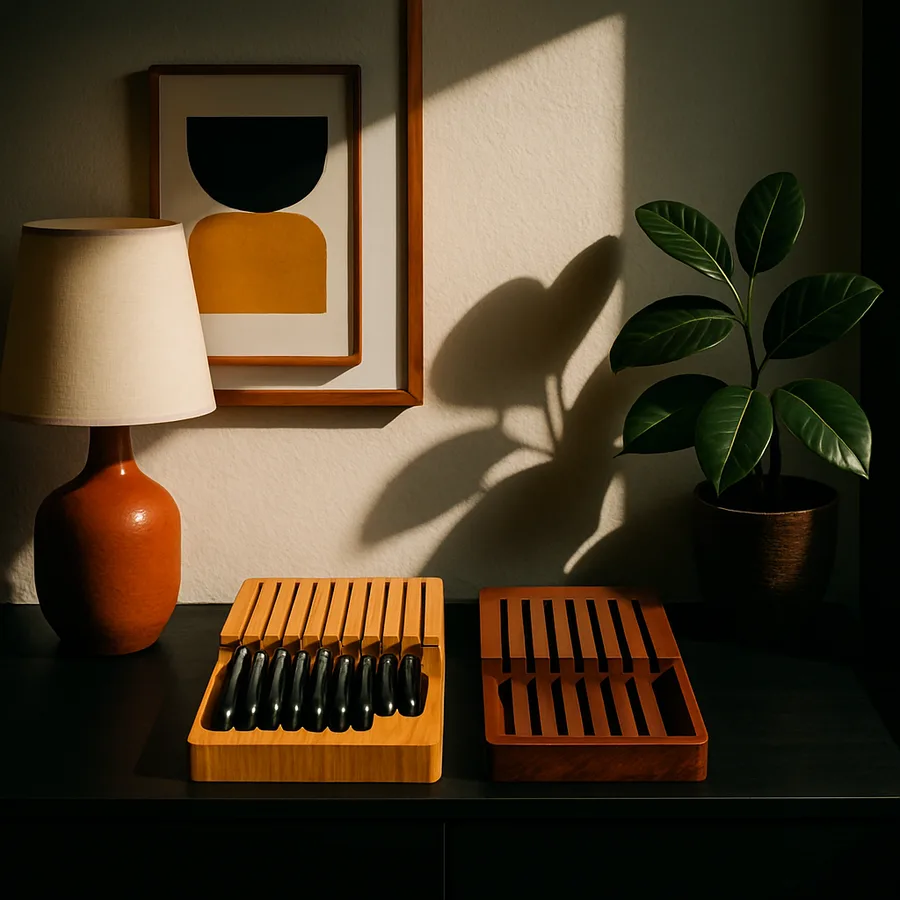
A knife drawer insert seems like a simple object until you start asking it to do its job for fifteen years. Hold a dozen blades of different geometries. Resist moisture from hands and rinsed cutting boards. Tolerate the occasional accidental nick from an over-eager reach. Not telegraph wear. Not stain. Not warp. The choice between bamboo and hardwood construction is, in this category, the most consequential material decision you will make for the drawer, and it deserves more thought than it usually gets.
Both materials are sold as premium, both photograph beautifully on retail sites, and both will work adequately on day one. The differences emerge over months and years: in how the slots wear, how the surface ages, how moisture changes the dimensions, and how the insert holds value if you ever sell the kitchen. This guide walks through the material science, the construction details that matter most, and the trade-offs that should drive your decision. By the end you should have a clear answer for your specific knife collection, your specific kitchen humidity profile, and your specific tolerance for patina.
The knife drawer insert is also a small but visible signal of design intent. In a furniture-grade kitchen, the moment a guest pulls open the drawer and sees an organized, beautiful insert with eight cleanly held blades is the moment the kitchen registers as serious. The choice of material disproportionately affects that first impression, even though almost no one consciously evaluates it.
What Bamboo And Hardwood Actually Are
"Bamboo" in kitchen inserts almost always means Moso bamboo, harvested as strips, dried, glued, and pressed into a panel under heat and pressure. The result is technically not wood at all (bamboo is a grass), but it behaves enough like a hardwood that the industry classifies it alongside one. Density typically runs 0.6 to 0.7 g/cm3 for vertical-grain bamboo and 0.7 to 0.9 g/cm3 for strand-woven bamboo, which is denser than red oak and approaches maple.
"Hardwood" in this category usually means one of four species: hard maple, walnut, white oak, or cherry. Hard maple dominates the entry premium tier because of its tight grain, light color, and low cost. Walnut sits at the top of the design tier. White oak has surged in popularity over the past five years as the dominant species in furniture-grade kitchens. Cherry is the warm, traditional choice that ages dramatically.
The construction methods diverge sharply. A bamboo insert is almost always a glued-strip panel, with slots routed across the grain. A hardwood insert is usually solid timber, with slots either routed or cut as individual blocks and assembled. The visual difference is subtle on day one and obvious at year five.
Bamboo's manufacturing economics also shape what you see in the market. The strip-and-glue process produces extremely consistent panels with no knots or wild grain figure, which is why bamboo inserts photograph so reliably across batches. Solid hardwood varies, sometimes dramatically, between pieces from the same supplier. For a buyer who wants the insert they receive to match the photo on the website, bamboo is the safer bet. For a buyer who wants a unique piece, hardwood's variability is part of the appeal rather than a defect.
Strand-woven bamboo, increasingly the dominant subtype in premium inserts, is engineered specifically for hardness. Raw bamboo strands are shredded, mixed with resin, and pressed under thousands of pounds of pressure into a dense composite. The result is harder than most domestic hardwoods but also less workable: it dulls router bits quickly and is harder to refinish if damaged. Most strand-woven bamboo inserts ship with a factory finish that is essentially impossible to refresh without specialized tooling.
Durability, Wear, And The Long-Term Surface
Both materials are hard enough to resist immediate blade damage. The Janka hardness rating, the standard measure of wood resistance to indentation, places hard maple at 1450 lbf, white oak at 1360, walnut at 1010, and strand-woven bamboo between 1800 and 3000 depending on the manufacturer. By that measure bamboo is the most damage-resistant option.
Wear at the slot edges, however, tells a different story. The glue lines in laminated bamboo can develop micro-fractures from repeated knife insertion, particularly with heavier chef's knives. Over five to ten years of daily use, those fractures accumulate as a slightly fuzzed slot edge. Solid hardwood, by contrast, develops a polished compression patina at the slot edge that many cooks consider a feature rather than a defect.
Surface aging is the most visible long-term difference. Bamboo holds its color and surface texture remarkably well, which is why it photographs identically at year one and year ten. Hardwoods change. Walnut lightens. Cherry darkens dramatically and develops a reddish-amber depth. White oak grays slightly under UV exposure. Hard maple yellows. For some homeowners these changes are precisely the appeal; for others they are an unwelcome surprise. The National Kitchen and Bath Association (NKBA) has noted in published material guidance that anticipated patina is among the most common sources of homeowner dissatisfaction in furniture-grade kitchen components.
Did you know moisture behavior decides slot fit?
All wood-based materials move with humidity, but they do not all move the same way. Hardwoods change dimension primarily across the grain, by roughly 0.2 to 0.3 percent per 10 percent change in relative humidity. Strand-woven bamboo moves less, typically 0.1 to 0.15 percent over the same range. In a humid kitchen this matters: a knife slot that fits perfectly in winter may bind a wide blade in summer humidity, particularly in solid hardwood inserts cut tight to a specific knife. Bamboo's lower movement is a real practical advantage for dimensional stability.
Construction Quality Markers That Separate Premium From Adequate
Within both material categories, construction quality varies more than material choice does. A poorly built hardwood insert performs worse than a well-built bamboo one, and vice versa. Five details consistently separate premium from adequate.
Slot machining. Premium inserts use individual machined slots tailored to common knife geometries: a wider slot for chef's knives, a narrower slot for paring knives, a tall slot for serrated bread knives, and a flat-bottomed slot for cleavers. Budget inserts use a single repeated slot width that fits everything poorly.
Slot bottom finish. The bottom of every slot takes the impact of the blade tip when a knife is inserted. Premium inserts pad the bottom with a felt or cork strip; budget inserts leave bare wood, which over time develops a small dent at every slot and dulls the very tip of the blade with each insertion.
Edge banding and joinery. Premium inserts use mitered, splined, or finger-joined edges that resist seasonal movement. Budget inserts butt-join the edges with glue alone, which opens slightly with humidity changes.
Finish. A food-safe oil finish (mineral oil, walnut oil, or a specifically rated cutting-board oil) penetrates the wood and resists moisture without trapping it. A polyurethane or lacquer finish looks glossier on day one but eventually flakes at high-wear contact points. The American Society of Interior Designers (ASID) routinely recommends penetrating oil finishes for any wood component that touches food or absorbs daily moisture.
Drawer fit. A premium insert is sized within 1/8 inch of the drawer interior dimensions, with a non-slip pad underneath. A budget insert leaves a half-inch gap on every side and slides around when the drawer opens.
Cost, Sustainability, And Resale Considerations
Bamboo inserts run roughly $40 to $120 depending on size and brand. Hardwood inserts run $80 to $280, with walnut and white oak at the top of the range. The price difference reflects both raw material cost and the fact that hardwood inserts are usually built with more involved joinery. A premium walnut insert from a small American manufacturer can reach $400 for a custom-sized piece.
Sustainability comparisons favor bamboo on a strict carbon and renewability basis. Moso bamboo regenerates in 5 to 7 years compared with 30 to 80 years for hardwood species, and its supply chain has been heavily certified for sustainable harvest. Hardwood sustainability is more nuanced: FSC-certified North American hardwood, particularly from managed forests, has strong sustainability credentials, but the certification chain is less standardized than bamboo's. The Forest Stewardship Council has reported that more than half of premium kitchen hardwood now carries some form of sustainable certification, though the rigor varies.
Resale and perception is where hardwood pulls ahead. In furniture-grade kitchens, particularly those targeting the higher end of the residential market, hardwood inserts read as premium in a way bamboo does not. Real estate listings and design publications consistently treat walnut and white oak components as differentiators in a way bamboo rarely is, regardless of actual quality. Whether that perception will hold for the next decade is a separate question; for now, it is a real factor in design decisions where future sale value matters.
One under-discussed dimension of the choice is repair and replacement supply chain. Bamboo inserts are largely produced by a small number of manufacturers in Asia, and individual SKUs are often discontinued after a few years. If a slot wears out or the insert is damaged, finding an exact replacement can be impossible after 24 to 36 months. Hardwood inserts from small American or European makers are easier to repair or replace in kind: many shops will custom-cut a replacement to match an existing piece, particularly in maple or white oak. For a long-horizon kitchen, that supply continuity is a quiet but meaningful factor.
Custom fabrication is worth a brief mention. If your knives are unusual (large cleavers, traditional Japanese yanagiba, oversized bread knives), an off-the-shelf insert in either material may not fit them. Several specialty shops will cut custom hardwood inserts to specifications you provide, typically for $250 to $600 depending on size and species. Custom bamboo inserts are harder to source because the strand-woven material is difficult to machine outside a factory environment. For collectors with non-standard knives, the hardwood path is essentially the only path.
Quick Reference
Use this section to decide which material fits your specific situation.
- Choose bamboo if: sustainability is a top priority, your kitchen is humid or has significant seasonal moisture swings, you want consistent appearance over years without patina, your budget for the insert is under $100, or you want a forgiving slot fit for varied knife sizes.
- Choose hardwood if: you appreciate or want patina development, you are matching other hardwood components in the kitchen, you are in a furniture-grade renovation where resale perception matters, you are willing to oil the insert occasionally, or you have specific knives whose geometry you want the slots cut to fit exactly.
- Within hardwood: hard maple for clean budget premium, white oak for current design language, walnut for top-tier furniture-grade kitchens, cherry for traditional warmth and dramatic aging.
- Construction quality markers to verify: individually machined slots in multiple widths, felt or cork slot bottoms, mitered or splined edge joinery, penetrating oil finish, snug drawer fit with non-slip pad.
For published material guidance on kitchen surfaces and resale-relevant material conventions, the frameworks at NKBA remain authoritative. For hardware specifications relevant to drawer fit and slide loading, Blum and Häfele publish detailed reference data worth reviewing before final selection.
Measure your knife drawer interior dimensions, count your knives by type, and shortlist three inserts (one bamboo, one mid-tier hardwood, one premium hardwood) before deciding. Holding the actual options in your hand makes the right answer obvious within minutes.
More Articles You May Like



Comments
Post a Comment