Vinyl Record Wall Display That Doesn't Damage Album Covers
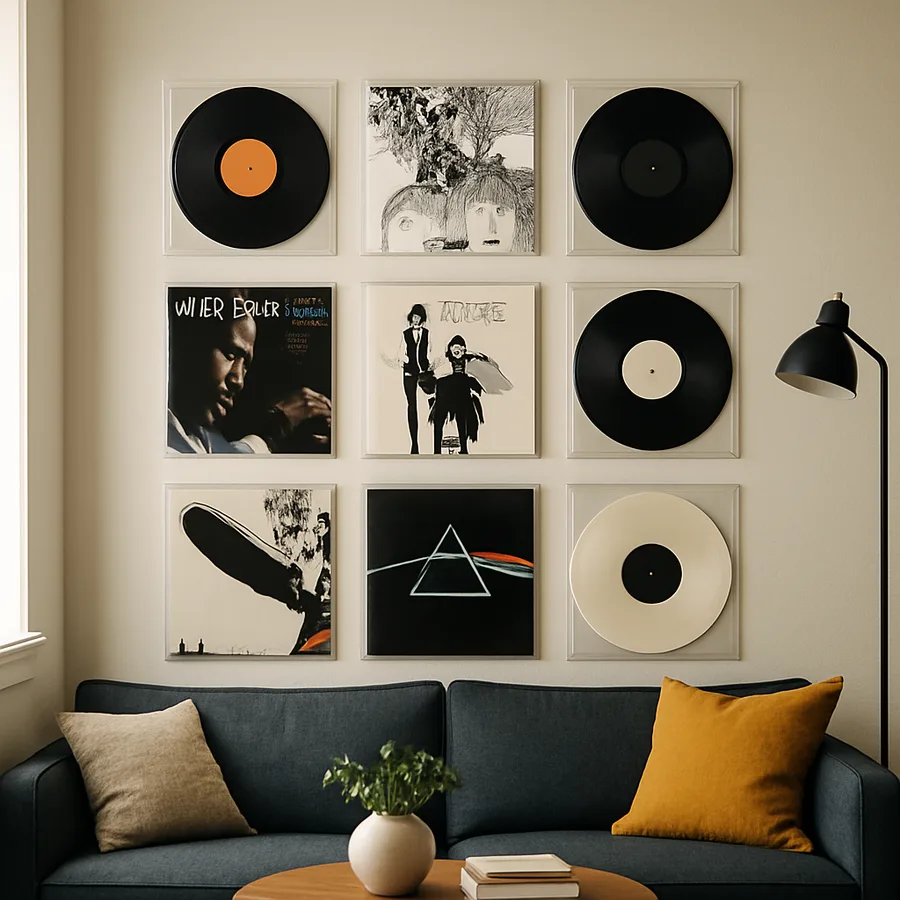
The original cover art on a Blue Note pressing or a first-issue Bowie record is irreplaceable, and the most common way collectors damage it is by hanging it on the wall. Direct adhesives, sun-faded jackets, warped corners from rubber-tipped clamps, and pinhole punctures from cheap frames have permanently devalued countless rare records over the last fifty years. The good news is that wall display is genuinely safe when the system is built around archival principles instead of hardware-store improvisation.
This guide explains how vinyl jackets actually deteriorate, walks through five non-damaging display systems, and covers the lighting and humidity choices that protect cover art for decades. Have you ever pulled a record off the wall after a few years and noticed the colors were noticeably duller than the matching jacket in your collection box? That is photochemical fading, and it is preventable. Have you ever found a small ring of adhesive residue on the back of a sleeve where a hanger used to be? That is also preventable, and the alternatives are no harder to use.
How Vinyl Jackets Actually Get Damaged
A standard 12-inch LP jacket is paperboard wrapped in a thin printed paper or sometimes a laminated finish. The structural body is fragile in five specific ways: UV exposure fades pigments, humidity swings warp the cardboard, direct adhesives bond to printed surfaces and tear them on removal, compression points from clamps create permanent dents, and flexing from a record left inside the jacket while wall-hung causes ringwear on the sleeve face.
The most underappreciated damage source is ringwear from the record inside the sleeve. A 12-inch LP weighs 140 to 200 grams, and that mass pressed against the inside of the jacket while the jacket hangs vertically creates a circular bulge on the front cover. The ring is faint at first and slowly burns in over months. The fix is simple: remove the record from the jacket while the jacket is on the wall, store the record separately in an inner sleeve, and reunite them only when playing.
The second most underappreciated damage source is humidity. The Library of Congress's preservation guidelines for paper-based collections specify a stable range of 30 to 50 percent relative humidity, with sharp swings being more harmful than steady high or low values. A bathroom-adjacent wall, a kitchen wall above a stove, or a wall that shares an exterior surface in a humid climate is a difficult environment for any paperboard sleeve, regardless of the hanging hardware.
The Smithsonian Institution's archival division, accessible through the Smithsonian, publishes guidance on paper-based collectible storage that maps directly onto vinyl jackets. They specifically warn against direct sunlight, fluorescent lighting in older buildings, and contact with acidic mounting materials. Each of those warnings translates into a specific design decision for a wall display.
System One: Archival Frames Designed for LPs
The cleanest, safest, and most reversible display system is a purpose-built record frame. These frames are sized to a standard 12.5-inch internal opening, have a depth that accommodates a standard jacket without compression, and use a hinged front-loading mechanism that lets you swap albums without disassembly. Brands like Art Vinyl Play & Display, Frametek, and Show & Listen have published detailed product specs and conservation notes.
The two specs to verify are UV-filtered glazing and acid-free backer board. UV-filtered glazing blocks 95 to 99 percent of damaging ultraviolet light without affecting visible color. Acid-free backer board prevents the slow yellowing that standard wood-pulp backers cause when pressed against the cover. Combined, these two specs extend the safe display life of a jacket from a few years to several decades.
The cost of a quality LP frame runs $35 to $80 each, which sounds high until you compare it to the replacement cost of a damaged collectible jacket. Architectural Digest has profiled record-collector home tours where the framing investment for a wall of 24 albums exceeded $1,200, and the homeowners considered it cheap insurance. For non-collectible reissues and personal favorites, the math is less dramatic but still favors archival frames over decorative cheap alternatives.
System Two: Reusable Adhesive Strips for Outer Sleeves
If frames are not the right look, the second-cleanest system uses archival outer sleeves combined with removable adhesive strips on the back of the sleeve, never on the jacket itself. The outer sleeve is a clear polyethylene or polypropylene bag that fully encloses the jacket, and the adhesive bonds to the bag rather than the printed cover.
For sleeve material, the spec to look for is PVC-free polyethylene or polypropylene at 3 to 4 mil thickness. PVC sleeves were common in the 1970s and 1980s and they slowly off-gas plasticizers that bond to printed surfaces and yellow over time. The contemporary archival standard is 100 percent polyethylene or polypropylene, and brands like Mobile Fidelity, Diskeeper, and Vinyl Storage Solutions explicitly label their products as PVC-free.
For the adhesive, the safest choice is Command-brand removable strips or equivalent, applied only to the back of the outer sleeve. These strips support up to 4 pounds in their standard size, which is roughly four times the weight of a typical empty jacket. They release cleanly when warmed slightly with a hairdryer, leaving no residue on either the wall paint or the sleeve. The American Society of Interior Designers has cited removable adhesive systems as "the single most renter-friendly framing method" in published trend reports.
System Three: Floating Acrylic Mounts
The third system uses a floating acrylic mount, where a clear acrylic shelf or bracket holds the jacket against the wall without enclosing it in a frame. These mounts are typically 12.5 to 13 inches wide, with a small lip at the bottom that supports the jacket and a clear retainer at the top that prevents tipping forward.
The advantage of floating acrylic is the clean modern look: no frame, no visible hardware, and easy weekly rotation. The disadvantage is the lack of UV protection. A floating-mount jacket is exposed to whatever lighting environment the room provides, which means the lighting strategy matters far more than it would behind UV glass. Better Homes & Gardens has profiled music-room installations where homeowners use floating acrylic specifically because they rotate albums weekly, eliminating long-term UV concerns through sheer rotation speed.
If you choose this system, mount the acrylic shelves on a wall that does not receive direct sunlight at any time of day. South-facing and west-facing walls are off-limits for unfiltered display; north-facing and east-facing walls in interior rooms work well. A simple test: hold a piece of plain white paper to the wall at noon and again at 4 p.m. for a week. If you see direct sun ever falling on the paper, that wall is not safe for unfiltered jacket display.
System Four: Picture Ledge for Album Rotation
The picture ledge approach treats album jackets like books on a shelf. A horizontal ledge 4 to 6 inches deep with a 0.5-inch front lip lets jackets stand vertically against the wall, supported by gravity and the lip. This is the system used by record stores for new-release displays, and it adapts beautifully to home use.
The ledge approach has three significant advantages: zero hardware on the jackets, instant rotation (literally seconds to swap a display), and the ability to layer multiple jackets in a single sightline. A typical 4-foot ledge holds 8 to 12 jackets layered in a row with the front-most jacket displayed and others visible behind it. The disadvantages are dust accumulation along the lip and the visible architecture of the ledge itself.
For installation, anchor the ledge into wall studs at every available location. A loaded ledge with 10 jackets weighs roughly 3 pounds, well within the load capacity of a single stud anchor, but lateral forces from someone bumping the ledge can pull it loose if anchored only in drywall. The Museum of Modern Art's exhibition design notes, available through the Museum of Modern Art, describe the use of similar ledge systems for graphic arts displays, with the same emphasis on stud anchoring.
System Five: Magnetic and Velcro Hidden Mounts
The fifth system uses thin steel plates or hook-and-loop strips hidden inside an outer sleeve and matched to mounting points on the wall. The bond is strong, the front of the jacket is completely unobstructed, and removal is instant. This is a specialty system, but it is increasingly popular for music rooms and DJ studios where rotation is constant.
For the magnetic version, a thin steel plate (around 0.5 millimeters thick) inserts inside the outer sleeve behind the jacket. The wall side carries a small rare-earth magnet rated to hold at least 2 pounds. The two surfaces snap together with a satisfying click and release with a slight lift. The risk is that strong magnets can theoretically affect very old shellac records, though modern vinyl is unaffected at the strengths used in display magnets.
For the hook-and-loop version, archival-grade hook-and-loop strips (think Velcro but acid-free) attach inside the outer sleeve and to a wall plate. The bond is reliable for jackets up to 5 pounds, which is well above the actual weight of a 12-inch LP. House Beautiful has documented installations using both systems for collector wall displays where the visual cleanliness of no visible hardware was the priority.
Lighting and Humidity for Long-Term Display
The hardware choice is half of the safe-display equation; the lighting and humidity environment is the other half. The Library of Congress preservation standard for paper-based displays calls for illuminance under 50 lux for permanent display, which is dimmer than most people realize. A typical residential reading area runs 200 to 400 lux, which over years will fade jacket pigments noticeably.
For a display wall, aim for indirect, warm-temperature lighting under 100 lux at the jacket surface. Track lighting with frosted lenses, wall-washer fixtures aimed at the ceiling, or table lamps positioned to spill rather than direct light all work. Avoid spotlights aimed at the jackets themselves; the concentrated beam will accelerate fading even with UV-filtered glazing.
For humidity, target 30 to 50 percent relative humidity year-round. A small hygrometer (around $20) in the room tells you whether you need a humidifier in winter or a dehumidifier in summer. Two stats worth knowing: the Smithsonian Institution's collections care team reports that paperboard fading rates roughly double for every 10 percent increase in relative humidity above 50 percent, and collectors' insurance providers often require documented humidity control for high-value record collection coverage.
Have you considered the temperature side of the equation? Stable temperature matters as much as stable humidity. A wall that backs to an attic, a garage, or an exterior surface in a cold climate will swing through 30 to 40 degrees of temperature variation across seasons, which stresses paperboard fibers and loosens any adhesive bonds. Interior walls perform far better than exterior walls for any long-term display.
Common Mistakes That Damage Records on the Wall
The first mistake is leaving the vinyl inside the jacket while it hangs. Ringwear is preventable simply by removing the disc and storing it separately in an archival inner sleeve. The second mistake is using self-adhesive frames or peel-and-stick mounts directly on the jacket. The bond is permanent at the molecular level, and removal will tear the cover surface every time without exception.
The third mistake is hanging records on a kitchen wall, a bathroom wall, or any wall within 6 feet of a humidity source. Steam, cooking grease, and humidity swings combine to deteriorate jackets faster than any other location in the house. The fourth mistake is using incandescent or halogen spotlights aimed directly at jackets. Even modern LED spotlights at high lumen output will fade pigments over years; warm indirect lighting is non-negotiable for long-term display.
The fifth mistake is failing to rotate. Even with archival frames and ideal lighting, fading is cumulative. Rotating display albums every 6 to 12 months distributes the wear across the collection rather than burning out the same dozen jackets. Collectors who rotate report essentially zero visible fading across decades; collectors who never rotate report perceptible fading on the wall albums within five years.
Conclusion
Vinyl wall display is genuinely safe when the system respects the materials. Archival frames with UV glass are the most protective; archival outer sleeves with removable adhesives are the most renter-friendly; floating acrylic and picture ledges suit modern rotating displays; magnetic and hook-and-loop systems suit hard-rotating music rooms. None of these systems require specialized tools, and all of them cost less than the replacement value of even a moderately collectible jacket.
The hardware decision is only half the work. Lighting, humidity, and rotation discipline matter as much as the mounting method, and ignoring any of those three will produce damage even in the best frames. The collectors with the cleanest, longest-lasting wall displays treat their music walls like miniature museums: stable environment, gentle light, regular rotation, and never the original disc inside the displayed jacket.
The reward for taking the time is significant. A wall of well-displayed albums becomes a slowly evolving piece of personal art, a mood-setter for the room, and a conversation starter for visitors. The albums you display say more about your taste than almost any other object in your home, and they deserve to be shown without slowly destroying them in the process.
Pull three jackets off your shelf this weekend and pick the right system for each: an archival frame for the most valuable, an outer sleeve with removable strips for a renter-friendly favorite, and a picture ledge for a rotating selection of recent listening. Live with the wall for a month, observe how the room feels with music made visible, and expand the display from there. The collection has been waiting to come out of the box.
More Articles You May Like



Comments
Post a Comment