Porch Ceiling Painted Haint Blue for Southern Tradition
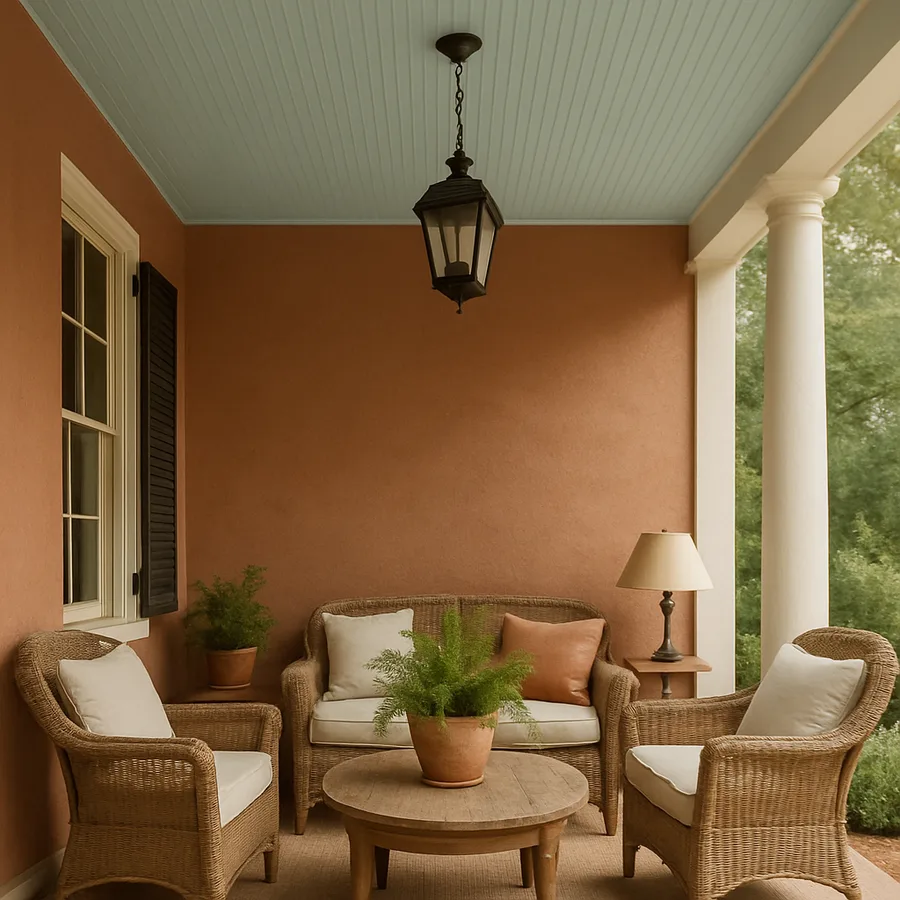
Step onto a porch in Charleston, Savannah, or any old town along the Gulf Coast and look up. The ceiling above you is almost certainly painted a soft, watery blue. It is a color so consistent across centuries of Southern architecture that it has its own name: haint blue. The tradition reaches back to the Gullah Geechee communities of the South Carolina Low Country, who painted ceilings, doorframes, and shutters this particular blue to ward off the haints, or restless spirits, that were said to be unable to cross water. Over time, the practice spread across the South, transforming from a folk protection into one of the most enduring and beloved design traditions in American residential architecture.
Today, haint blue is enjoying a renewed moment in design, embraced not just for its history but for the way it makes a porch feel. The pale, sky-mimicking hue elongates the day, softens shadows, and creates the illusion of an extended sky just above your head. Paint companies including Sherwin-Williams, Benjamin Moore, and Farrow & Ball all sell colors marketed specifically as haint blues, and Southern Living magazine has repeatedly named the practice one of the most enduring residential design traditions in the United States. According to a National Association of Home Builders (NAHB) regional survey, more than 60% of new homes built in the coastal Southeast still incorporate a painted porch ceiling, and the most popular color, by a wide margin, remains haint blue.
The Folk History of Haint Blue
The story of haint blue begins with the Gullah Geechee people, the descendants of West and Central Africans who were enslaved on the rice and indigo plantations of the South Carolina, Georgia, and Florida coasts. The Gullah preserved many West African spiritual traditions, including a deep belief in the existence of haints, the troubled spirits of the dead who could enter homes and disturb the living. To protect against haints, the Gullah painted ceilings, doorways, and window trims a specific shade of blue believed to mimic both water and sky, two elements that haints could not cross.
The blue itself was likely produced from indigo, the dye crop that built much of the Carolina Low Country economy. Mixed with whitewash and applied to porch ceilings, indigo produced a soft, slightly chalky blue with hints of green and gray, the same color that millions of Americans now associate with Southern porches. Over time, white plantation owners adopted the practice, and the blue ceiling spread from Gullah communities throughout the broader South.
By the early twentieth century, the practical and aesthetic benefits of the blue ceiling had eclipsed its spiritual origin in popular memory. People said it kept wasps and birds from nesting (because they mistook the ceiling for sky), or that it kept porches cooler in summer. Both claims have some basis in observation, though neither is the original reason. The haint blue ceiling was, and is, a piece of African American spiritual heritage that became a defining element of American Southern architecture. Better Homes & Gardens and other major design publications have written extensively about preserving the cultural origin of the tradition rather than treating it as a generic decorating trend.
Why Haint Blue Still Resonates Today
Beyond the cultural significance, haint blue has practical and emotional power that explains its enduring popularity. The pale, water-and-sky color creates the visual sensation that the porch ceiling has dissolved into the open air, extending the perceived height of the space and softening the boundary between sheltered and outdoor. On a hot afternoon, sitting beneath a haint blue ceiling feels distinctly cooler than sitting beneath a beige or wood-toned one, even if the actual temperature is identical. Color psychologists call this chromatic thermal perception, and it is a real, measurable effect.
The color also flatters skin tones. Anyone who has been photographed beneath a haint blue ceiling knows that the soft reflected light is gentle and warm, particularly in late afternoon. This is why so many Southern homes are photographed for magazines and weddings on the porch rather than inside. The ceiling acts as a giant diffuser, scattering light evenly across faces and fabrics. Editors at House Beautiful have written about this effect repeatedly, noting that no other ceiling color produces the same flattering, dreamy quality of porch light.
There is also the simple pleasure of looking up. A blue porch ceiling rewards the small habit of glancing skyward when you sit down, take a deep breath, and let yourself be still. It is a color that invites slowness. In a world that increasingly demands speed, attention, and stimulation, a porch ceiling that whispers look up, breathe, stay is no small gift. Have you ever sat on a porch where the ceiling color made you instantly slower? That is haint blue at work.
Choosing the Right Shade of Haint Blue
Not every blue qualifies as haint blue, and choosing the wrong shade can produce a result that feels theatrical rather than authentic. The traditional palette is pale, soft, and slightly desaturated, with a hint of green or gray that prevents it from reading as a child's room blue. The goal is a color that mimics sky reflected on water, not a primary blue and not a navy.
Designers consistently recommend a small group of reference colors. Sherwin-Williams Atmospheric (SW 6505) is a popular contemporary haint blue. Benjamin Moore Palladian Blue (HC-144) reads as soft, warm, and slightly green, and is among the most photographed haint blues in modern design portfolios. Farrow & Ball Borrowed Light (No. 235) and Cabbage White (No. 269) both work beautifully on porch ceilings. Local Southern paint companies, including Magnolia Home and several heritage Charleston brands, sell their own proprietary haint blues that lean closer to the original Gullah tradition.
The best way to choose is to sample. Paint a 3x3 foot swatch directly on the porch ceiling, since the color will read very differently in actual porch light than in a paint store. Observe the swatch at three different times: morning, midday, and late afternoon. Haint blue should look soft and watery in all three conditions, never harsh or cartoonish. If the sample reads as too saturated or too gray, try the next swatch. The right blue feels like it has always been there.
Sheen, Surface Prep, and the Right Paint Type
Choosing the color is half the project. The right sheen and the right surface preparation are what make a haint blue ceiling look professional rather than amateur. Most designers recommend a satin or eggshell sheen for porch ceilings. Flat finishes look beautiful but trap dirt and are nearly impossible to clean. High-gloss finishes reflect too much light and reveal every imperfection in the wood or beadboard surface. Satin strikes the right balance, offering some sheen for easy cleaning while still reading as soft and matte from below.
Use an exterior paint, not interior, even though the porch is technically sheltered. Exterior paint formulations are designed to handle humidity, temperature swings, and the slight UV exposure that even a covered porch receives. Look for an acrylic latex exterior paint with mildew resistance, since porch ceilings are vulnerable to mildew growth in humid climates. Brands like Sherwin-Williams Emerald Exterior, Benjamin Moore Aura Exterior, and PPG Manor Hall are widely considered top-tier for this application.
Surface preparation determines whether the paint job lasts five years or fifteen. Wash the existing ceiling with a mild detergent solution to remove cobwebs, dust, and pollen. Inspect for any peeling, cracking, or mildew, and address those areas with a primer designed for problem surfaces. If the existing surface is bare wood or has been previously painted with an oil-based product, use a high-adhesion bonding primer first. Skipping this step is the most common reason DIY haint blue ceilings start peeling within two seasons.
Application Techniques That Make a Difference
The actual application of haint blue to a porch ceiling is straightforward but rewards attention to a few details. Use a high-quality nylon-polyester brush for cutting in around beams, light fixtures, and the perimeter. For the broad ceiling surface, use a quality 3/8-inch nap roller and an extension pole. Roll in slow, overlapping passes, maintaining a wet edge to avoid lap marks. Two coats are almost always required to achieve full coverage, especially with the lighter haint blue colors that have low pigment density.
If your porch ceiling features beadboard (the narrow vertical wood planks common in Southern construction), pay particular attention to the grooves between boards. These grooves are where lap marks and missed coverage are most obvious. Cut into the grooves first with a brush, then roll the flat surface, working in sections to maintain consistency. Tongue-and-groove ceilings reward patience here, since the texture is part of what makes the finished result look authentic.
Plan the project for a stretch of dry, mild weather. Exterior paint cures best between 50 and 85 degrees Fahrenheit and below 70% humidity. Painting on a humid Southern afternoon is asking for streaking, slow drying, and mildew problems down the road. Two consecutive dry days, with light wind to help curing, produces the best result. ASID certified designers consistently advise homeowners to invest in proper conditions rather than rushing the project.
Pairing Haint Blue With the Rest of the Porch
A haint blue ceiling does not exist in isolation. The most photographed porches pair the blue ceiling with crisp white trim, a warm wood floor (often natural fir or painted gray), comfortable seating, and porch lighting that complements rather than competes with the ceiling color. The result is a layered, intentional space that reads as classic Southern hospitality.
For trim, choose a warm white rather than a cool one. Warm whites like Benjamin Moore Simply White or Sherwin-Williams Alabaster harmonize with the haint blue and prevent the porch from feeling cold. Floors painted in porch gray (a soft, slightly green-leaning gray) are traditional in the Carolinas and Georgia, while natural wood floors finished with a tinted oil sealer offer a more modern alternative. Whatever you choose, keep the floor color matte or low-sheen so it does not compete with the ceiling.
Furniture should lean classic and inviting: white wicker, woven natural fibers, painted wood rocking chairs, or weathered teak. Avoid plastic furniture in saturated colors, which fights the gentle palette of the porch. Add ferns in classic urns, a ceiling fan with wood blades to circulate air, and small porch lights with warm-white bulbs in the 2700K range. The whole composition should read as a single coherent space rather than a collection of mismatched pieces.
Conclusion: A Tradition Worth Honoring
Painting a porch ceiling haint blue is one of the most rewarding small projects a homeowner can undertake. It honors a centuries-old tradition rooted in African American spiritual heritage. It transforms the daily experience of sitting on the porch by making the space feel cooler, taller, and more peaceful. It pays disproportionate dividends in photographic appeal and resale value, and it costs less than almost any other exterior renovation a homeowner can take on.
The principles are straightforward. Choose a soft, slightly desaturated blue with a hint of green or gray. Use a quality exterior acrylic paint in a satin sheen. Prepare the surface meticulously and apply two coats in good weather. Pair the ceiling with warm white trim, soft wood or porch-gray floors, and warm-white lighting. Honor the cultural origin of the practice when you talk about it with family and visitors, since the tradition belongs to a community whose contribution to American architecture deserves to be remembered.
The National Association of Realtors (NAR) consistently reports that exterior upgrades return strong value, and porch enhancements rank high among buyer-preferred features. More than that, however, a haint blue porch ceiling produces daily, lived-in pleasure that no resale calculation can capture. It is the color you sit beneath while drinking the morning coffee, the color you look up at when a summer storm rolls in, and the color that quietly tells visitors that this household values both history and beauty.
If your porch ceiling is currently bare wood, beige, or white, consider scheduling the upgrade for the next stretch of dry weather. Sample a few haint blues directly on the ceiling. Pick the one that feels most like the sky reflected in still water. Then commit. Take a Saturday, prep the surface, and paint the ceiling that will quietly transform every porch sit for the next decade. Have you noticed how the most beloved porches in your own neighborhood often share that one upward-looking detail? Now you know why, and now you know how to bring it home.
More Articles You May Like


Comments
Post a Comment