Electric Towel Warmer Energy Use vs Hydronic for Daily Cost
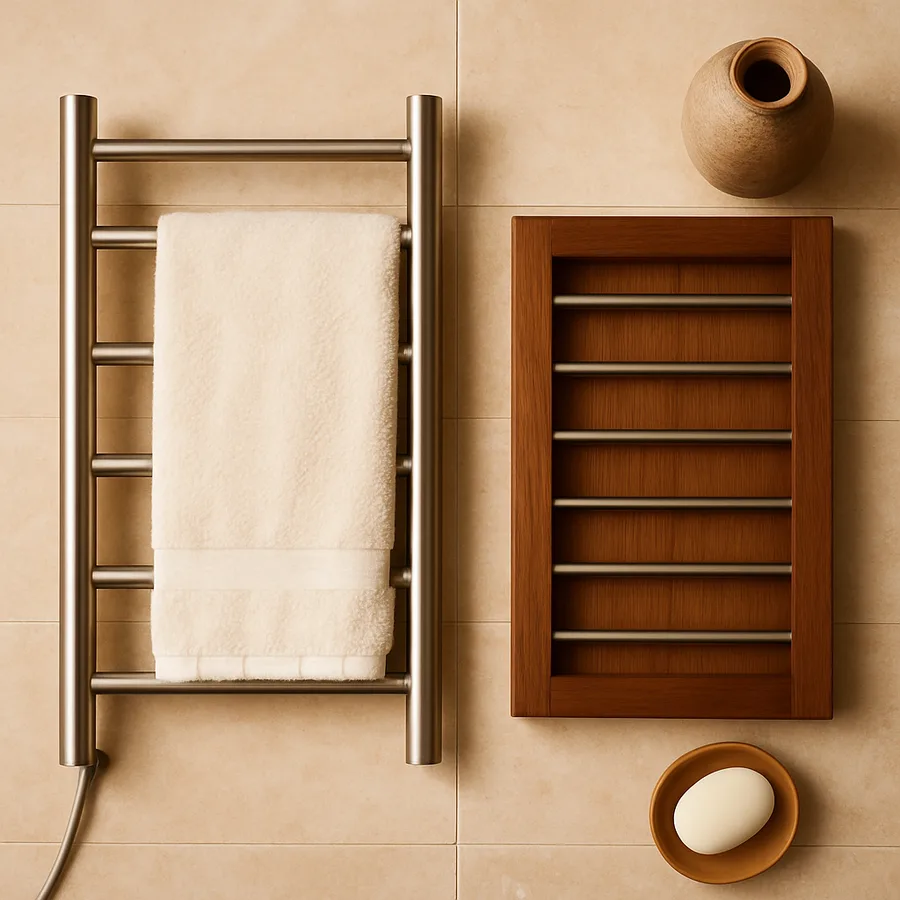
A towel warmer is a small luxury with a much larger annual operating cost than most homeowners assume, and the difference between an electric model and a hydronic model on the daily power bill is the kind of detail that gets glossed over in showroom literature. The two systems deliver almost identical comfort outcomes, a warm towel and a partially heated bathroom, but they reach that result through completely different energy paths. One pulls electricity directly from the wall and converts it to heat at almost 100 percent efficiency; the other taps a home's existing hydronic heating loop and runs at whatever fuel rate the boiler operates on.
This article walks through the actual energy math for both systems in real-world bathroom scenarios, the install cost differences that affect total ownership cost, the comfort and runtime considerations that drive day-to-day operation, and the scenarios where each system is the obvious choice. It assumes typical residential applications and uses national average energy prices for illustrative calculations; the reader should plug in local rates for an accurate comparison in their own zip code.
How Each System Generates Heat
An electric towel warmer is a sealed unit with internal heating elements, similar in concept to an electric baseboard heater shaped like a ladder. It plugs into a standard outlet or hardwires into a dedicated circuit, draws between 60 and 200 watts depending on size and design, and converts virtually all that power into heat through resistance heating. There is no plumbing, no boiler dependency, and no integration with a broader heating system. The unit is independent.
A hydronic towel warmer is a small radiator that connects to the home's hot water heating system. Water from the boiler, supplied at a temperature between 110 and 140 degrees Fahrenheit, circulates through the radiator and gives off heat. The towel warmer becomes another small zone or a piggyback on an adjacent zone, and its heat output depends on water temperature, flow rate, and the radiator's internal volume. Because the heat source is the boiler, the cost per BTU is whatever the boiler's fuel and efficiency produce.
The fundamental energy distinction is the source. Electric resistance heat costs whatever the local electricity rate happens to be, with no efficiency multiplier. Hydronic heat costs whatever the boiler's fuel costs divided by the boiler's efficiency. In a region with cheap natural gas and a 95 percent condensing boiler, that rate can be a third or less of the local electricity rate; in a region with expensive natural gas or an older 80 percent boiler, the gap narrows considerably.
Daily Energy Use Math for an Electric Unit
A representative residential electric towel warmer rated at 150 watts produces 0.150 kilowatt-hours of heat per hour of operation. A typical homeowner runs the unit during morning and evening shower windows, perhaps 4 hours per day total, plus another 2 hours of partial-output cycling on a thermostatic timer. That works out to roughly 0.75 kilowatt-hours per day, or about 275 kilowatt-hours per year if used daily.
At the U.S. national average residential electricity rate of approximately 16 cents per kilowatt-hour reported by the U.S. Energy Information Administration, that annual energy use translates to about 44 dollars per year. In high-cost regions where electricity runs 25 to 30 cents per kilowatt-hour, the same usage pattern costs 70 to 85 dollars annually. In low-cost regions with hydropower or coal-dominated grids at 10 cents per kilowatt-hour, the same usage costs around 28 dollars annually. The range is meaningful but not enormous in any region.
What about leaving the unit on continuously, which many homeowners actually do? A 150-watt towel warmer running 24 hours a day consumes 3.6 kilowatt-hours daily, or about 1,310 kilowatt-hours annually. At the national average rate, that is roughly 210 dollars per year, which is close to the install cost of the unit itself. A timer is the single best investment a homeowner can make on an electric towel warmer; reducing runtime from continuous to scheduled cuts the annual cost by 60 to 80 percent without affecting comfort during use windows.
Daily Energy Use Math for a Hydronic Unit
A hydronic towel warmer's heat output depends on water temperature and flow, but a representative residential unit produces between 500 and 1,200 BTU per hour at typical residential water temperatures, with most units landing around 800 BTU per hour. That is roughly 230 watts of equivalent heat output, slightly higher than a comparable electric unit because the radiator surface is in direct contact with hot water rather than a bounded electrical element.
The cost calculation begins with how the boiler produces that heat. A 95 percent condensing natural gas boiler producing 800 BTU per hour for 6 hours per day uses about 0.05 therms per day. At the U.S. national average residential natural gas price of roughly 1.50 dollars per therm, that is about 7 cents per day, or roughly 26 dollars per year. The same usage on a propane boiler at 3.50 dollars per gallon and 92,000 BTU per gallon costs slightly more, around 50 dollars per year. On heating oil it lands somewhere in between.
The hydronic system's annual cost comes in well below the electric system's annual cost in most regions where natural gas is available. The gap holds even when accounting for the small electricity needed to run the boiler's circulator pump, which is typically 60 to 100 watts of additional draw during call-for-heat cycles. The catch is that hydronic only makes sense if the home already has a boiler; installing a boiler just to feed a single towel warmer would be absurd.
Installation Cost and Complexity
An electric towel warmer is the simplest possible install. The unit is mounted on the wall with anchors rated for the unit's weight, the supply cord is plugged into a nearby outlet or hardwired into a dedicated circuit, and a programmable timer is added between the circuit and the unit. Total install cost runs from 200 dollars for a basic plug-in unit up to 1,500 dollars or more for a large hardwired hardwired model with a built-in timer and high-end finish. The labor is one electrician for half a day in the hardwired case, or zero labor for the plug-in case.
A hydronic towel warmer requires PEX or copper supply and return lines from the home's hydronic manifold to the bathroom, a thermostatic radiator valve or zone actuator to control output, and bleed and shutoff valves at the unit. In a new build with the manifold being installed anyway, the marginal cost is the unit itself plus an additional pair of supply runs, perhaps 800 to 2,000 dollars. In a retrofit, the cost climbs sharply because supply lines must be routed through finished walls and ceilings, easily reaching 3,000 to 5,000 dollars in a typical second-floor bathroom retrofit.
Have you priced the install separately from the unit itself? The labor and rough-in costs often exceed the equipment cost on hydronic retrofits, which is the main reason electric towel warmers dominate retrofit projects regardless of long-term operating cost. If the home already has hydronic heat and the bathroom is being gut-renovated with walls open, the marginal cost of adding a hydronic towel warmer is small. Outside that scenario, electric is almost always the practical choice.
Comfort and Runtime Considerations
Both systems heat towels to similar temperatures, generally 95 to 115 degrees Fahrenheit at the bar surface, which is warm enough to feel pleasant without being hot to the touch. Both systems also contribute meaningful supplemental heat to a bathroom, particularly to the area immediately around the unit. A 150-watt electric unit and an 800-BTU-per-hour hydronic unit produce roughly comparable bathroom heat contributions, and either one can take the edge off a cold morning bathroom on its own.
The runtime profile differs slightly. Electric units reach setpoint faster, typically warming a damp towel in 20 to 30 minutes, because the heating elements are in direct contact with the bar material. Hydronic units take 30 to 45 minutes because the boiler must come on, the manifold zone must open, and the radiator must reach steady-state water temperature. For households that want a warm towel waiting at the end of a shower, that 10 to 15 minute difference rarely matters; for households that turn the unit on as they enter the bathroom, electric responds noticeably faster.
What about heat recovery in cold climates? A hydronic unit cycles with the rest of the home's heating system, so during a cold winter morning when the boiler is already running for the bathroom floor or another zone, the towel warmer adds essentially zero marginal energy cost beyond what the boiler is already consuming. An electric unit runs at full electric rates regardless of what else is happening in the house. In cold climates with hydronic floor heat, the hydronic towel warmer compounds in efficiency in a way the electric unit cannot.
Code, Safety, and Certification
Electric towel warmers in bathrooms must be installed per the National Electrical Code, which requires Class A GFCI protection on any 15-amp or 20-amp branch circuit serving a bathroom. Hardwired units must be UL-listed for damp or wet locations as appropriate, and the supply circuit must be sized for the unit's maximum draw plus a margin. Plug-in units must use the bathroom's existing GFCI-protected receptacle, and most manufacturers specify a minimum clearance from tubs, showers, and sinks to prevent water contact.
Hydronic towel warmers fall under plumbing code rather than electrical code, with International Plumbing Code, IAPMO Uniform Plumbing Code, and local amendments governing the supply piping. The radiator itself must be rated for potable or closed-loop service depending on the system design; closed-loop hydronic heat almost always uses a sealed system with corrosion inhibitor, and the towel warmer must be compatible with that fluid. Bleed valves at the unit and isolation valves at the manifold are required for service.
According to the U.S. Department of Energy, residential heating accounts for the largest share of household energy use in cold climates, and small comfort appliances like towel warmers contribute marginally to that total when used on schedules. ENERGY STAR resources on heating efficiency reinforce that schedule control is the single highest-value lever for any small heating appliance.
Total Cost of Ownership Over a Decade
A reasonable 10-year cost of ownership comparison combines install cost, annual energy use, and incidental maintenance. For a representative electric unit at 600 dollars installed, 44 dollars per year in energy at the national average rate with a timer, and minimal maintenance, the 10-year total comes to roughly 1,040 dollars. For a hydronic unit added during a new build at 1,200 dollars installed, 26 dollars per year in energy, and a small annual share of boiler service cost attributed to the towel warmer zone, the 10-year total comes to roughly 1,560 dollars.
The electric system wins on 10-year ownership cost in most representative scenarios, even with a higher annual energy bill, because the install cost gap exceeds the energy cost gap. The math flips in two scenarios: when electricity is genuinely expensive, north of 25 cents per kilowatt-hour, in which case the energy cost difference compounds quickly, and when the hydronic install is happening anyway as part of a broader new-construction project, in which case the marginal install cost shrinks.
The National Kitchen and Bath Association, commonly known as NKBA, identifies towel warmers as a frequently requested upgrade in mid-range and high-end bathroom remodels, with adoption strongest in primary suite renovations. The choice between electric and hydronic is increasingly driven by whether the project is a remodel or new construction, with new construction trending hydronic where the home has a boiler and remodels trending electric.
Conclusion
The electric-versus-hydronic towel warmer decision is more about install context than operating cost in most homes. Electric units win in retrofits, in homes without an existing hydronic system, and in any scenario where simplicity and predictable install cost matter. Hydronic units win in new construction with hydronic heating, in cold climates where the boiler is running anyway, and in homes where natural gas or another inexpensive boiler fuel offsets the higher install cost over a decade or more. The energy use math favors hydronic on a per-BTU basis, but the install cost math favors electric on a total-ownership basis in most scenarios.
For most homeowners considering a towel warmer in an existing home, the answer is an electric unit on a programmable timer. Pick a unit sized for the bathroom and the towels in use, install it on a GFCI-protected dedicated circuit, set the timer to run for 60 to 90 minutes around morning and evening shower windows, and enjoy a warm towel without thinking about the energy bill. The annual operating cost is modest, the install is simple, and the comfort delivered is identical to a hydronic unit at four times the install cost.
For homeowners building new or undertaking a major renovation that includes hydronic heating, specify a hydronic towel warmer as part of the broader hydronic design. The marginal install cost is small, the operating cost over decades is lower, and the unit integrates naturally with the rest of the home's heating system. Have a hydronic-experienced installer size the radiator for the bathroom's actual heat needs and confirm that the manifold has a free zone available, and the towel warmer becomes part of a unified heating story rather than a standalone appliance.
Whichever path you choose, install a programmable timer or thermostat and use it. The single largest variable in lifetime towel warmer cost is whether the unit runs on a schedule or runs continuously, and the comfort benefit of continuous operation over scheduled operation is essentially zero. A 30-dollar timer can save more energy over a decade than choosing the cheapest unit on the showroom floor.
More Articles You May Like



Comments
Post a Comment