Transform Your Space: Innovative Interior Design Trends to Watch This Year
The way we think about interior spaces is undergoing a fundamental recalibration. Homes are no longer just shelters or status symbols; they are performance environments expected to support productivity, wellness, social connection, and personal expression simultaneously. That expanded mandate has produced a wave of design innovation that goes far deeper than surface-level aesthetics. The International Interior Design Association (IIDA) describes the current moment as a convergence point where technology, sustainability science, and human-centered design are merging into a unified practice for the first time. The result is a set of trends that are not merely stylish but functionally transformative.
This article examines six innovation-driven trends that are actively reshaping residential interiors. Each section looks at the practical applications, realistic cost implications for projects budgeted at $5,000 to $15,000 per room, and the professional expertise required to execute well. Whether you are a homeowner preparing to renovate or a design professional evaluating which new capabilities to adopt, the goal is to move beyond trend lists and into actionable understanding. What follows is a map of where interior design is headed and what it takes to get there.
Adaptive Rooms: Spaces That Shift with Your Schedule
The fixed-purpose room is becoming obsolete. Homeowners increasingly need spaces that serve multiple functions throughout the day, transforming from a focused workspace at nine in the morning to a social gathering area by seven in the evening. Adaptive room design addresses this through movable partitions, furniture with concealed dual purposes, and lighting systems that reconfigure the mood and perceived boundaries of a space without any physical rearrangement. The American Society of Interior Designers (ASID) reports that demand for multifunctional design solutions has grown by 60 percent over the past three years, making it the single fastest-growing category in residential consultations.
Execution requires more planning than a traditional single-purpose room. A designer must map every activity the space needs to support, identify the transitions between activities, and select furniture and fixtures that facilitate those transitions seamlessly. A murphy bed with an integrated desk, for example, transforms a guest bedroom into a home office in seconds, but only if the room's electrical outlets, lighting zones, and storage are designed to support both modes. Firms billing at $150 to $500 per hour find that adaptive room projects require roughly 20 percent more schematic design time than comparable single-function rooms, but the client satisfaction payoff justifies the investment because the finished space genuinely performs double duty rather than awkwardly compromising on both functions.
Smart home integration elevates adaptive design from clever furniture placement to genuine spatial transformation. Motorized partitions can descend from ceiling tracks to divide an open-plan area into private zones. Lighting scenes shift color temperature and intensity to signal a change in the room's purpose, from cool, bright task lighting during work hours to warm, dimmed ambient lighting for evening relaxation. Houzz data shows that homes with well-executed adaptive spaces command a resale premium of 8 to 12 percent over comparable properties with fixed-layout rooms. Have you ever wished a room in your home could do two entirely different jobs equally well? Adaptive design makes that possible, and the technology enabling it connects directly to the next trend: intelligent home systems that anticipate your needs.
Predictive Smart Home Systems
Smart home technology has evolved past the era of novelty voice commands and into genuinely predictive operation. Current-generation systems learn occupancy patterns, daily routines, and seasonal preferences, then adjust lighting, climate, and shading proactively without any manual input. The difference between a reactive smart home, one that responds to commands, and a predictive smart home, one that anticipates behavior, is the difference between a tool and an environment. NCIDQ-certified designers who specialize in technology integration report that predictive systems fundamentally change how a space feels because the environment adapts to the occupant rather than requiring the occupant to manage the environment.
The design implications are substantial. When a home's lighting, temperature, and shading operate autonomously, the designer gains freedom to make choices that would be impractical in a manually controlled space. Deep-set windows that would be uncomfortably bright without motorized shading become viable. Open floor plans that would waste energy without zone-controlled HVAC become efficient. Hallways and stairwells that would require constant switch operation become intuitive with occupancy-sensing fixtures. AD PRO has profiled firms that now include a smart home consultation as a standard component of every project above $10,000 per room, recognizing that the technology is no longer a luxury add-on but a design enabler.
Budget-conscious homeowners can adopt predictive smart home features incrementally. A smart thermostat with learning capabilities costs $200 to $400 and typically pays for itself in energy savings within eighteen months. Smart lighting that adjusts color temperature throughout the day to support circadian health runs $500 to $2,000 per room depending on fixture count. The most cost-effective strategy, recommended consistently by IIDA technology reports, is to install the wiring infrastructure and network backbone during any renovation and add smart devices gradually as budget allows. This avoids the costly retrofit of opening finished walls later. Do you interact with your home, or does your home interact with you? Predictive systems redefine that relationship. The intelligence embedded in these systems also powers the next trend: immersive visualization that lets you experience design proposals before construction begins.
Real-Time AR Design Collaboration
Augmented reality has progressed from a presentation gimmick to a collaborative design tool. The current generation of AR applications allows the designer and client to stand together in the actual room and see proposed changes overlaid in real time: wall colors, flooring, furniture, lighting fixtures, and even the view through a proposed window enlargement. This shared visual experience transforms the design conversation from abstract discussion to concrete evaluation. ASID research indicates that projects using real-time AR collaboration reach design approval 35 percent faster than projects relying on traditional mood boards and 2D renderings, a time savings that benefits both the client's schedule and the designer's profitability.
The technology is particularly powerful for material decisions. Seeing a marble countertop swatch is categorically different from seeing that marble rendered at full scale across a kitchen island with accurate veining, reflectivity, and shadow behavior. AR eliminates the imagination gap that causes so many material-related regrets. For a project budgeted at $5,000 to $15,000 per room, preventing even one material change order after fabrication or installation can save $1,000 to $5,000 and several weeks of delay. IIDA research quantifies the impact: AR-assisted projects experience 42 percent fewer post-approval design changes than conventionally presented projects.
Real-time AR also democratizes access to high-quality design visualization. Five years ago, photorealistic renderings required expensive software, specialized hardware, and hours of rendering time. Current tablet-based AR apps produce comparable results instantly, which means designers at every price point can offer immersive visualization without passing significant technology costs through to the client. Houzz reports that AR capability is now a top-five factor in how homeowners select a designer, ahead of portfolio style and second only to personal referrals. The expectation is set, and firms that cannot meet it are losing engagements to those that can. With visualization tools showing what a space will look like, the next question is what that space will be made of, and that leads to one of the most significant material innovations in recent memory.
Engineered Natural Materials: Performance Meets Authenticity
The tension between wanting natural materials and needing practical performance has long been a central compromise in interior design. Natural stone stains. Solid wood warps. Genuine leather scratches. Engineered natural materials resolve this tension by starting with authentic base materials and enhancing them with modern treatments that preserve their appearance and tactile quality while dramatically improving durability and maintenance. Porcelain slabs that replicate the veining and depth of Calacatta marble, engineered hardwoods with wear layers that resist scratching and moisture, and treated leathers that maintain their patina without absorbing spills are redefining what clients can expect from natural aesthetics.
The cost profile is compelling. A genuine Calacatta marble slab for a kitchen island might cost $8,000 to $15,000 installed, while a high-quality porcelain alternative runs $3,000 to $6,000 with comparable visual impact and superior stain resistance. For homeowners working within a per-room budget, engineered alternatives free up resources for other priorities without requiring a visible aesthetic compromise. AD PRO notes that even high-end designers are specifying engineered materials for high-traffic and high-moisture applications, reserving genuine natural materials for lower-wear areas like bedroom accent walls or decorative shelving where their imperfections can be appreciated without practical penalty.
Sustainability adds another dimension to the engineered materials trend. Many engineered products use recycled content, require less raw material extraction, and generate less waste during fabrication than their natural equivalents. A recycled-glass terrazzo countertop, for instance, diverts post-consumer glass from landfills while producing a surface that is harder, less porous, and more color-consistent than traditional cement-based terrazzo. ASID's materials committee has endorsed the category as a significant step forward for sustainable design practice. The evolution of materials is complemented by the next trend, which transforms how natural elements are integrated into built spaces at a structural level.
Structural Biophilic Design
Biophilic design has historically been treated as an additive layer: plants placed on shelves, nature photography hung on walls, green paint applied to an accent surface. The structural biophilic trend treats nature not as decoration but as infrastructure. Living walls that double as air filtration systems. Interior water features that provide humidity regulation and acoustic masking. Skylights and light wells engineered to track natural daylight patterns deep into the building footprint. These interventions are designed into the architecture from the beginning, not retrofitted after the aesthetic decisions are made. IIDA's biophilic design working group calls this the single most important evolution in wellness-oriented design, because structural integration produces measurably stronger health outcomes than decorative addition.
The investment required for structural biophilic design is meaningful but defensible. A professionally installed living wall with automated irrigation costs $8,000 to $25,000 depending on size and plant selection. An interior water feature engineered for humidity and sound management runs $5,000 to $15,000. These numbers place structural biophilic elements at or above typical per-room budgets, which means they need to be justified by quantifiable benefits. The data supports the investment: NCIDQ-certified designers cite research showing that structural biophilic interventions in home offices increase self-reported productivity by 15 percent and reduce stress-related absenteeism, metrics that translate directly into economic value for remote workers.
Maintenance is the practical concern that separates successful biophilic installations from expensive failures. Living walls require ongoing care, proper irrigation, adequate light, and periodic plant replacement. Water features need water-quality management to prevent mineral buildup and biological growth. Designers who recommend structural biophilic elements must also design the maintenance protocol and ensure the client understands the commitment. The best installations use automated systems that minimize manual upkeep, but zero-maintenance living elements do not exist. Honest communication about maintenance requirements is what separates a responsible design professional from one chasing a trend. Does your home actively contribute to your physical and mental well-being, or is it simply a container you live inside? Structural biophilic design bridges that gap. The final trend addresses the aesthetic movement that ties many of these innovations together.
Warm Minimalism: The Refined Middle Ground
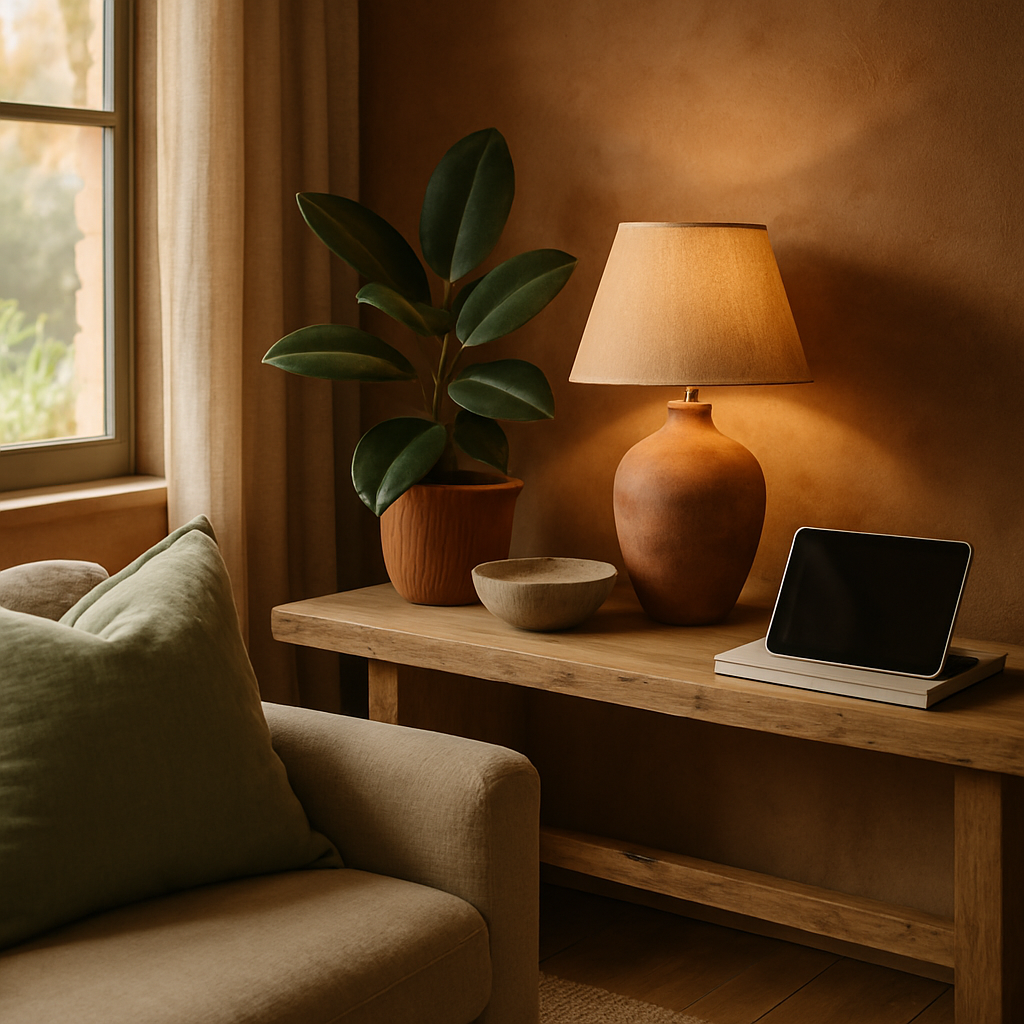
Warm minimalism occupies the space between the austerity of pure minimalism and the richness of quiet luxury. It retains the edited, intentional quality of minimalist design but replaces cold surfaces and stark contrasts with organic textures, rounded forms, and a palette grounded in natural warmth. Think plaster walls in soft sand tones, bouclé upholstery on sculptural seating, travertine surfaces with filled-and-honed finishes, and blackened steel frames softened by leather wrapping. The result is a space that feels restrained and spacious but also welcoming and tactile. Houzz identifies warm minimalism as the fastest-growing aesthetic search category, with particular strength among homeowners aged 30 to 50 who are furnishing primary residences rather than rental properties.
The Japandi influence on warm minimalism is evident in the emphasis on craftsmanship and natural materials, but warm minimalism is more eclectic in its sourcing. A Japandi interior maintains strict geographic and stylistic coherence; a warm minimalist interior might combine a Japanese ceramic vase, a Scandinavian lounge chair, and a Moroccan hand-knotted rug, unified by color and texture rather than by cultural origin. This flexibility makes warm minimalism more accessible to a wider range of clients and budgets. A designer working within a $5,000-to-$15,000-per-room budget can achieve a compelling warm minimalist result by investing in a few high-quality foundational pieces and letting the architecture do the rest.
Designers billing at $150 to $500 per hour note that warm minimalism is one of the most satisfying styles to execute because it rewards skill over spending. The challenge is not sourcing expensive items but selecting the right few items and placing them in exactly the right relationship to each other and to the architecture. Negative space, the areas where nothing is placed, is as important as the objects themselves. ASID's design trends panel describes warm minimalism as the aesthetic most likely to define the current decade, precisely because it accommodates the other trends on this list: biophilic elements, sustainable materials, smart home technology, and AR visualization all integrate naturally into its framework. This convergence is what makes warm minimalism more than a style; it is a design philosophy aligned with how people want to live now.
The six trends explored here share a common thread: they prioritize how a space performs over how it photographs. Adaptive rooms respond to the complexity of modern life. Predictive smart systems remove friction from daily routines. AR visualization reduces risk and accelerates decision-making. Engineered materials resolve the tension between beauty and practicality. Structural biophilic design improves measurable health outcomes. Warm minimalism provides the aesthetic framework that unifies these innovations into coherent, livable spaces. Together, they represent a maturation of interior design from a visual discipline into a holistic practice that treats the home as an active participant in the occupant's well-being.
If these trends resonate with your vision for your own home, the most effective next step is a focused consultation with an NCIDQ-certified designer who has demonstrated experience with the specific innovations that interest you. Ask to see completed projects that incorporate adaptive design, biophilic elements, or smart home integration, and ask specifically about the budget ranges those projects fell within. A one-hour paid consultation, typically $150 to $300, will give you more clarity about feasibility and cost than weeks of independent research. Your home has the potential to do more than look good; it can actively make your life better, and the trends shaping the field right now are built to deliver exactly that.
More Articles You May Like



Comments
Post a Comment