Staircase Lighting Ideas That Improve Safety and Ambiance
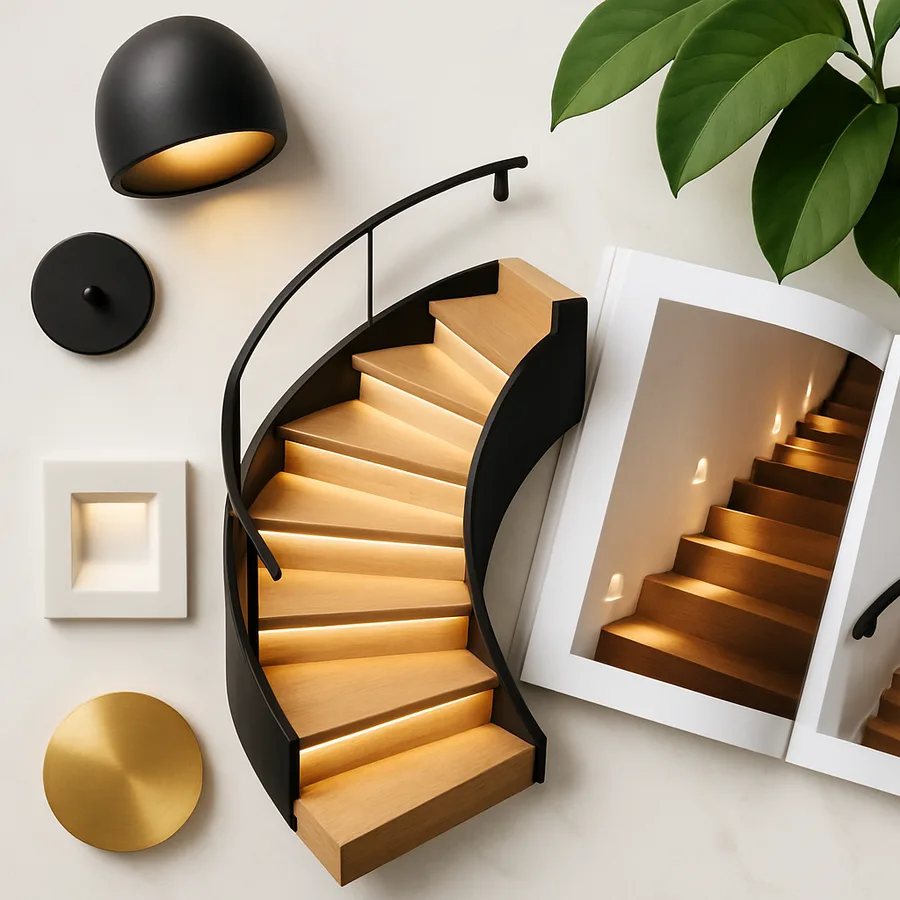
Staircases Are the Most Neglected Lighting Zone in Residential Design
Walk through any model home or newly constructed house and you will find carefully considered lighting in the kitchen, the living room, the master bathroom, and even the closets. Then look at the staircase. Chances are high that it is lit by a single ceiling fixture at the top, a single ceiling fixture at the bottom, or a combination of the two that leaves the middle section of the stairs in relative shadow. The staircase, which is the most physically dangerous transitional space in any multi-story home, receives the least thoughtful lighting treatment. This is not a minor oversight. It is a design failure with measurable consequences that affects millions of households every year.
The National Safety Council reports that staircase falls account for over one million emergency department visits annually in the United States, making stairs the second leading cause of accidental injury after motor vehicle incidents. Inadequate lighting is a contributing factor in a significant percentage of these falls, particularly among adults over 65, whose age-related changes in depth perception and contrast sensitivity make well-lit stair treads essential for safe navigation. The Illuminating Engineering Society (IES) recommends a minimum of 20 foot-candles of illumination on stair treads, measured at the walking surface, with additional emphasis on uniform distribution that eliminates dark spots between steps. Most residentially lit staircases fall well below this standard, particularly in the critical middle section where overhead fixtures from above and below converge into a dim no-man's-land.
The good news is that staircase lighting has undergone a design revolution driven by LED technology, miniaturized fixtures, and smart controls. Solutions that were prohibitively expensive or technically impractical fifteen years ago are now affordable, simple to install, and available in styles that range from invisible recessed hardware to dramatic architectural statements. A homeowner can transform a dangerous, dimly lit staircase into a safely illuminated, visually striking feature for as little as $50 in LED strip lights and a weekend afternoon of work, or invest several thousand dollars in a professionally installed system that integrates with the home's smart lighting network. The range of options is wide, but they all share a common goal: making every step visible, every transition safe, and every journey up or down the stairs a pleasantly lit experience rather than a hazard navigated in shadow.
Have you ever walked down your stairs at night, misjudged the edge of a tread, and caught yourself on the railing? That moment of sudden alarm, the stomach drop and the adrenaline spike, is your body telling you that the lighting has failed. It does not need to happen again. The ideas in this guide address every staircase type, every budget level, and every aesthetic preference, from minimalist modern to traditional warmth, with specific product categories, placement dimensions, and installation approaches for each.
LED Step Lights Recessed Into the Wall
Recessed LED step lights installed into the stair-adjacent wall at every second or third riser are the most architecturally clean solution for staircase illumination. Each fixture is a small rectangular or circular unit, typically two to four inches wide, that mounts flush with the wall surface and casts a downward wash of light across the tread below. The fixture body sits inside a housing recessed into the wall cavity, leaving only a slim faceplate visible. When properly installed, recessed step lights provide uniform illumination across every tread without any visible light source that could cause glare to someone ascending or descending the stairs.
Placement height for recessed step lights is critical. The fixture centerline should sit 6 to 8 inches above the tread surface of the step it is intended to illuminate. This height positions the light output low enough to wash the tread surface thoroughly without throwing light upward into the eyes of someone walking down the stairs. Installing the fixtures higher, at 12 inches or above, shifts the light pattern from a tread wash to a wall wash, which improves ambient brightness but reduces the contrast between tread and riser that makes each step's edge visible. The Houzz staircase lighting gallery shows hundreds of examples of recessed step lights at various heights, and the installations rated most highly by users consistently place the fixtures in the 6-to-8-inch range.
Color temperature selection affects both the safety and the atmosphere of the staircase. Warm white LEDs in the 2700K to 3000K range create a welcoming amber glow that suits residential staircases and transitions smoothly with the warm lighting typical of bedrooms, living rooms, and hallways. Cool white LEDs at 4000K and above produce higher contrast and sharper tread edge visibility, which improves safety performance but creates a commercial or institutional feel in a residential setting. The optimal compromise for most homes is 3000K, which provides warm residential character with sufficient contrast for safe navigation. Several step light manufacturers offer tunable white fixtures that adjust color temperature via a wall controller or smart home integration, allowing the homeowner to set cool bright light during daytime and warm dim light at night.
Installation of recessed step lights in an existing wall requires cutting openings in the drywall, running low-voltage wiring between fixtures, and connecting to a transformer or driver that converts line voltage to the 12V or 24V that the LED fixtures require. This is a moderate-difficulty project that most handy homeowners can accomplish with basic tools, a stud finder, and a drywall saw, but it involves working with electrical wiring behind finished walls and should comply with local electrical codes. For homes with open stringer staircases where the wall is accessible from behind, such as a basement staircase with an unfinished adjacent space, the wiring is straightforward. For enclosed staircases flanked by finished walls on both sides, the wiring can be routed through the wall cavity by fishing cable from a single access point, though this requires more patience and possibly a flexible drill bit to navigate around studs.
Under-Tread LED Strip Lighting
LED strip lights mounted under the front edge of each tread nosing create a floating, ethereal effect where each step appears to hover above the riser below it. This approach, sometimes called "stair nose lighting" or "tread edge lighting," has become one of the most popular staircase lighting treatments in contemporary residential design. The light source is completely hidden from view, tucked under the overhang of the tread nosing, and the illumination radiates downward and outward to highlight the riser face and the tread edge of the step below. The visual effect is striking, particularly on open-riser staircases where the light passes through the gap to the floor below, and the safety benefit is substantial because every tread edge is defined by a bright line of light that makes missteps nearly impossible.
Installation requires an LED strip rated for indoor use, an aluminum channel with a diffuser lens to eliminate individual LED dot visibility, and a compatible LED driver. The aluminum channel is cut to the width of each tread and adhered or screwed to the underside of the nosing. The LED strip is pressed into the channel's adhesive track, and the diffuser lens snaps over the top to spread the light evenly. Low-profile channels measuring 7mm or less in height are virtually invisible from normal standing and walking positions. Wiring runs from channel to channel can follow the stringer if the staircase has an open or exposed stringer design, or can be routed through small holes drilled in the riser if the staircase is fully enclosed.
The U.S. Department of Energy classifies LED strip lighting as one of the most energy-efficient illumination methods available, consuming as little as 2.4 watts per linear foot for standard-density strips. A staircase with 14 treads, each fitted with a 36-inch strip, uses approximately 10 watts total, less than a single standard light bulb. Operating this system 12 hours per day costs roughly $0.50 per month in electricity at average U.S. rates. The minimal energy consumption makes it practical to leave staircase strip lighting on continuously during evening and nighttime hours, ensuring the stairs are always safely illuminated without any measurable impact on the electricity bill.
Dimming capability adds versatility to under-tread strip lighting. A system running at 100 percent brightness during evening hours can be dimmed to 10 or 15 percent for overnight use, providing enough visibility to navigate the stairs safely during a middle-of-the-night trip without producing enough light to fully wake the person using them. Smart LED controllers compatible with Wi-Fi, Zigbee, or Z-Wave protocols allow brightness scheduling that automates this transition, dimming the stairs at bedtime and brightening them at the first alarm. Some controllers also support motion triggering, where a sensor at the top or bottom of the staircase activates the lights when someone approaches, illuminating the path ahead before the first step is taken.
Motion-Activated and Smart Staircase Lighting Systems
The most sophisticated staircase lighting systems use motion sensors to detect an approaching person and illuminate the stairs sequentially, one step at a time, in the direction of travel. A sensor at the top of the staircase and a sensor at the bottom determine which direction the person is heading, and the controller activates the step lights in a cascading sequence that lights each step just before the person reaches it. The visual effect is theatrical, a flowing wave of light that guides the person up or down the stairs, and the practical benefit is that the lights operate only when someone is actually using the stairs, consuming zero energy during the many hours each day when the staircase is unoccupied.
Sequential staircase lighting controllers are available from several manufacturers, with the most popular being the Stair Light Controller from Flexfire LEDs and comparable systems from HitLights and InStyle LED. These controllers manage up to 16 independently addressable channels, one per step, and allow the user to configure the cascade speed, the on-duration per step, the brightness level, and the fade-in and fade-out timing. A typical configuration lights each step for 3 to 5 seconds after activation, with a 0.2-second delay between sequential steps, creating a smooth flowing effect that traverses a 14-step staircase in approximately 3 seconds. The entire system remains illuminated for a configurable hold period after the last motion detection, typically 30 to 60 seconds, before fading off in reverse sequence.
Integration with broader smart home ecosystems allows staircase lighting to participate in whole-home lighting scenes. A "Goodnight" scene can dim the staircase to 5 percent and switch it to motion-activation mode. A "Party" scene can set the staircase to full brightness with a color wash if RGB strips are installed. A "Movie" scene can turn the stairs off entirely except for motion-triggered activation, preventing light spill into the adjacent media room. The American Society of Interior Designers reports that integrated staircase lighting is one of the top ten smart home features requested by clients in multi-story homes, ranking alongside automated window treatments and whole-home audio as a feature that meaningfully improves daily life.
For homeowners who want motion-activated staircase lighting without the complexity of a full sequential system, battery-operated motion-sensing LED puck lights offer a simple alternative. These self-contained units mount to the wall at each landing or at every third step, activate when motion is detected within their sensor range, and shut off automatically after 15 to 30 seconds of inactivity. No wiring is required. Each unit costs $8 to $15, runs on three AAA batteries that last approximately six months under typical use, and provides enough light to navigate the stairs safely without illuminating them to full brightness. The trade-off is less visual sophistication and periodic battery replacement, but for staircases in secondary locations like basements, attics, or back hallways, the simplicity and zero-installation nature of puck lights makes them a practical and immediate solution.
Pendant and Chandelier Lighting for Open Stairwells
Homes with open stairwells, where the staircase rises through a vertical shaft visible from multiple floors, present a unique opportunity for statement lighting that no other space in the house can accommodate. A multi-story pendant or chandelier suspended in the stairwell creates a dramatic vertical focal point that draws the eye upward, emphasizes the architectural height of the space, and provides ambient illumination to the stairs and the surrounding landings simultaneously. The fixture hangs from the ceiling at the top of the stairwell and drops to a point roughly centered in the vertical space, often reaching down two full stories or more.
Scale is the paramount consideration for stairwell pendants. A fixture that looks substantial in a showroom may appear small and lost in a two-story stairwell that measures 8 feet wide by 20 feet tall. The general guideline from the American Lighting Association is that a stairwell pendant should measure at least 24 inches in diameter for a standard residential stairwell and should hang so that its lowest point is at least 7 feet above the highest walking surface it passes, which is typically the upper landing. Fixtures measuring 30 to 48 inches in diameter are common in larger stairwells and produce the visual impact that the space demands. Globe pendants, cascading multi-light chandeliers, and linear vertical fixtures are the three most effective forms for stairwell applications, each creating a different aesthetic character while filling the vertical void with light and visual interest.
Installation of a heavy stairwell fixture requires a ceiling electrical box rated for the fixture's weight, which may mean upgrading a standard box to a fan-rated or chandelier-rated box that is secured to the structural framing above. The fixture's hanging rod or chain must be cut to the precise length that positions the bottom of the fixture at the correct height, accounting for the ceiling height, the fixture's overall length, and the necessary clearance above walking paths. This is one staircase lighting project where professional installation is strongly recommended, both because of the weight and height involved and because accessing the ceiling in a two-story stairwell requires scaffolding or a specialized ladder that most homeowners do not own.
How often do you look up when walking through your stairwell? If the answer is rarely, a statement pendant gives you a reason to. The vertical space above a staircase is one of the largest volumes of unused air in any multi-story home, and filling it with a beautiful, luminous fixture transforms dead space into the architectural centerpiece of the entire floor plan. Combined with step-level lighting that handles the safety function, a stairwell pendant addresses the ambiance function, and together they create a staircase experience that is both safe and visually magnificent.
Balancing Safety Requirements With Aesthetic Goals
Every staircase lighting decision involves a tension between safety, which demands bright, uniform illumination with high contrast at tread edges, and ambiance, which favors soft, warm, atmospheric light that complements the home's interior character. The resolution is not a compromise where both goals are partially achieved. It is a layered approach where dedicated safety lighting addresses visibility at the tread level and ambient lighting addresses atmosphere at the wall and ceiling level. These two layers operate independently, at different brightness levels and often on different control circuits, combining to produce a staircase that is both completely safe and genuinely beautiful.
The safety layer consists of step lights, tread lights, or strip lights positioned to illuminate the walking surface directly. These fixtures should produce a minimum of 20 foot-candles on every tread, with particular attention to the nosing, the front edge where the foot lands and where missteps originate. The light should reveal the tread edge through brightness contrast against the riser below, not through harsh glare. Warm white light at 2700K to 3000K provides adequate contrast for most tread and riser color combinations, and the fixtures should be shielded or recessed so that no bare light source is visible to someone standing at either end of the staircase, as direct glare reduces rather than improves visibility.
The ambiance layer consists of wall sconces, recessed wall washers, pendant fixtures, or indirect cove lighting positioned to illuminate the walls, ceiling, and handrail without directing light onto the treads. This layer creates the visual warmth and architectural interest that make the staircase feel like a designed space rather than a utilitarian passageway. Wall sconces at landing levels, a pendant in an open stairwell, or LED strips concealed in a handrail channel all contribute to the ambiance layer. These fixtures can run at any brightness and color temperature that suits the home's aesthetic, because they are not responsible for making the steps visible. That responsibility belongs entirely to the safety layer below.
The International Residential Code (IRC) requires that interior stairways be provided with illumination capable of producing at least 1 foot-candle at the walking surface, with a wall switch at each floor level served by the stairway. This code minimum is far below the IES recommendation of 20 foot-candles and represents a safety floor rather than a design target. Meeting code is mandatory; meeting the IES standard is where good design begins. A layered lighting installation that provides robust step illumination plus atmospheric ambient light exceeds both the code minimum and the IES recommendation, producing a staircase that satisfies the building inspector, the interior designer, and most importantly, the family that uses it every day. Start your staircase lighting project this weekend and turn your most dangerous transitional space into one of the most striking features of your home.
More Articles You May Like



Comments
Post a Comment