Home Gym Rubber Flooring: Rolled vs Interlocking Tiles Reviewed
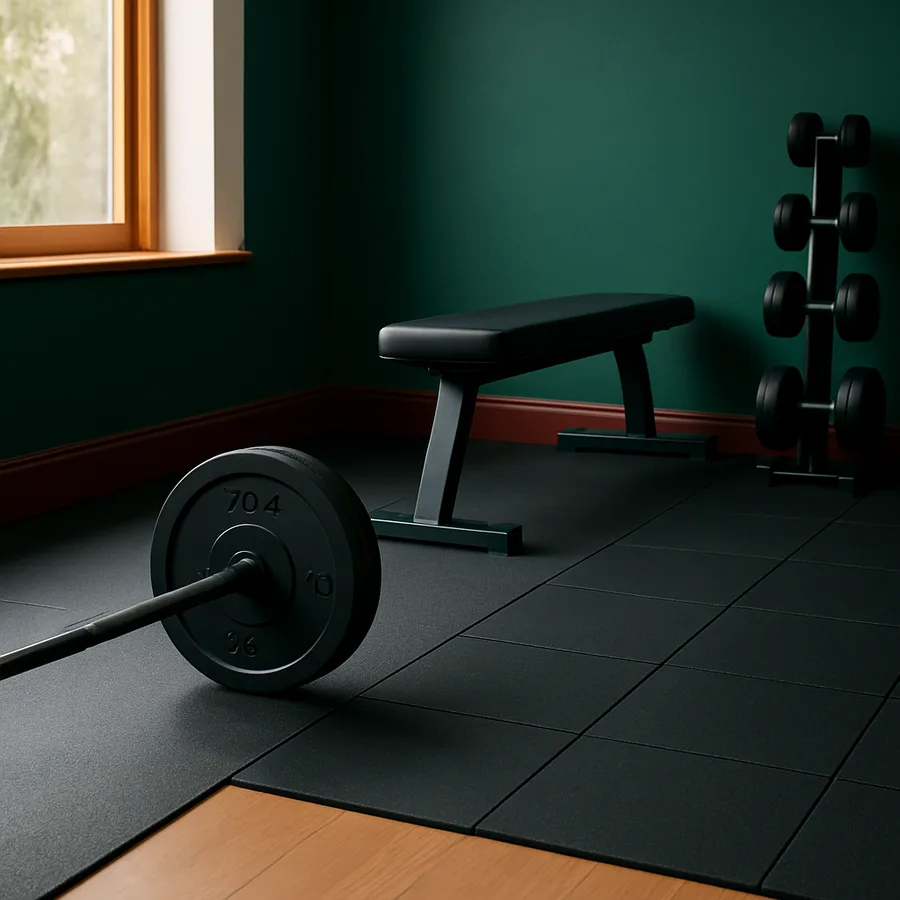
Choosing the right home gym rubber flooring is one of those decisions that looks simple on the showroom floor and becomes surprisingly nuanced once you start dropping weights, pushing sleds, and sweating through three workouts a week in the same room. The two dominant formats that homeowners weigh against each other are rolled rubber and interlocking rubber tiles, and the right answer depends on how you train, what the subfloor looks like, and how much punishment the surface will absorb in the first year. The National Strength and Conditioning Association (NSCA) has long emphasized that flooring directly influences lifter safety and joint loading, which is why the choice deserves more thought than most buyers give it.
In this review I want to give you a working framework for evaluating both products against each other, informed by what the American College of Sports Medicine (ACSM) says about impact attenuation, what the National Association of Home Builders (NAHB) recommends for residential loading, and what experienced gym builders actually report after five years of daily use. The goal is not to crown a universal winner. It is to walk you through thickness, density, seams, subfloor prep, and long-term maintenance so that you pick the product that matches your actual training. Are you a recreational lifter dropping 135 pounds from the hip, or do you regularly bail out of a 315-pound clean? Those two scenarios call for very different flooring specs.
How Rolled Rubber and Interlocking Tiles Actually Differ
Rolled rubber is typically sold in four-foot-wide rolls, ranging from six feet to fifty feet in length, in thicknesses between 3/8 inch and 3/4 inch. It is manufactured from recycled styrene-butadiene rubber (SBR), usually with a small percentage of EPDM color fleck if you pay a premium for aesthetics. The defining feature is that it installs as a continuous sheet, producing a nearly seamless surface once rolled into position and either dry-laid, double-sided-taped along the seams, or fully adhered with a urethane adhesive. The result is a surface that behaves like a single membrane: weight rolls across it without catching, plates slide without tripping, and moisture has far fewer pathways into the subfloor.
Interlocking rubber tiles, by contrast, come as puzzle-edge squares, usually 2 feet by 2 feet or 3 feet by 3 feet, in the same thickness range. The tiles lock together through a tongue-and-groove or dovetail edge, and they are almost always dry-laid without adhesive. The appeal is obvious: one person can install a 200-square-foot gym in an afternoon, and you can pull the tiles up and move them when you relocate. The trade-off is equally obvious. Every seam is a potential ingress point for moisture, dust, and bar whip, and a puzzle edge under a dropped 45-pound plate can lift, chip, or shift depending on the tile density.
One practical reader question I hear often is whether the visible seams on tiles actually cause problems during real training, or whether that worry is overstated. In my experience, seams matter most for three activities: rolling equipment like a loaded sled or prowler, dropping weights from overhead on a repeated basis, and any kind of floor work where skin contacts the rubber. If your training skews toward bodyweight circuits, dumbbell work, and moderate barbell lifts, seams are a non-issue. If you are doing Olympic lifting or CrossFit-style WODs, seams matter a lot.
Thickness, Density, and Impact Attenuation
The conversation about home gym rubber flooring almost always collapses into a conversation about thickness, but density is arguably more important. Shore A hardness measures how stiff the rubber is, and a typical recycled SBR product runs between 55 and 65 Shore A. Higher Shore A means a harder, less forgiving surface that transmits more impact to the subfloor but stands up to rolling loads better. Lower Shore A deadens impact more effectively but compresses faster under equipment feet. The Rubber Manufacturers Association publishes density guidelines that most reputable flooring vendors cite, and a density of at least 0.95 grams per cubic centimeter is considered the floor for serious gym use.
Thickness determines how much of a dropped weight's kinetic energy the rubber absorbs before the force reaches your subfloor. A 2019 study referenced by the ACSM found that impact attenuation improves non-linearly with thickness: moving from 3/8 inch to 1/2 inch reduces peak force transmission by roughly 18 percent, but moving from 1/2 inch to 3/4 inch cuts another 31 percent off the peak. That jump from 1/2 to 3/4 is where most serious home lifters land, and it is the thickness I recommend for any gym where barbells will be dropped on a concrete subfloor.
There is a wrinkle with interlocking tiles here. Because tiles rely on an edge profile to stay locked together, manufacturers have to moderate density: a tile that is too hard will not compress enough for the puzzle edge to bed properly, and the seams will telegraph through. That is why you rarely see interlocking tiles harder than 60 Shore A, while rolled rubber can push 68 Shore A without installation problems. If you lift heavy and drop often, this is a meaningful argument in favor of rolled.
Subfloor Prep and Moisture Management
Neither rolled rubber nor interlocking tiles should be installed without paying close attention to the subfloor underneath. The Resilient Floor Covering Institute (RFCI) publishes moisture testing protocols that apply directly to rubber products, and the consensus threshold is a maximum moisture vapor emission rate of 5 pounds per 1,000 square feet per 24 hours, measured using the calcium chloride test. Concrete slabs in basements routinely exceed this number, especially in homes built before modern vapor barriers were standard.
For rolled rubber, moisture management is more forgiving because the sheet itself acts as a partial vapor retarder, and a urethane adhesive bond further restricts migration. For interlocking tiles, every seam is a chimney for water vapor to rise through, and the underside of each tile can stay damp for weeks if the slab is pushing moisture. The Institute of Inspection, Cleaning and Restoration Certification (IICRC) has documented multiple cases where interlocking rubber over damp concrete led to hidden mold growth within 18 months. If your space is a below-grade basement, this is a serious concern and probably tips the decision toward rolled rubber installed over a 6-mil polyethylene vapor barrier.
On plywood subfloors above grade, the calculus shifts. Plywood breathes better, moisture is rarely the controlling issue, and interlocking tiles perform well because their dry-lay installation avoids trapping adhesive fumes in the home. A reader once asked me whether it was acceptable to install rolled rubber directly over carpet in a spare bedroom gym, and the answer is a reluctant no: carpet compresses unpredictably under equipment feet and allows the rubber to rock, which defeats most of the stability you paid for.
Installation Realities for the DIY Homeowner
Installation is where the two products diverge most sharply. Interlocking tiles are genuinely DIY-friendly. A homeowner with a tape measure, a utility knife, and a straight edge can lay 300 square feet in three to four hours. The tiles do not care about small variations in the subfloor, and border tiles can be trimmed in place with a sharp blade. The only real mistake people make is skipping the dry-layout step before committing to cuts along the walls.
Rolled rubber is a different animal. A 3/4-inch roll 25 feet long weighs around 400 pounds, which means you need two strong adults and a plan to move it from the driveway to the gym. Cutting rolled rubber requires a fresh utility knife blade every 10 feet of cut, a straight edge, and patience. Seams need to land along the length of the roll, not across it, and if you are using urethane adhesive you have to commit to the cut position before the glue skins over. Most homeowners who install rolled rubber say the experience is memorable for the wrong reasons. That said, the finished result is worth the effort for a dedicated training space.
One decision that trips people up is whether to adhere rolled rubber or leave it dry-laid. Dry-lay is fine for spaces under 200 square feet with furniture around the perimeter holding the edges down. For larger spaces, or for any gym where equipment rolls across the surface, full adhesion is the right call. The NAHB Remodelers Council has noted that floating rubber floors over 250 square feet show measurable edge curl within 24 months of installation.
Cost, Longevity, and Total Ownership
On a per-square-foot basis, the two products are closer than most buyers expect. Rolled rubber in 3/4-inch thickness typically runs between $4.50 and $7.50 per square foot delivered. Interlocking tiles in the same thickness run $3.75 to $6.25 per square foot. Installation costs reverse the math. Professional installation of rolled rubber with adhesive averages $2.25 per square foot, while interlocking tile installation, if you hire it out, is about $0.85 per square foot. For a 400-square-foot gym, the total installed cost difference often lands within $300 of each other, which is noise relative to the equipment budget.
Longevity is where rolled rubber pulls ahead. A properly installed rolled rubber floor, adhered to a clean concrete subfloor, will last 15 to 20 years of heavy residential use with minimal visible wear. Interlocking tiles, especially in the high-traffic drop zone under the barbell, typically show edge wear and seam lifting at the seven to ten year mark, and most owners end up replacing a handful of tiles along the way. Commercial gym operators surveyed by IHRSA reported that rolled rubber replacement cycles averaged 11.4 years in their facilities, compared to 6.8 years for interlocking products.
Resale is an underrated factor. Interlocking tiles can be pulled up and moved to a new house, which gives the product a residual value that rolled rubber cannot match. If you rent, if you plan to move within five years, or if you are building a gym that may transition to a different room, interlocking tiles retain meaningful value. Rolled rubber, once adhered, is a permanent improvement to the home and usually gets written off as a sunk cost.
Safety, Hygiene, and Odor Considerations
The question of whether rubber flooring is safe for indoor use comes up frequently, and it deserves a direct answer. Recycled SBR rubber off-gasses volatile organic compounds, primarily in the first 30 to 90 days after installation. The Environmental Protection Agency has studied indoor rubber surfaces extensively and concluded that properly ventilated installations pose no measurable health risk to adult occupants, though they recommend a break-in period of at least two weeks with windows open and HVAC running before heavy use. If you are unusually sensitive to odors, EPDM-blend or virgin rubber products cost roughly 40 percent more but off-gas far less.
Hygiene favors rolled rubber by a significant margin. A continuous surface can be damp-mopped with a pH-neutral cleaner, and sweat does not pool in seams. Interlocking tiles require periodic disassembly and cleaning underneath, because hair, dust, and microbial residue accumulate at the joint lines. A reader asked me recently whether this was truly a problem in a dry, well-ventilated space, and the honest answer is that it depends on how often you train shirtless and how humid the room runs. In a converted garage with occasional use, it is a minor concern. In a daily-use studio, it is a real maintenance burden.
Slip resistance is similar between the two products when new. The National Floor Safety Institute uses a dynamic coefficient of friction benchmark of 0.42 for residential wet surfaces, and both rolled rubber and interlocking tiles comfortably exceed that rating when clean. Where they differ is in the presence of chalk and sweat. Tiles tend to develop slick spots at the seams where liquid collects, while rolled rubber fouls evenly and can be wiped down in a single pass.
Conclusion
If you are building a permanent home gym in a space you own, expect to train there for more than five years, and plan to do any combination of barbell work, dropped lifts, or rolling equipment, rolled rubber at 3/4-inch thickness is the defensible choice. It costs more in labor, demands more from the installation process, and forgives fewer mistakes in the subfloor, but it delivers a surface that behaves like commercial gym flooring and ages gracefully for the better part of two decades. The investment pencils out over the life of the installation, and the daily training experience is materially better than a tiled alternative.
If your situation is more provisional, if you rent, if you share the space with a kid's playroom, or if your training profile skews toward moderate loads and bodyweight work, interlocking tiles are an excellent product that solves 85 percent of the problem at 60 percent of the effort. Do not treat the choice as a compromise. Tile manufacturers have iterated hard on edge geometry and density over the past decade, and a 3/4-inch premium tile from a reputable vendor will outperform budget rolled rubber from a discount supplier every day of the week. Match the product to your training and your living situation, not to what forum posters insist is the only serious choice.
Regardless of which format you choose, pay attention to the three fundamentals that determine long-term outcomes: verify moisture conditions on your subfloor before ordering, specify thickness and density appropriate to your lifting loads, and commit to the installation method the manufacturer actually recommends rather than shortcutting to save an afternoon. Organizations like the NSCA, ACSM, and RFCI all converge on the same point: flooring is infrastructure, not decoration, and the choices you make on day one echo through every workout for years afterward. Do your homework on the front end, and the surface underneath you will disappear from your attention, which is exactly what good flooring is supposed to do.
Ready to make the call? Pull out a tape measure this weekend, sketch your gym footprint including the drop zone, and request samples of both rolled rubber and interlocking tiles from at least two vendors before you commit. Feeling the products in your hand, flexing them for stiffness, and comparing the density against the specs on the data sheet will tell you more in five minutes than any online review. For authoritative guidance as you evaluate, consult the published standards from the National Strength and Conditioning Association, review the installation protocols from the Resilient Floor Covering Institute, and cross-reference the moisture testing guidance published by the IICRC before finalizing your order.
More Articles You May Like



Comments
Post a Comment