Frameless Glass Steam Shower Doors That Seal Properly
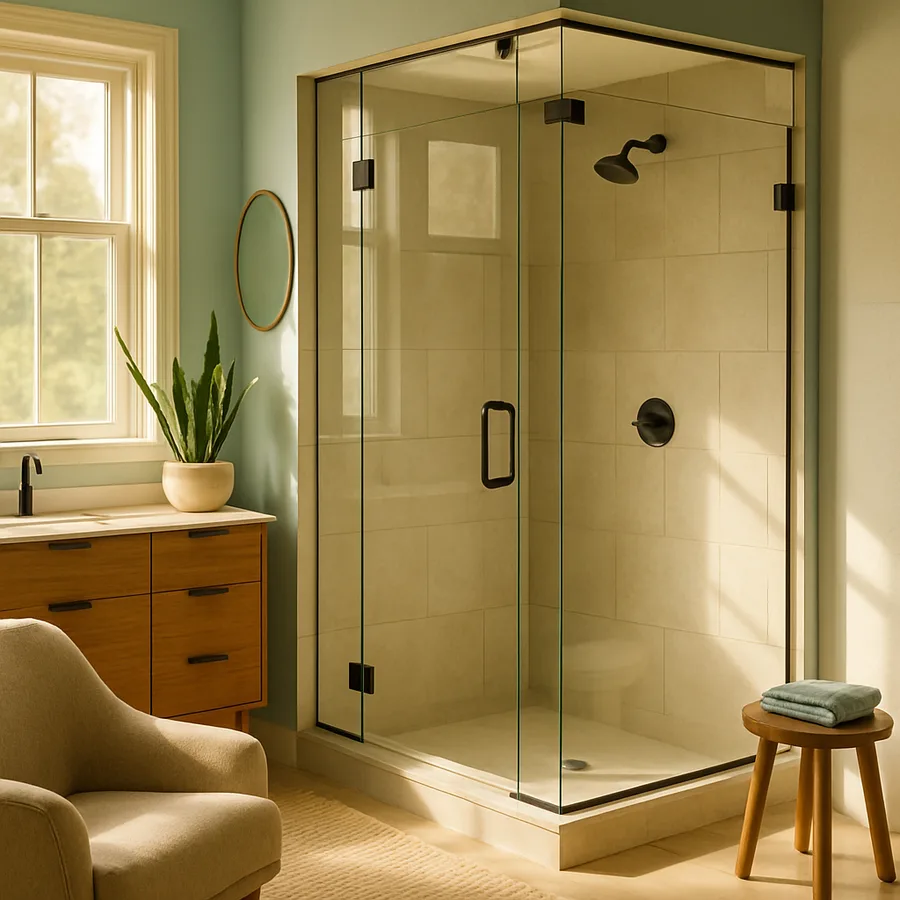
A frameless glass steam shower door has to do something ordinary doors do not: hold hundred-and-fifteen-degree vapor inside a compartment tightly enough that the generator can reach and maintain target temperature. Ordinary shower doors leak air constantly because they were designed to let moisture escape rather than trap it, and installing a standard frameless door on a steam enclosure guarantees a miserable experience. The generator runs continuously, the compartment never fully heats, condensate pours from every gap, and the homeowner concludes the steam feature was a mistake. Nine times out of ten, the mistake was specifying the wrong door.
This article covers what makes a frameless glass door actually capable of sealing a steam shower. The short version: full-height glass to the ceiling, continuous gaskets at every edge, a transom panel or dedicated vent for post-session air exchange, and hardware rated for sustained exposure to hot moist air. The long version involves manufacturers, standards bodies, tempering specs, and tradeoffs that matter. According to a U.S. Bathroom Trends report from Houzz, steam showers were the single fastest-growing premium bath feature, and industry installers report that door-related failures account for roughly one in three service calls. Getting the door right removes that risk entirely.
Why Standard Frameless Doors Fail in Steam Enclosures
A standard frameless glass shower door runs to roughly seventy-eight inches of height and leaves a gap at the top for ventilation, a small gap under the door for drain water to escape, and minimal sealing at the hinge pivot. This is a perfect design for a conventional shower because it promotes drying after use. In a steam enclosure, it is catastrophic. Every gap becomes a steam exit path, and the generator has to keep producing steam faster than the door leaks it, which usually means never reaching target temperature at all.
The physics are simple and unforgiving. Steam at one hundred fifteen degrees is less dense than ambient air at seventy degrees, so it rises to the top of the compartment and escapes through any opening near the ceiling. A standard door with a ten-inch gap above the top rail will lose roughly twenty percent of generated steam every minute the generator runs, and an uninsulated top transom loses even more. The Tile Council of North America method SR613 recognizes this implicitly by requiring steam enclosures to be fully sealed, and any serious steam generator manufacturer refuses to warranty performance in non-sealed enclosures.
Condensate management is the second failure mode. Steam that touches cold glass condenses instantly into liquid water, which runs down the interior glass face toward the bottom. A standard door with a small gap under it lets this water escape, but a steam door sealed tightly to the floor must manage condensate differently. Professional steam door designs include a small interior sill that channels condensate to the drain, or a magnetic bottom sweep that allows water to pass under the door only when the bather opens it. Have you ever mopped condensate puddles after a shower? A properly sealed steam door eliminates that chore entirely.
Full-Height Construction and the Transom Question
A frameless glass steam shower door must run to the ceiling of the enclosure, which almost always means an eight-foot or nine-foot glass panel. For doors taller than eighty-four inches, the glass must be tempered or laminated safety glass compliant with ANSI Z97.1 or CPSC 16 CFR 1201, and the panel thickness typically steps up from three-eighths inch to half inch for structural rigidity. Hinges and fasteners must be rated for the added weight, which is why steam door hardware looks heavier than standard shower-door hardware.
The transom, if present, seals the gap between the top of the door and the ceiling. Transoms can be fixed glass panels attached above the door, or the door itself can run the full ceiling height with an integrated transom vent. Integrated vents are motorized louvers that open automatically at the end of a steam session, flushing moist air out of the enclosure and drying surfaces before mildew can establish. The Home Ventilating Institute recommends at least thirty minutes of active ventilation after every steam session, and integrated vents automate this step without homeowner intervention. Additional installer guidance on vent sizing is published through the PHCC.
Fixed transoms are cheaper but force the homeowner to crack the door open after sessions to vent moisture. Motorized transom vents cost between eight hundred and eighteen hundred dollars installed and they pay for themselves in mold prevention and finish longevity. Either option is dramatically better than the typical fail mode of a sealed-but-unvented enclosure where moisture lingers, tile grout absorbs water, and silicone joints fail within five years. Ask any tile setter who has repaired a steam enclosure about this, and they will tell you ventilation decides the lifespan of the room.
Gaskets, Sweeps, and the Continuous Seal Requirement
Gasketing is where the actual sealing work happens. A properly specified frameless glass steam shower door uses four different gasket types, each engineered for a specific edge condition. A soft silicone rubber gasket seals the hinge side against the jamb post, compressed when the door closes. A magnetic strip along the strike edge seals against a matching magnetic strip on the adjacent fixed panel or jamb. A flexible PVC sweep seals the bottom edge against the shower curb or threshold. A compression gasket or fin seal addresses the top edge against the transom or ceiling.
Hinge design matters because hinges interrupt the gasket line. Wall-mounted pivot hinges with integrated gasket pockets create a continuous seal around the pivot shaft, while cheap friction hinges leave gaps that invite leaks. Premium steam-rated hinges carry UL or IAPMO listings, and the International Association of Plumbing and Mechanical Officials maintains a database of certified products at IAPMO. Do not substitute standard hinges to save money; the sealing at the hinge is the single most failure-prone point in a steam door.
Bottom sweeps deserve special attention because they sit in puddled water every session. Standard PVC sweeps harden and crack within three to five years, while silicone sweeps flex and recover indefinitely. The American Society of Mechanical Engineers publishes relevant material standards, and reputable manufacturers publish material data sheets that identify the elastomer compound. Ask for the data sheet and look for high-temperature silicone or EPDM rated for at least two hundred fifty degrees Fahrenheit continuous service, well above the operating temperature of any steam shower.
Glass Tempering, Thickness, and Weight Considerations
Tempering makes shower glass safe. Annealed glass shatters into large sharp shards, while properly tempered glass breaks into small rounded pebbles. The Consumer Product Safety Commission regulation 16 CFR 1201 requires all shower glass to meet Category II safety glazing performance, which is verified through impact testing. Any reputable glazier delivers tempered panels by default, but it is worth confirming the certification mark on the glass edge before installation because retrofit mistakes have led to serious injuries.
Thickness affects both rigidity and weight. Three-eighths-inch glass is the minimum for frameless doors up to seventy-two inches tall, while half-inch glass is standard for doors above seventy-eight inches or panels exceeding thirty-six inches in width. A full-height steam door in half-inch glass weighs roughly three hundred fifty pounds for an eight-foot panel at twenty-four inches wide, which puts real load on hinges and jamb framing. Expect your installer to verify blocking behind the jamb wall before hanging the door, because drywall anchors alone will not hold.
Laminated glass is an increasingly popular alternative, especially for tall steam doors above eight feet. Laminated glass sandwiches a clear polyvinyl butyral film between two glass panels, and the film holds broken shards in place if the glass fails, eliminating the risk of a heavy panel collapsing onto a bather. The National Glass Association maintains design guidance for laminated and tempered architectural glass, and laminated construction is becoming the professional default for any door panel exceeding eighty inches in height in residential applications.
Waterproofing Integration and Code Compliance
A frameless glass steam shower door cannot be treated as a standalone product. It must integrate with the waterproofing membrane of the enclosure, the ceiling slope, the threshold detail, and the drain layout. The International Code Council Chapter 14 governs interior wall finish materials in wet locations, and any contractor building a steam enclosure should produce a waterproofing mockup before tile work begins. The mockup should show continuous vapor retarder behind the jamb stud, sealed transitions to the threshold, and compatible adhesives at every gasket contact point.
Threshold details are where sloppy installations leak. A properly built steam shower has a cast-in or dimensional lumber threshold that provides a solid base for the door sweep and a continuous waterproof surface from compartment to bathroom floor. Tile setters sometimes shortcut this detail with a simple tile curb and grout, which fails quickly under daily steam exposure. Insist on a dedicated threshold component and flash it with a vapor-impermeable membrane lapped into both the shower floor and the bathroom floor waterproofing.
Ceiling intersection is equally critical. Full-height doors that seal to the ceiling need a compatible ceiling material that can accept the gasket and survive long-term vapor exposure. Tile ceilings with cement board backing handle this well. Drywall ceilings, even moisture-resistant drywall, degrade at the gasket line within five to seven years. The Tile Council of North America method SR613 specifically addresses ceiling details for steam showers, and compliance with that method protects the installation against premature failure. For broader clearance standards around the enclosure, refer to the NKBA. Ask your tile setter for a SR613 compliance confirmation in writing.
Maintenance, Cleaning, and Keeping the Seal Tight
Gaskets last longer when they stay clean. Soap, body oils, and hard-water deposits accumulate on gasket surfaces and reduce their ability to compress tightly against mating surfaces. A weekly wipe-down with a mild soap solution preserves gasket flexibility for a decade or more, while neglected gaskets stiffen and crack within two or three years. The American Cleaning Institute publishes guidance on safe cleaning chemistries for rubber and silicone surfaces, and any cleaner compatible with those elastomers will do the job without degrading the seal.
Glass cleaning matters as much as gasket care. Hard water etches glass over time, producing a hazy surface that cannot be restored without professional polishing. A weekly squeegee after each session, followed by a monthly cleaning with a pH-neutral glass cleaner, keeps the surface clear for decades. Applying a silica-based protective coating every six to twelve months reduces mineral adhesion and makes routine cleaning significantly easier. Does your bathroom have hard water above seven grains per gallon? A whole-house softener is almost mandatory for steam enclosures.
Annual inspection catches problems before they escalate. Once per year, inspect every gasket, sweep, and hinge for wear, cracks, or misalignment. Replace any gasket that shows hardening or loss of compression, which usually runs thirty to one hundred dollars per gasket depending on length and profile. Check the magnetic strip along the strike edge for debris that might reduce magnetic pull, and clean the pivot pocket in wall-mounted hinges to prevent corrosion. A five-minute annual inspection routine extends door lifespan from ten years to twenty-five years and keeps the enclosure performing as it did on day one.
Conclusion
A frameless glass steam shower door that seals properly is not an upgrade to a standard frameless door. It is a fundamentally different product, engineered from the hinge up to hold pressurized steam vapor inside a heated compartment for the duration of a session without leaking. Every decision from glass thickness to gasket material to transom ventilation compounds with the others, and a single wrong choice in the specification stage compromises the whole system. Homeowners who treat the door as a fixture purchase rather than a system component are the ones who end up with disappointed expectations and expensive rework.
The right approach starts with the generator manufacturer's installation manual. Every reputable steam generator maker publishes door and enclosure specifications that must be met for warranty coverage, and those specifications include gasket coverage, transom height, waterproofing standard, and ceiling slope. Follow the manufacturer's specification exactly, then add a transom vent if the manual does not already require one. Insist on UL-listed or IAPMO-certified hardware, full-height glass to the ceiling, and continuous gasket coverage at every edge. Compromises at this level produce failures that are painful to diagnose and expensive to repair years later.
Work with a glazier experienced in steam installations specifically. Ask for references, photographs of completed enclosures, and descriptions of previous failures and how they were resolved. Visit a completed enclosure during an active steam session if possible, and pay attention to how much condensate escapes around the door, how quickly the compartment reaches temperature, and how the glazier explains the gasket and sealing strategy. A confident installer welcomes these questions because the answers demonstrate expertise that casual installers cannot fake.
Ready to specify a steam shower door that seals correctly and lasts for decades? Book a free consultation with one of our Interior Bliss steam specialists. We will review your generator manufacturer's requirements, evaluate your enclosure dimensions and ceiling height, and recommend a door and hardware package matched to your specific installation. The door is the difference between a steam feature you use every week and one that disappoints you by the second winter, and the right specification starts with a conversation about how you actually want your enclosure to perform.
More Articles You May Like



Comments
Post a Comment