Foam Crown Molding vs Wood: Cost and Appearance Differences
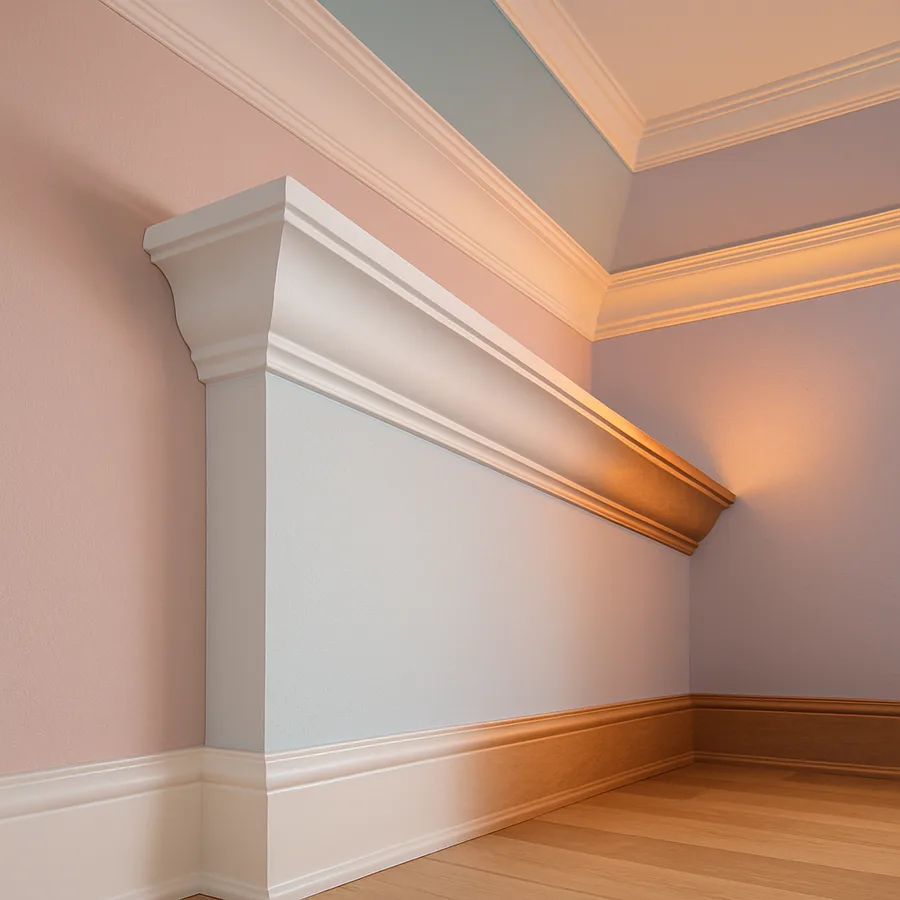
Walk into any big-box trim aisle and you will see two visibly different product families labeled as crown molding. One is milled wood or primed MDF, heavy in your hand and crisp along its edges. The other is polyurethane foam, light as a cardboard tube and often pre-finished with a factory primer. Both claim to deliver the same architectural outcome. Both can look convincing when installed. And yet the two materials behave differently at every stage of the project: price, cutting, fastening, finishing, durability, and eventual resale perception. Choosing between them is not a trivial decision, and most online comparisons skip over the details that actually matter once the pieces are on the wall.
A 2024 industry analysis from the National Association of Home Builders (NAHB) estimated the U.S. residential molding and trim market at roughly $4.2 billion annually, with polyurethane foam capturing 14% of the unit volume despite holding only about 8% of the dollar volume. That disparity tells the core economic story: foam is cheaper, and the market knows it. What the numbers do not tell you is whether that cost difference represents genuine value or a long-term regret. This article unpacks both sides.
Price Comparison Per Linear Foot
Hard numbers first. Primed MDF crown in a four-inch Colonial profile runs $1.80 to $3.50 per linear foot at national big-box retailers, depending on profile complexity. Finger-jointed primed pine at the same profile runs $2.50 to $5.00 per linear foot. Solid poplar, the paint-grade hardwood standard, runs $4.50 to $9.00 per linear foot. Stain-grade species (red oak, cherry, white oak) run $8 to $22 per linear foot, scaling with profile and species rarity.
Polyurethane foam crown in the same four-inch Colonial profile runs $2.50 to $6.00 per linear foot from major brands like Focal Point Architectural Products and Fypon. For simple profiles, that puts foam near the low end of paint-grade wood; for complex, ornate profiles with dentils, egg-and-dart, or multi-step build-ups, foam becomes dramatically cheaper than the equivalent carved wood, sometimes by a factor of four or more. That ornamental-complexity crossover is where foam wins decisively on cost.
Installation labor narrows the gap. NARI-certified installers typically charge the same linear-foot rate for foam and wood when the profiles and room geometry are comparable, which surprises many homeowners. Why? Because foam requires specialized adhesive, careful handling to avoid denting, and the same level of cope-versus-miter decision-making as wood. The National Association of the Remodeling Industry publishes regional pricing guides that confirm this parity.
How Each Material Reads on the Wall
Appearance is where the debate gets interesting. In simple painted profiles mounted to a standard drywall wall, a well-installed and properly caulked foam crown is genuinely difficult to distinguish from MDF or primed wood at normal viewing distances. The edges are crisp, the shadow lines are correct, and the paint finish is identical. Homeowners who tell themselves they will "always be able to tell" are often wrong, especially in rooms with moderate light.
The difference appears in three specific conditions. First, in raking light, foam sometimes shows a subtle surface texture that wood does not, particularly on the flat sections between decorative elements. Second, in ornate profiles with deep shadow pockets, foam can appear slightly "softer" around the sharpest interior details because the molding process cannot quite replicate the crispness of a sharp router bit. Third, at close viewing distances (less than three feet), the weight difference becomes visible when trim pieces are tapped or touched, because foam flexes subtly under hand pressure in a way wood does not.
Where does your room fall on those three axes? A powder room with fluorescent overhead light and a close ceiling will expose foam's weaknesses more readily than a great room with ambient lighting and a vaulted ceiling. Have you walked the room at different times of day to see how raking light plays across the wall-ceiling junction? That fifteen-minute exercise is the single best way to predict which material will disappoint you later.
Durability, Dents, and Long-Term Behavior
Wood is a dimensional material. It expands and contracts with humidity, shrinks slightly over its first two years after installation, and eventually develops small gaps at miters and copes that require periodic caulking maintenance. It resists impact remarkably well; a door slammed into a wood crown will usually leave a scar but not a structural failure.
Foam is dimensionally stable to an almost absurd degree. It does not expand, does not contract, does not warp, does not rot, and does not support mold or mildew growth. The American Society for Testing and Materials (ASTM) standards for rigid cellular polyurethane (ASTM D1622, D1623) describe a material that is essentially inert under residential conditions, and manufacturer warranties of 10 to 25 years reflect that stability. What foam lacks is impact resistance. A vacuum cleaner handle swung into foam crown will crush a divot that cannot be sanded out; the only repair is filler, feathering, and repainting.
For homes with active children, pets, or heavy furniture moves, wood tolerates abuse better in the long run. For homes with stable adult occupancy, pristine conditions, or locations where moisture is a factor (bathrooms, basements, kitchens near the stove), foam's immunity to moisture-driven failure makes it the more durable choice in practice. The Environmental Protection Agency (EPA) publishes indoor moisture guidance that bears directly on material selection in humidity-prone rooms, and foam repeatedly emerges as the recommended option in those technical documents.
Installation: Tools, Adhesives, and Fastening
Foam and wood install using overlapping but not identical technique. Both can be cut on a compound miter saw, though foam cuts best with a fine-tooth finish blade rather than a carbide rip blade; coarser blades tear the cell structure and leave fuzzy edges. Both can be coped, though coping foam requires a very sharp utility knife rather than a coping saw; a saw tears the foam at the profile edge.
Fastening diverges sharply. Wood crown installs with 15- or 16-gauge finish nails driven into framing, supplemented by construction adhesive on the back of the molding for long runs. Foam crown installs primarily with polyurethane adhesive (a specialty product sold under brand names like PL Premium and Loctite PL 375), supplemented by small 18-gauge brad nails used only to hold pieces in position while the adhesive cures. Driving heavy finish nails into foam crushes the material around the nail head and telegraphs through paint.
The installation speed advantage goes to foam for simple rooms. Because foam is light, a single installer can hold and position a sixteen-foot run without help, whereas the same wood run requires two people. For complex rooms with tight tolerances and ornate joints, wood is arguably faster because each correction is a recut rather than an adhesive cleanup. The Fine Homebuilding video library includes side-by-side time studies on this exact comparison, and the results are closer than most homeowners assume.
Finishing, Painting, and Repair Considerations
Both materials accept paint well, but the prep is different. Wood and MDF require priming (oil or shellac on bare wood; primer is usually applied at the factory on MDF) followed by two or three coats of finish paint. Foam typically ships pre-primed with a finish suitable for immediate topcoating; some products even ship pre-painted in bright white and require no additional finishing unless the homeowner wants a custom color.
Stained finishes are the exception that proves the rule. Foam cannot be stained; its surface is non-porous and takes color only as paint. For stain-grade applications (Craftsman interiors, historic restorations, library or study millwork), wood remains mandatory. The American Institute of Architects (AIA) historic-preservation technical briefs specifically call out the inauthenticity of painted substitutes in stain-grade restoration contexts, and some historic-district review boards prohibit foam substitutes outright.
Repair economics tilt the other way. A damaged section of wood crown can sometimes be repaired in place with filler, sanding, and touch-up paint; severely damaged sections require splicing in a new piece, which a skilled carpenter can do invisibly. A damaged section of foam crown usually requires replacement of the entire damaged piece, but because foam is cheaper and comes off the wall relatively cleanly with a utility knife at the adhesive line, the total repair cost is often similar. The American Society of Interior Designers (ASID) renovation cost guides estimate typical crown molding repair at $75 to $250 per section regardless of material.
Resale Perception and Buyer Behavior
Does foam crown hurt resale value? The honest answer is: rarely, but sometimes. In homes priced below the regional median, buyers and inspectors almost never distinguish between foam and wood crown, and most MLS listings do not specify material. In homes priced above the regional median, particularly in price bands where architectural authenticity matters (historic districts, custom-built homes, high-end condos), foam crown is more likely to be noticed by knowledgeable buyers and their agents.
The National Association of Realtors (NAR) Remodeling Impact Report consistently lists crown molding as one of the highest-ROI interior upgrades, but its data does not distinguish by material, suggesting that the effect is driven by the presence of crown rather than the specific substrate. A 2023 realtor survey conducted by Architectural Digest found that only 12% of respondents could reliably distinguish foam from wood crown in staged photographs, and even fewer could do so without physically touching the molding.
A practical resale rule: use foam in bedrooms, bathrooms, and utility spaces without hesitation, and consider wood or MDF in the entry foyer, living room, and any room a buyer will photograph. The incremental cost of using wood in the three most-photographed rooms in a typical home is often under $400, a rounding error against the total renovation budget. Is that incremental cost worth it for your specific market? Your local listing agent can answer that question better than any national generalization.
Which to Choose for Which Room
With all the variables in hand, a rational specification emerges. For a typical three-bedroom, two-bath home with moderate ceiling heights and conventional architecture, a mixed specification often produces the best blend of cost, appearance, and durability. Use MDF or poplar in the living room, dining room, and entry foyer. Use polyurethane foam in bedrooms, closets, and any room where moisture or simple budget limits are binding constraints. Use cellular PVC or foam in bathrooms and laundry rooms where moisture resistance is critical. Use stain-grade hardwood only in rooms intentionally designed around natural wood finishes.
Profile complexity modifies this default. Ornate Colonial, Victorian, or Baroque profiles with deep shadow lines and multiple decorative elements are significantly cheaper in foam, and the cost differential often justifies foam even in primary rooms. Simple Modern reveals and flat Craftsman build-ups, by contrast, are about the same price in either material, so the wood choice becomes an almost free upgrade in those cases.
The decision gets easier when you approach it by room rather than by house. Walk through each space, note the ceiling height, the likely viewing distance, the lighting conditions, the moisture exposure, and the architectural character, then specify the material that fits. Mixed specifications are normal in custom homes and nothing to apologize for.
Conclusion: The Smart-Money Specification
The foam-versus-wood debate is really a debate about where to spend money and where to save it. Foam is not categorically worse than wood, and wood is not categorically better than foam. Each material has conditions under which it is the obviously correct choice, and most homes benefit from a thoughtful mix rather than a blanket specification. The worst outcomes come from buying whichever material happened to be on sale the day the project started, without considering the architectural context of the room.
Budget realistically for both materials and labor. Published data from NAHB, NARI, and NAR all point in the same direction: crown molding is a high-impact upgrade regardless of substrate, and the material premium for wood is often more about owner satisfaction than buyer perception. If you intend to live in the home for ten or more years, buy the material that makes you happiest to see every morning. If you intend to sell within three years, buy the material that maximizes return per dollar in your specific market.
Remember that installation quality dominates material quality in the final visual result. A foam crown cut precisely, caulked meticulously, and painted patiently will look better than a wood crown installed carelessly. Invest in the installer, whether that is your own weekend time or a carpenter's day rate, and choose the material that matches your project's specific demands. Organizations like AIA, ASID, NAHB, and NARI all publish supporting documentation worth consulting before final specification.
Not sure which material suits your room? Download the Interior Bliss crown-material decision checklist, take our three-minute room assessment quiz, and get a free room-by-room specification sheet tailored to your home's ceiling heights, humidity profile, and viewing conditions. Share your results with our reader forum and get feedback from working interior designers within forty-eight hours.
More Articles You May Like



Comments
Post a Comment