Attic Playroom Designs That Use Every Awkward Corner
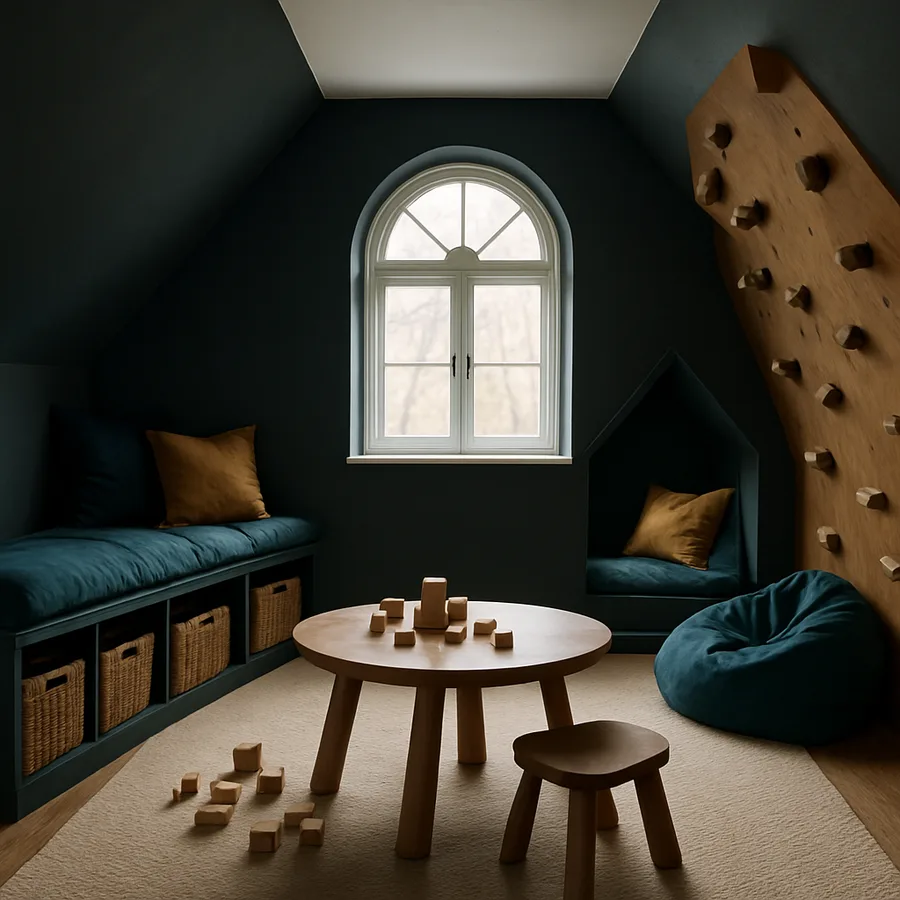
Children see an attic differently than adults do. Where a grown-up notices the sloped ceiling, the low kneewall, and the awkward chimney chase, a seven-year-old sees a fort, a tunnel, and a secret reading cave. A well-designed attic playroom leans into that childlike imagination rather than flattening it into a generic rectangle. The eaves become tents. The dormer becomes a puppet theater. The triangular corner under the rafter becomes a beanbag cave. Every awkward inch gets a job, and the room becomes the favorite space in the house.
The appeal is not just aesthetic. The American Academy of Pediatrics has long emphasized the developmental importance of open-ended, unstructured play, and a 2023 report from the American Society of Interior Designers (ASID) on family-focused residential design found that homes with a dedicated play space saw measurably reduced clutter in common living areas, with 74% of surveyed parents reporting better household organization after adding one. Attics are often the most underused floor in the house, making them the logical home for a room the kids actually want to spend time in.
Safety First: The Non-Negotiable Foundation
Before any paint or rug arrives, the attic must be genuinely safe for children. That starts with the stairs. The International Code Council (ICC) residential code specifies minimum stair widths, maximum riser heights of 7.75 inches, minimum tread depths of 10 inches, and handrails on at least one side for any staircase serving a habitable room. Spiral stairs, ship's ladders, and folding attic stairs are usually not acceptable for a playroom serving small children, and most jurisdictions will not issue a certificate of occupancy without compliant stairs.
Egress is equally important. If the playroom will also function as a sleeping space for guests or sleepovers, it must include a compliant emergency escape and rescue opening, typically a window with a minimum clear opening of 5.7 square feet and a sill no higher than 44 inches above the floor. Even when the room is purely play, adding a proper egress window is a future-proofing move that also floods the space with daylight. Install window guards with release mechanisms that meet the ASTM standard for fall prevention, and cover any exposed rafters with padded edge guards to prevent the inevitable running-into-things incidents.
Mapping the Awkward Corners
Every attic has its quirks, and the first design move is to name them. Walk the room with a notebook and list the problem zones. There is always a low triangular eave cavity, often a chimney chase that blocks the center of the floor, sometimes a plumbing stack that threads up through the space, and usually at least one structural collar tie running across at head height. Rather than hiding these features, the most successful playrooms assign each one a specific use.
The low triangular eave becomes a carpeted crawl tunnel with a small arched door. The chimney chase becomes a vertical chalkboard wall or a magnetic paint feature. The plumbing stack gets boxed in with a curved column that doubles as a climbing pole. The collar tie becomes a swing-bar or a rope-ladder anchor after structural review. Ask yourself a simple question: what would a nine-year-old do with this corner if there were no furniture rules? That answer is almost always the right design.
Storage That Kids Can Actually Use
Play storage fails when it is designed for adults. Tall shelves, heavy lids, and opaque bins all defeat the goal, which is a child putting their own things away without a parent's intervention. The most effective approach uses low, open cubbies along the kneewall at heights a child can reach, soft fabric bins that are light enough for small hands, and picture labels for pre-readers or simple word labels for early readers. The kneewall cavity that defeats adult storage planning is exactly the right scale for kid storage.
Mix open and closed storage intentionally. Open shelves hold the toys in active rotation, which are easy to grab and easy to put back. Closed cabinets or labeled bins on higher shelves hold the seasonal rotation, arts-and-crafts supplies that need supervision, and outgrown items that are pending donation. Rotating toys in and out of active storage every few weeks is a favorite trick of early-childhood educators because familiar toys feel new again after a month on the shelf. The room stays less cluttered and the play stays more engaged.
Reading Nooks, Forts, and Quiet Zones
A playroom that is all active play quickly becomes exhausting for everyone in the house. Designing in at least one deliberate quiet zone gives children a place to decompress, read, or recover from sensory overload, which is especially valuable for neurodivergent kids. The deepest eave corner, the one that is too low for standing, is almost always the best spot. Line it with a snug twin mattress or a firm foam pad, add string lights along the ceiling, hang a curtain or a canopy across the opening, and stock a small bookshelf within reach.
The American Academy of Pediatrics has published guidance noting that quiet, low-stimulation spaces support self-regulation skills in children, and the Center on the Developing Child at Harvard University has similarly emphasized the importance of predictable retreat spaces during periods of overstimulation. A reading nook is not a luxury, it is a developmental tool hiding inside a charming design. Parents who have added one almost universally report that children use it more than predicted and ask to spend time in it unprompted.
Lighting inside a quiet nook should be warm, soft, and controllable by the child. A single plug-in puck light with a remote, a small clip-on reading lamp, or a string of battery-powered fairy lights all work beautifully and put the controls in reach of small hands. Avoid harsh overhead LEDs inside the nook itself, because the point is retreat, not interrogation. Consider adding a small bookshelf at arm height so a child can rotate books without leaving the nook, which deepens the sense of sanctuary.
Sound matters too. A well-made quiet nook feels genuinely quieter than the rest of the room, and that is usually because soft surfaces have been layered deliberately. A cushion, a wool throw, a fabric canopy, and a rug all absorb frequencies and drop ambient noise noticeably. Parents of highly sensitive children often report that a thoughtfully lined nook becomes the most effective self-regulation tool in the house, better than any timer, chart, or bedtime script.
Active Play: Climbing, Swinging, and Moving
Attic playrooms are often tall enough for surprising amounts of active play when the structure is properly evaluated. A licensed engineer can assess whether a collar tie or purlin can support a swing, a trapeze, a climbing rope, or an aerial yoga hammock, and the cost of that evaluation is usually modest compared to the fun and developmental value of the resulting feature. Indoor climbing walls, even modest ones, promote motor development and vestibular integration, which occupational therapists regularly highlight as essential childhood inputs.
Safety surfacing under any climbing or swinging feature is essential. The ASTM F1292 standard provides impact attenuation guidance for playground surfaces, and residential analogs include thick gym-style foam tiles, dense area rugs layered over carpet pad, and shredded foam pits. Would you be willing to commit a corner of the room to a permanent crash pad that is always ready for use? Families who do report that the crash pad becomes the single most used feature in the room, for everything from somersault practice to reading forts to sibling wrestling matches.
Consider installing a Pikler triangle, a small indoor trampoline, or a balance beam for younger children, all of which support gross motor development without requiring structural anchoring. For older children, modular climbing holds bolted into a reinforced wall section can create a small bouldering zone with adult supervision. The combination of unstructured climbing, swinging, and balancing inputs is exactly what pediatric occupational therapists recommend for vestibular and proprioceptive development, and an attic playroom may be the easiest place in the house to offer all three in one room.
Do not forget the role of boring practicality. Clear floor space, not equipment, is the most important feature of an active-play zone. A rug that can be rolled up and stored along the kneewall, furniture on casters that rolls against the walls, and storage that closes away toys at the end of the day all keep the open floor open. The best active-play rooms are ones where the floor can be cleared in 60 seconds, turning the space from a cluttered chaos into an inviting open area for the next game.
Color, Sound, and the Sensory Envelope
Color in a playroom should energize without overwhelming. Bright primaries on every surface quickly exhaust even the most enthusiastic child, while an entirely neutral palette often feels adult and unwelcoming. The best approach usually layers a soft, warm neutral on the sloped ceilings and large wall areas, then introduces vivid color in rugs, bins, artwork, and a single feature wall such as a chalkboard or mural. That balance keeps the room feeling spacious while still reading as clearly a child's domain.
Acoustics matter more than most parents expect. A hard-surfaced attic playroom can amplify every shriek and ricochet it through the rest of the house, making the room unpleasant to be in and noisy from below. Cover at least 60% of the floor with a dense rug, add fabric wall hangings or acoustic panels, and upholster any seating in heavy woven fabric. The combination of absorption and cushioning drops the room's reverberation time significantly, and the household peace dividend is substantial.
Think too about how the playroom will evolve as the children grow. A room that is perfect for a toddler may feel babyish to a ten-year-old, and a room scaled to older kids can be intimidating for preschoolers. The most resilient attic playrooms design in a few flexible anchors, such as a full-height chalkboard wall, a long low shelf system, and a movable rug, and then let the accessories change out every few years. Picture labels give way to word labels, then to color-coded labels, then to open storage with no labels at all as children grow into more autonomous organization. Planning for change from the beginning is cheaper and kinder than rebuilding later.
Another longevity strategy is designing the room so it can gracefully convert to a teen hangout, guest suite, or home office once the children outgrow active play. A playroom that can become a study lounge with a paint change and a furniture swap is a far better long-term investment than one hardwired with permanent climbing features that are hard to remove. The NAHB and ASID both publish guidance on multi-generational and flexible residential design, and the same principles that make a home accessible to aging parents also make a playroom adaptable across childhood stages. The best attic playrooms quietly anticipate their own next chapter, which is a kindness to everyone who will live in the house over the next 20 years.
Conclusion
An attic playroom rewards creativity in a way that almost no other room does, because the sloped ceilings, tucked eaves, and structural oddities that frustrate adult designers are exactly the features that delight children. When safety is addressed first and the awkward corners are assigned jobs rather than hidden, the room becomes a daily destination rather than a seasonal storage overflow. Parents frequently report that the attic playroom changes household traffic patterns for years, pulling kids up and away from the living room screens.
The practical path is a straightforward sequence. Confirm that your stairs, egress, and smoke alarms meet ICC standards. Walk the attic and name every awkward corner with a specific purpose. Design storage at kid scale, with low shelves and picture labels that invite self-service cleanup. Carve out at least one deliberate quiet zone in the deepest eave. Plan active play features only after a licensed engineer has confirmed the structure can carry the loads. Finally, soften the acoustics and layer the color so the room feels energizing but not chaotic.
If you want to start this weekend, spend an hour in the attic with a tape measure and a sheet of graph paper. Mark every awkward corner, label each with a possible use, and ask your kids what they would want in each spot. Their answers may surprise you, and more importantly they may commit the children to caring about the space in a way that a top-down design never will. A playroom shared in the planning tends to be a playroom loved in the living.
Take the first step today. Schedule a free consultation with a local licensed contractor who has completed attic conversions, verify your attic's structural capacity with a qualified engineer, and begin sketching zones on graph paper with your children. Useful resources include the International Code Council residential code overview, the American Academy of Pediatrics guidance on play, and the NAHB remodeler directory. The most magical room in your house is probably hiding above your head.
More Articles You May Like



Comments
Post a Comment