Standalone Versus Whole House Air Purifier Comparison
Indoor air quality has moved from a niche concern to a mainstream household priority, and the marketplace now offers two fundamentally different solutions to the same problem. On one side sit standalone room air purifiers, compact appliances that scrub the air of a single space. On the other are whole house air purifiers, professionally installed systems that integrate directly with your central HVAC equipment to filter every cubic foot of conditioned air. Choosing between them is not simply a matter of budget. It is a question of how your home is built, how your family lives in it, and what you actually want filtered out of the air your children breathe at three in the morning.
The U.S. Environmental Protection Agency notes that Americans spend roughly 90 percent of their time indoors, where pollutant concentrations can be two to five times higher than typical outdoor levels. That single statistic explains the explosion of air purifier marketing across home improvement aisles, retailer landing pages, and Sunday morning television. But the marketing rarely explains the architectural and mechanical realities that decide whether you should buy a $300 tabletop unit, install a $1,500 in-duct media cabinet, or do both.
How Each System Cleans the Air
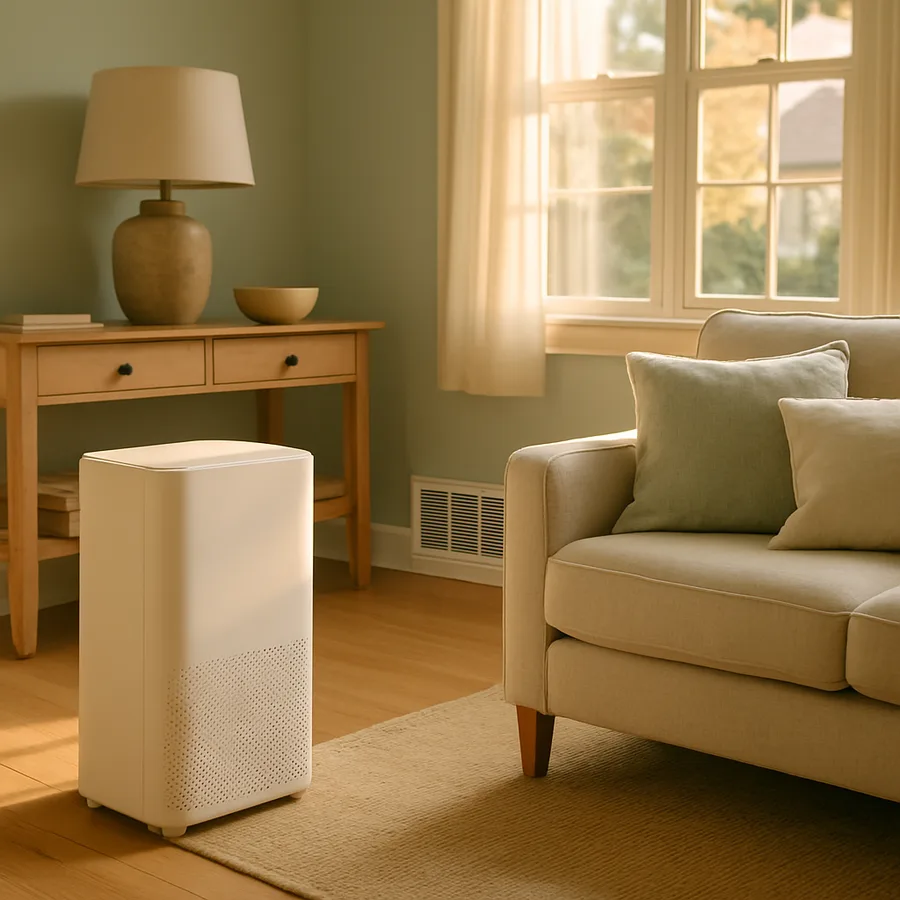
A standalone purifier is essentially a fan with a filter stack inside a decorative enclosure. Air is pulled in through a pre-filter, passes through a true HEPA filter rated to capture 99.97 percent of particles at 0.3 microns, and is then pushed back into the room. Higher-end models add activated carbon for odors and volatile organic compounds, ultraviolet lamps for microbial inactivation, or ionizers that charge particles to make them clump and settle. Because the fan and motor are sized for one room, airflow is typically rated between 100 and 400 cubic feet per minute.
A whole house system instead piggybacks on the blower already inside your furnace or air handler. Every time the HVAC system runs, return air is forced through a deep-pleated media cabinet, an electronic precipitator, or in advanced designs both. Because that central blower can move 1,200 to 2,000 cubic feet per minute, a whole house unit cycles far more air per hour than any portable. The catch is that filtration only happens when the blower is running, which is why high-performance integrations are usually paired with a variable-speed ECM motor that can be set to a low continuous fan mode.
Have you ever wondered why your bedroom feels dusty even though your filter is brand new? The answer often lies in the gap between rated and delivered performance. A purifier sitting behind a couch, or a one-inch filter slot that allows air to bypass around the media, can cut effective filtration by half regardless of what the box promises.
A useful mental model is to think of each system in terms of air changes per hour, a metric that captures how many times the entire volume of a space is processed by the filter in sixty minutes. A standalone purifier in a properly sized room typically delivers four to five air changes per hour, which is the threshold at which allergy sufferers reliably notice symptom relief. A whole house system running its blower continuously usually delivers two to three air changes per hour across every room simultaneously, with surge capacity during heating or cooling cycles. The standalone wins on local intensity. The whole house wins on coverage. Neither metric alone tells the full story, and the right comparison is always against the specific room or rooms where your family actually spends time.
Coverage Area and Real World Performance
Standalone purifiers are sold by their Clean Air Delivery Rate, or CADR, a metric developed by the Association of Home Appliance Manufacturers. AHAM recommends matching CADR to roughly two-thirds of the room square footage assuming an eight-foot ceiling. A 200 CADR unit therefore comfortably handles a 300 square foot bedroom but struggles in an open concept great room of 600 square feet. Most homeowners discover the hard way that one mid-priced tower cannot serve a kitchen, living room, and dining room simultaneously, no matter how aggressively the box art suggests otherwise.
Whole house systems do not have a square footage rating because they treat every cubic foot of air the duct system serves. In a 2,500 square foot single story, that translates to even filtration across bedrooms, bathrooms, and living spaces, provided the duct design is reasonable and the return grilles are not blocked by furniture. ENERGY STAR guidance reminds homeowners that a leaky duct system can lose 20 to 30 percent of treated air before it reaches the registers, which means a premium purifier mounted to a poorly sealed plenum is filtering air your family never breathes.
Cost Breakdown and Long Term Operating Expense
Noise is the variable buyers most often underestimate at the store and most often regret after delivery. Standalone purifiers running on their highest fan speed produce 50 to 65 decibels, comparable to a window air conditioner, which is fine in a living room during the day but intrusive in a bedroom at night. Most owners end up running their units on medium or low speed at night for sleep comfort, which cuts effective CADR by 30 to 60 percent. The takeaway is to size the purifier so its medium setting matches your room rather than relying on the rated turbo number that you will rarely actually use. Whole house systems avoid this trade-off entirely because the blower lives in a basement, attic, or utility closet where its noise is acoustically separated from sleeping spaces.
Sticker price is where the two categories diverge sharply. A capable standalone HEPA unit retails between $150 and $700, with premium boutique brands stretching to $1,000 or more. Replacement filters run $40 to $120 every six to twelve months. Energy use ranges from 30 watts on low to 100 watts on turbo. Run a single unit continuously and you can expect roughly $40 to $90 per year in electricity at average U.S. residential rates.
A whole house installation generally costs $700 for a basic media cabinet upgrade and $1,200 to $3,500 for an integrated electronic or HEPA bypass system, professional labor included. Annual filter cartridges run $60 to $200. Electricity is harder to isolate because the blower runs anyway, but adding continuous low fan operation adds perhaps $10 to $25 per month for a properly specified ECM motor. Spread across the typical fifteen-year lifespan of a furnace, the per-year cost is competitive with running three or four standalone purifiers around the clock.
Allergen and Pollutant Removal Compared
For a homeowner with seasonal allergies, the relevant question is what each system actually pulls out of the air. Pollen and pet dander are large particles, often 5 to 100 microns, and any reasonable filtration captures them effectively. Fine dust, smoke, and viral aerosols are far smaller and demand either true HEPA or a deep-pleated media filter rated MERV 13 or higher. Wildfire smoke in particular has driven a surge in HEPA standalone sales across the western United States.
The American Lung Association notes that while no air cleaner removes 100 percent of indoor pollutants, properly sized HEPA filtration measurably reduces respiratory symptoms in allergic and asthmatic patients. Where standalone units shine is in localized hot spots such as a litter box room or a bedroom with chronic dust accumulation. Whole house systems excel where the goal is consistent baseline air quality across every space, including rooms where you would never want to hear a fan motor humming, like a nursery.
Volatile organic compounds present a different challenge entirely. Particulate filters of either type capture almost no gaseous pollutants, which means cooking off-gas, paint fumes, formaldehyde from new furniture, and cleaning product residue pass through pleated media largely unimpeded. Both standalone and whole house systems can address this gap by adding activated carbon stages, but the quantity of carbon matters enormously. A token half-inch carbon pre-filter in a budget standalone exhausts its capacity within weeks, while a four-inch carbon bed in a whole house cabinet can last six to twelve months under typical residential VOC loads. Homeowners worried specifically about new-construction off-gassing or chronic cooking odors should weight carbon capacity heavily in their decision, sometimes more heavily than HEPA rating itself.
Installation and Maintenance Realities
Plugging in a standalone purifier is the work of two minutes. You read the manual, peel the plastic off the new filter, and find an outlet. Replacement filters arrive by mail, and a vacuum hose handles the pre-filter once a month. The portability also pays dividends during renovation work or wildfire smoke events when you can move the unit to wherever the family is sleeping.
Whole house systems require a contractor with sheet metal skills and a basic understanding of static pressure. A poorly chosen filter that is too restrictive can starve the blower, reduce comfort, and shorten the life of the heat exchanger. Maintenance is less frequent but more consequential. Forget to change a deep-pleated cartridge for eighteen months and the system can either bypass the media entirely through gasket gaps or, worse, collapse the filter into the cabinet.
Choosing the Right Approach for Your Home
If you rent, live in a single-story apartment, or have central forced air that lacks return duct space for a media cabinet upgrade, the decision is largely made for you. A pair of well-sized standalone HEPA units, one in the primary bedroom and one in the most-used living area, will outperform a hodgepodge of cheap one-inch fiberglass filters by an order of magnitude. Pick models with verified AHAM CADR ratings and avoid units that rely primarily on ionization, which can produce trace ozone.
If you own a home with reasonable duct design and you plan to stay long enough to amortize the investment, a whole house upgrade combined with a single bedroom standalone unit gives you the best of both worlds. The central system handles baseline particulate and odor control, while the bedroom unit provides redundant filtration during sleep hours when the HVAC cycle may be off for long stretches. Are you the kind of homeowner who notices dust on dark furniture within forty-eight hours of cleaning? If yes, the layered approach will probably pay for itself in vacuuming time alone.
Conclusion
The standalone versus whole house question is rarely either-or for households serious about indoor air quality. Standalone units win on price, portability, and the ability to surge filtration capacity exactly where and when you need it. Whole house systems win on consistency, capacity, and the simple fact that they do their work invisibly while your family goes about its day. Most homes benefit from a thoughtful blend of both, with the central system providing the steady baseline and a portable unit reinforcing the room where you spend the most uninterrupted hours.
Before spending money in either direction, take an honest inventory of how your home actually performs today. Walk through each room with the lights low and a flashlight. Look at the dust patterns on shelves, around return grilles, and along baseboards. Notice where pets sleep, where cooking smells linger longest, and where you wake up congested. Those observations tell you more about your air quality than any product specification sheet ever will.
Then, before you click buy on the highest-CADR model in your price range, pause and ask whether the underlying ductwork, filter slot dimensions, and blower capacity of your existing system are even capable of supporting the upgrade you are considering. A thirty-minute conversation with a reputable HVAC contractor costs nothing and will steer you away from the two most common purifier purchase mistakes: oversizing for a tiny room or assuming a budget portable can shoulder the work of an entire home.
If you are weighing this decision right now, start by measuring the largest room you want filtered, write down the square footage, and use that single number to anchor every product comparison you make this week. The path to cleaner indoor air is almost always paved with realistic expectations rather than expensive impulse buys.
More Articles You May Like



Comments
Post a Comment