Solar Step Lights for Outdoor Stair Safety at Night
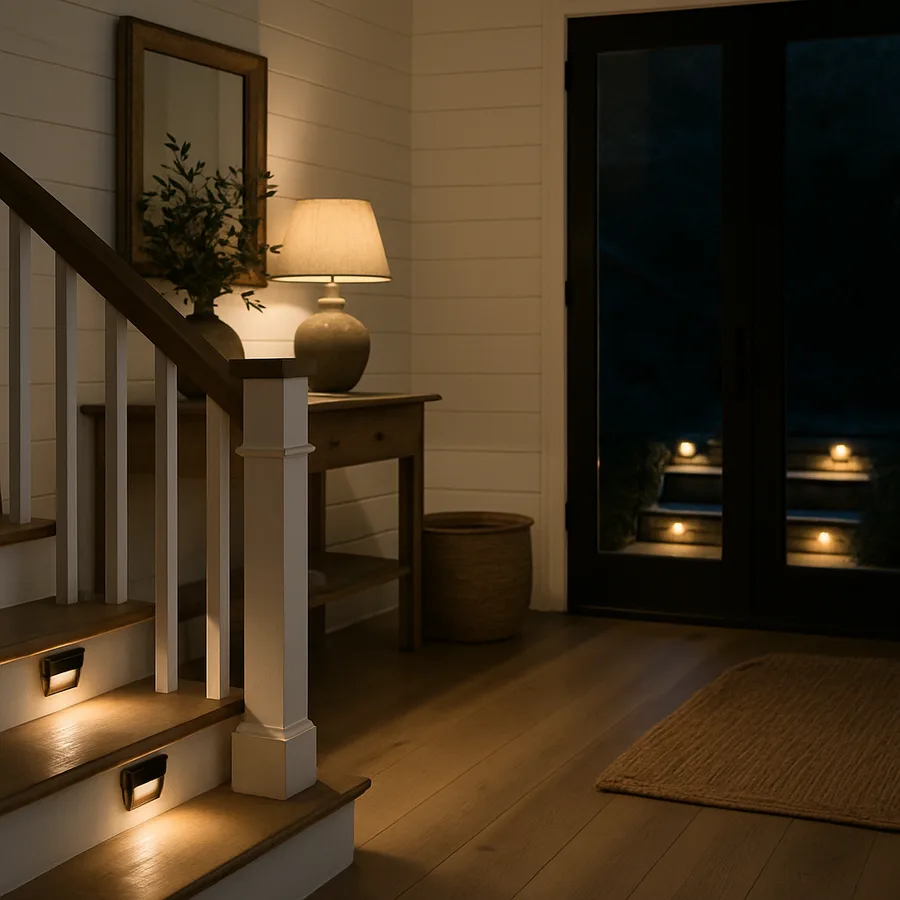
Why Outdoor Stairs Are a Hidden Hazard After Dark
Outdoor stairs occupy a strange middle ground in residential safety planning. They are technically part of the home, yet they sit outside the ring of warm interior light, often surrounded by shrubs, hardscape, and changes in elevation that the human foot cannot infer in shadow. According to the National Institute on Aging, more than one in four adults over sixty-five experiences a fall each year, and a meaningful portion of those falls happen on porch steps, deck stairs, and walkway treads where the only light comes from a distant entry fixture or, worse, the moon. The eye adapts slowly to gradient lighting, and a single dim bulb at the top of a flight of stairs creates a high-contrast tunnel that masks the lip of every tread below.
Builders rarely treat outdoor steps with the same lighting intensity they bring to a kitchen island, but the consequences of a missed tread are far more serious than a misplaced spatula. The Centers for Disease Control and Prevention reports that fall-related injuries cost the U.S. healthcare system more than fifty billion dollars annually, and stair-related falls feature heavily in that figure. Solar step lights occupy a sweet spot in this risk landscape: they install without trenching, run on free photons, and stay operational during grid outages when traditional low-voltage systems go dark.
Have you ever paused at the top of your back steps because you genuinely could not see where the next tread began? That moment of hesitation is a warning, and it is exactly the problem a properly specified solar step light is designed to solve. This Old House contributors have repeatedly emphasized that visual rhythm, not raw brightness, governs whether stairs feel walkable, and solar fixtures excel at delivering that rhythm because they are inexpensive enough to install on every single step.
How Solar Step Lights Actually Work
A modern solar step light is a small, self-contained energy system. A photovoltaic panel, usually polycrystalline or monocrystalline silicon between fifty and two hundred milliwatts, charges a lithium iron phosphate or nickel-metal hydride cell during daylight. A photoresistor or simple voltage comparator detects darkness and triggers an LED driver, typically running one to four warm-white or cool-white LEDs at low current. The whole system is governed by a microcontroller no larger than a fingernail, and the case is sealed against rain, frost, and the inevitable garden hose.
The performance ceiling depends on three variables: panel size, battery capacity, and LED efficacy. A fixture with a two-hundred-milliwatt panel paired with a one-thousand-milliampere-hour cell can comfortably deliver eight to ten lumens for the entire dark cycle on a summer night. In December, the same fixture may only manage four hours of usable output before dimming, which is why the better manufacturers publish two runtime numbers: peak summer and worst-case winter. Energy Star guidance on outdoor lighting emphasizes that runtime claims must be evaluated against the user's actual latitude and panel orientation rather than a marketing photograph taken in San Diego.
One subtlety that surprises first-time buyers is the difference between path lighting and step lighting. A path light spreads a wide cone across a horizontal walkway. A step light directs a narrow, downward wash specifically onto the tread surface, often with a small shield that prevents glare from striking the eye of the descending walker. If you mount a path-style fixture on a stair riser, the user looks straight into the LED and is briefly blinded, the opposite of the intended effect.
Picking the Right Fixture: Lumens, Color Temperature, and Beam Spread
The lumen target for residential exterior steps is lower than most homeowners assume. The Illuminating Engineering Society recommends roughly five to ten lux at the tread surface for safe descent, which translates to as little as three to eight lumens per fixture when the light is mounted six to eight inches above the tread. Overshooting this range produces hot spots and pupil constriction, which actually worsens the contrast between the lit step and the dark landscape beyond.
Color temperature matters more than most product pages admit. A 2700K to 3000K warm white mimics incandescent porch light, integrates with most exterior architecture, and avoids the harsh blue cast that draws insects and irritates neighbors. A 4000K neutral white reads slightly cleaner on stone hardscape but can feel clinical against wood decking. Anything above 5000K should be avoided for residential applications: it is the color of headlights and emergency vehicles, and it disrupts the melatonin response of anyone using the steps before bed.
Beam spread is the third specification that separates a workable fixture from a useful one. A 120-degree downward wash will cover a forty-eight-inch tread evenly when mounted at the riser midpoint. A narrow forty-five-degree spot will create a bright island in the center with dark corners, exactly where shoes catch. NAHB remodeling guides note that lighting designers increasingly specify wide-beam, low-output fixtures over narrow-beam high-output ones for residential safety applications, because the former is more forgiving of imperfect placement.
Placement Strategy for Treads, Risers, and Landings
Three placement strategies dominate residential installations, and each has tradeoffs. The first is riser-mounted lighting, where a small fixture is recessed or surface-mounted into the vertical face of each step. This approach delivers the cleanest visual line during descent because the light grazes the tread above without shining into the user's eyes. It does, however, require either a recessed pocket or a low-profile surface fixture less than one inch deep, and it makes the riser the photovoltaic-charging surface, which limits panel size.
The second strategy is handrail or balustrade integration, where lights are mounted to the underside of the rail or to vertical balusters, casting a downward wash. This is the easiest retrofit because the rail is at hand height and easy to drill. It also keeps the panel high enough to avoid leaf litter and snow piling. The drawback is that handrail-mounted fixtures require a clear sightline to the sky for charging; a deeply covered porch will starve them of sun.
The third strategy is post-cap or pier-cap lighting, which floods a broader area but does not specifically target the tread. This works well at landings and at the top and bottom of a flight, but it should not be the only lighting on a long stair. A combined approach, caps at the terminal landings and riser or rail lights at every tread, is what professional designers specify when stair safety is the explicit brief.
Weather, IP Ratings, and Long-Term Durability
Outdoor electronics live a hard life. A solar step light experiences thermal cycling from below freezing to over one hundred forty degrees Fahrenheit on a black-painted riser in July, plus repeated immersion during heavy rain and the slow chemical assault of pollen, salt mist, and lawn-treatment overspray. The relevant durability spec is the Ingress Protection rating, written as IP followed by two digits. The first digit (zero to six) describes solid-particle resistance; the second (zero to nine) describes water resistance.
For step lights, the floor specification is IP65: dust-tight and protected against low-pressure water jets from any direction. IP67 adds short-term submersion resistance, which is useful in regions with heavy snowmelt or coastal flooding. IP44, sometimes seen on inexpensive imports, is inadequate for ground-level installation and will fail within two seasons. AAMA testing standards for exterior fenestration components are a useful proxy here: any product that cannot survive AAMA-style accelerated weather cycling will not survive a real winter on an exposed stair.
Battery chemistry deserves equal attention. Lithium iron phosphate (LiFePO4) cells maintain capacity through roughly two thousand charge cycles and tolerate sub-freezing temperatures far better than older NiMH chemistry. Cheap solar lights still ship with NiMH cells that lose half their capacity below twenty degrees Fahrenheit and need annual replacement. Reading the spec sheet for the cell, not just the fixture, is the single most reliable predictor of whether a solar step light will still be working in year five.
Installation Mistakes That Compromise Safety
Even the best fixture fails when installed poorly. The most common error is panel shading: mounting the light under a deep eave, behind dense shrubbery, or on the north face of a structure where it never sees direct sun. A solar panel needs four to six hours of unobstructed daylight to charge a battery for an overnight cycle. Anything less and the fixture will dim or shut off before sunrise, exactly when stair traffic resumes for early commuters.
The second common error is uneven spacing. A homeowner installs lights on the first, third, and fifth steps and leaves the others dark, assuming the eye will fill in the gaps. It does not. The brain reads dark treads as either missing or unsafe, and the user begins to grip the handrail tightly and slow descent, which actually increases fall risk on icy nights when momentum and weight transfer matter. NARI remodeling contractors regularly note that consistency, not intensity, is what makes a stair feel professionally lit.
The third common error is ignoring the local building code. The International Code Council publishes the International Residential Code, which in section R303.7 requires illumination at all interior and exterior stairways. Solar fixtures satisfy this requirement only if they actually function on demand; an automatic photo-controlled fixture that dies at three a.m. arguably does not satisfy code intent. Some jurisdictions are beginning to require hardwired backup illumination for primary egress stairs, with solar permitted as supplementary. Before specifying solar as the sole stair lighting on a means-of-egress staircase, check with the local building department.
Cost, Lifespan, and the Return on a Twenty-Dollar Fixture
The economic case for solar step lights is unusually strong because the alternative is so expensive. A hardwired low-voltage stair lighting system requires a transformer, conduit or cable, a switching scheme, and either a licensed electrician or a confident DIYer with a trench shovel. Total installed cost commonly lands between fifteen hundred and four thousand dollars for a typical deck. Solar fixtures, by contrast, range from twelve to sixty dollars per unit, install with two screws, and require zero ongoing electricity.
The relevant lifespan question is not how long the LED lasts, since modern LEDs run fifty thousand hours or more, but how long the battery lasts. LiFePO4 cells in well-designed fixtures retain eighty percent of capacity after roughly six to eight years of nightly cycling. After that point, the cell is replaceable in better fixtures and disposable in cheaper ones. Buyers who prioritize replaceable batteries cut their long-term cost by more than half.
Are you weighing solar against a full hardwired retrofit for a porch you only use seasonally? In most cases the math favors solar three to one, with the additional benefit that the fixtures travel with you if you move. If you are building new and the trench is already open for other electrical, hardwired wins on absolute brightness and reliability, but solar still has a role as redundancy on the lowest tread, which is statistically the most-missed step on any flight.
Conclusion
Solar step lights are no longer the dim, blue-tinted novelty they were a decade ago. The combination of efficient LEDs, lithium iron phosphate batteries, and inexpensive microcontrollers has produced fixtures that genuinely solve the nighttime stair-safety problem at a fraction of the cost of hardwired alternatives. The technology has matured to the point where the limiting factor is no longer the hardware but the homeowner's willingness to specify warm color temperatures, wide beam spreads, and consistent placement on every tread.
The path to a safer stair is short and worth walking. Map your steps, check sun exposure at each riser at noon and four p.m., select an IP65-or-better fixture in the 2700K to 3000K range with a wide downward beam, and install one fixture per tread. Test the system after three nights of charging, then again after the first heavy rain, and replace any fixture that underperforms before the season turns dark.
If you are planning a deck refresh this season, treat lighting as a structural specification, not a decorative afterthought. Walk your stairs at midnight before you spend a dollar, note exactly where your eye loses the tread edge, and place a fixture at every one of those points. The result is the kind of quiet, almost invisible safety improvement that pays back the first time a guest walks down your back steps in the dark and never has to think about it.
Ready to upgrade your outdoor stairs before fall? Take five minutes tonight to count your treads, photograph the riser faces, and order one fixture per step plus two spares, then enjoy the next decade of confident nighttime descents. For deeper guidance on outdoor lighting fundamentals, consult the ENERGY STAR lighting resources, the NAHB remodeling library, and the This Old House outdoor projects archive.
More Articles You May Like


Comments
Post a Comment