Pedestal Sink vs Wall-Mount Vanity in a Half Bath Layout
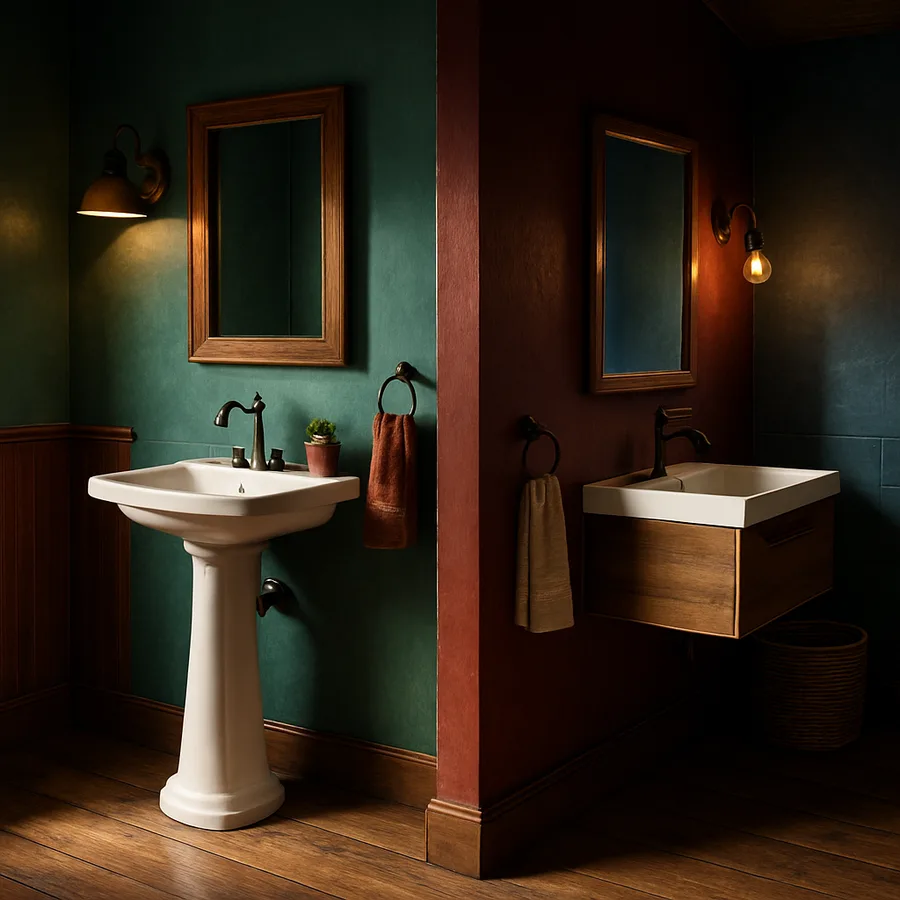
In a half bath, the sink decision is the design decision. Because the room has almost nothing else, no tub, no shower, sometimes not even a window, the sink carries roughly half of the room's visual weight and a large share of its functional performance. The two most common choices, a pedestal sink and a wall-mount vanity, look superficially similar from a distance, but they solve different problems. Choosing the wrong one turns a half bath into a room that looks fine but functions poorly, or stores well but feels cluttered.
This guide compares the two directly across the decisions that actually matter in a small half bath: floor space, storage, plumbing, cleaning, style, and resale. Each section treats them as what they are, competing answers to the same question, and ends with clear conditions under which one beats the other. By the end, you should be able to look at your own half bath's layout and pick the right one without second-guessing.
The Core Difference: Floor-Touching vs Wall-Hung
A pedestal sink is a two-piece fixture, a basin and a supporting column, where the column rests on the floor and the basin sits on top. The plumbing typically runs inside or behind the column, and the whole assembly touches both the floor and the wall. A wall-mount vanity, sometimes called a floating vanity, is cantilevered entirely from the wall and touches the floor only if the designer specifies legs or a pedestal-style front. That mounting difference is small on paper but large in practice.
The floor-touching pedestal sink creates one visual line from floor to rim, which gives the fixture a classical, anchored feel. The wall-hung vanity creates a shadow gap between the cabinet and the floor, which gives it a lighter, more modern feel. Houzz data from recent half-bath renovations shows that roughly 42% of homeowners choose a pedestal sink and 38% a wall-mount vanity, with the remainder split between console sinks and traditional floor-mount vanities. The near-even split reflects how differently the two solve for the same room.
The real question is not which looks better, because both can look great, but which better matches how you will actually use the half bath. That comes down to storage needs, plumbing reality, cleaning habits, and style direction. Every other decision flows from those four.
Storage: The Single Biggest Functional Difference
A pedestal sink has no storage. None. The column can hide a pipe and, in some models, a small decorative shelf, but the fixture offers essentially zero enclosed storage. A wall-mount vanity, even a shallow one, typically offers a drawer, a cabinet, or both. That is the starkest functional difference between the two, and it should drive the decision more than aesthetics in most households.
Ask yourself honestly: what does the half bath need to store? The real inventory for most households is small, a few extra rolls of toilet paper, a pack of hand towels, a bottle of hand soap refill, maybe a small basket of cleaning supplies. That is it. If the rest of the house has adequate linen and supply storage, a pedestal sink's lack of storage is not a problem, because nothing needed to be stored there in the first place. A small floor basket or a wall-mounted cabinet handles the overflow.
If the half bath is also the only accessible bath for guests staying overnight, or if the household has very limited storage elsewhere, the wall-mount vanity wins easily. The drawer holds hand towels; the cabinet holds backup supplies; the top holds a soap dispenser and nothing else. A National Kitchen and Bath Association (NKBA) survey of homeowner satisfaction in small bathroom renovations found that storage complaints were three times more common among pedestal sink owners than among vanity owners, but satisfaction with visual openness was also significantly higher.
Floor Space and Visual Openness
Both pedestal sinks and floating wall-mount vanities free visible floor space compared to a traditional floor-standing vanity, but they do so differently. A pedestal sink's column is narrow, typically 8 to 12 inches wide at the base, so the floor around the column remains visible and walkable. A floating vanity's cabinet is wider, typically 20 to 30 inches, but the floor beneath the cabinet is also visible. The net floor visibility depends on width.
For a very small half bath under 20 square feet, a pedestal sink usually creates more perceived floor space, because the column is so narrow that the eye barely registers it. For a half bath in the 20-to-30-square-foot range, a floating vanity creates about the same perceived openness while adding storage. Above 30 square feet, the floating vanity wins outright, because the room has enough floor for the cabinet width to disappear visually.
A reader's question worth asking: when you imagine the finished room from the doorway, do you see a single slender object against a wall, or a horizontal surface with a sink on it? The first answer points to a pedestal; the second points to a vanity. Both are valid; they just tell different visual stories. Architectural Digest has published extensive photo galleries of both approaches in small half baths, and the strongest examples of each make the same point: the fixture choice should match the room's intended emotional register, traditional-anchored for pedestals, modern-lifted for floating vanities.
Plumbing and Installation Realities
Plumbing is where these two fixtures differ most technically. A pedestal sink typically accepts plumbing from the wall or the floor through the column, and many models are designed to hide the plumbing entirely within the pedestal. That flexibility makes pedestal sinks relatively easy to install in both new construction and renovations, even in older homes where plumbing locations may be legacy placements.
A wall-mount vanity requires plumbing through the wall, which is straightforward in new construction and a bigger project in renovations. If the existing drain and supply lines come up through the floor, they must be re-routed into the wall before a wall-mount vanity can be installed, unless the vanity includes a decorative panel or legs to disguise the floor-up plumbing. Rerouting plumbing from floor to wall is not a cheap fix; it usually means opening drywall, moving a drain line, and patching. Better Homes & Gardens has a plumbing retrofit guide that walks through what is involved.
Wall strength is a second concern for wall-mount vanities. A loaded vanity plus a user leaning on it can put 150 to 200 pounds of load on the wall, and not every half-bath wall is built for that. Blocking between studs before drywall goes up is the right solution in new construction; in renovations, an opened wall and added blocking is often required. Pedestal sinks carry most of their load on the floor, so wall strength is less critical, though the basin still bolts to the wall for stability.
Cleaning, Maintenance, and Long-Term Livability
Pedestal sinks and wall-mount vanities both clean more easily than traditional floor-standing vanities, which trap dirt along their bases. But they clean differently. A pedestal sink's pedestal has a rounded or shaped profile that collects dust and hair at the base, and the joint where the column meets the basin can be a magnet for grime. On the other hand, the small footprint means there is less to clean.
A wall-mount vanity has no floor contact, so the entire floor is one wipeable plane, including the area under the cabinet. This is a meaningful hygiene advantage in a half bath that also serves guests or children. The cabinet itself, however, adds surface area, sides, front, underside, that collects dust and splashes, and a cabinet with many seams or decorative detail can be harder to wipe than a smooth pedestal column.
Over a ten-year ownership period, both fixtures are durable if well-made. Pedestal sinks in vitreous china rarely crack unless mishandled, and they have no moving parts or finishes to wear. Wall-mount vanities in solid wood or high-quality laminate hold up well, but hardware, drawer slides, and hinges are wear points that eventually need replacement. Consumer Reports has noted in its bathroom fixtures durability reporting that vitreous china pedestal sinks have one of the lowest failure rates of any bathroom fixture category, which partly explains their long presence in the American bathroom market.
Style, Resale, and When Each Wins
Style-wise, pedestal sinks carry a traditional or transitional signal almost regardless of the specific model. Even a modernized pedestal in a minimalist profile reads as a nod to classical bathroom design, because the form descends from Victorian and early twentieth-century plumbing. Wall-mount vanities, by contrast, carry a modern signal, again almost regardless of model, because the cantilevered form is a twentieth-century innovation tied to modernism.
This style signaling matters for resale. In older homes, colonials, Victorians, classic bungalows, and traditional ranches, a pedestal sink can feel appropriate in a way a floating vanity cannot. In newer homes and contemporary renovations, the reverse is true. A mismatch between fixture style and home style registers as "cheap update" to buyers, even when the individual fixture is high-quality. A Zillow listing analysis found that half baths whose fixtures matched the home's architectural style sold, on average, at 0.7% higher price-per-square-foot than homes with mismatched fixtures, a small but measurable premium.
When does each win? Pedestal sinks win in very small rooms under 20 square feet, in traditional or period homes, in households that do not need half-bath storage, and when the plumbing comes up through the floor and cannot be cost-effectively re-routed. Wall-mount vanities win in rooms 25 square feet and up, in modern or contemporary homes, in households that need meaningful half-bath storage, and in new construction where plumbing can be planned wall-ward from day one. A reader's question worth ending on: if a friend walked into your finished half bath and described it in one word, would you want that word to be "classic" or "modern"? The honest answer should decide the fixture.
Conclusion
Pedestal sinks and wall-mount vanities are not interchangeable. They solve different problems, signal different styles, and demand different plumbing setups. The right choice for any given half bath depends on a handful of specific factors, room size, storage need, plumbing starting point, home style, and household cleaning tolerance, and a careful walk through those factors will almost always point clearly to one answer.
If your half bath is under 20 square feet, in an older home, and already has floor-up plumbing, a pedestal sink is probably the right answer. It preserves the narrow floor plan, matches the home's architectural vocabulary, and avoids a plumbing retrofit. Add a small wall-mounted cabinet or a shelf above the toilet for the modest storage a half bath actually needs, and the room will feel intentional rather than compromised.
If your half bath is 25 square feet or larger, in a newer or contemporary home, with plumbing you can plan or re-route into the wall, a wall-mount floating vanity is almost certainly better. It adds real storage, keeps the floor visually open, and signals a modern sensibility that matches the architecture. The upfront cost is higher than a pedestal, but the daily livability and long-term resale value usually justify the premium.
Either way, commit to the choice and build the rest of the room around it. Half bath design rewards consistency; a beautifully chosen fixture paired with a hesitant design around it looks like a compromise, while a clearly committed room, pedestal or vanity, looks like a deliberate statement. If you find yourself flipping back and forth between the two options for more than a week, stop considering both and pick the one your home's architectural style points toward. A pedestal in a Victorian will almost always feel more correct than a floating vanity, and a floating vanity in a modern build will almost always feel more correct than a pedestal, regardless of which fixture is technically better on paper. Listen to the house first, the catalog second.
One last note on budget. A quality pedestal sink costs roughly $300 to $700 installed, plus a faucet. A quality wall-mount vanity with a cabinet, top, and sink runs $900 to $2,500 installed, plus plumbing relocation if needed. That cost delta buys you storage and a more modern look, but it is a real delta. If the budget is tight and the half bath is truly a guest-only room, the pedestal path is usually the smarter financial choice, and the design can still feel complete with strong lighting, a well-chosen mirror, and interesting paint or paper on the walls. Compare real-world pedestal and wall-mount installations in our half-bath gallery on Interior Bliss, filtered by room size and home style, to see which approach fits your space.
More Articles You May Like



Comments
Post a Comment