Lever Door Handles vs Knob Replacements for Arthritic Hands
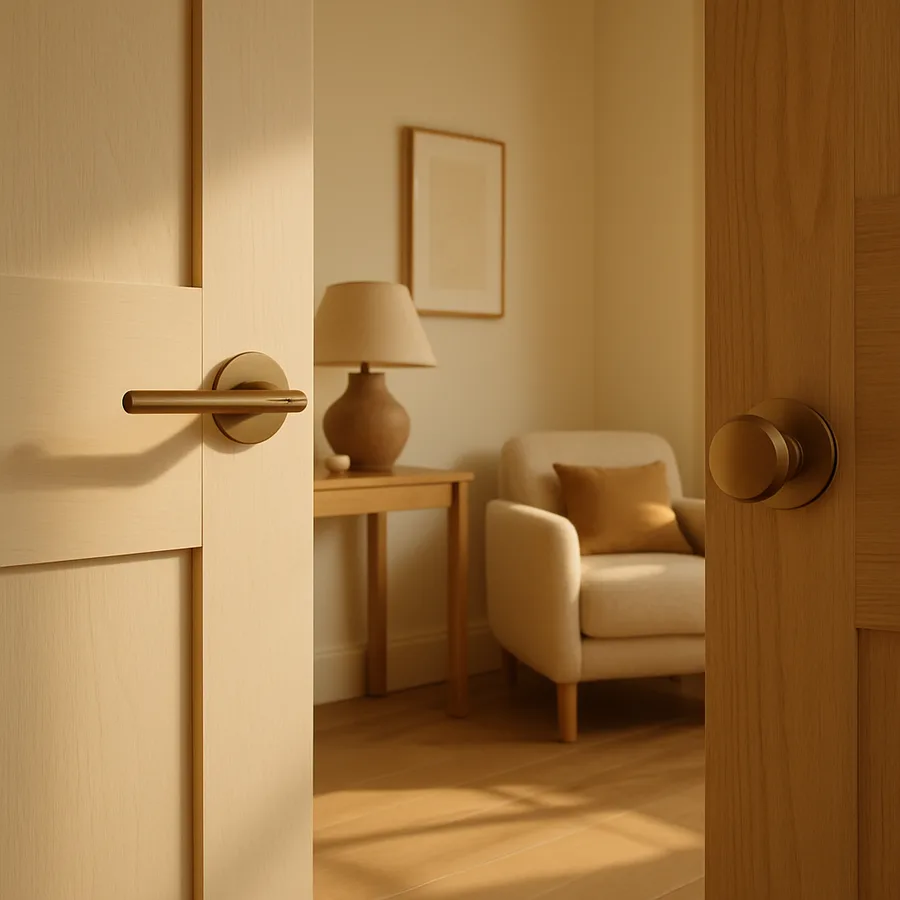
The humble doorknob is one of those everyday objects that quietly punishes anyone with hand limitations. For a person with osteoarthritis, rheumatoid arthritis, carpal tunnel syndrome, or simply the reduced grip strength that comes with age, the act of grasping a round knob and twisting it can range from mildly painful to genuinely impossible. Multiply that across the dozen or more doorknobs in a typical home, and you have a steady drip of frustration that erodes independence long before any other mobility challenge appears.
Replacing knobs with lever handles is among the simplest and most cost-effective home modifications available. The Arthritis Foundation reports that approximately 54 million American adults have been diagnosed with some form of arthritis, and grip-related limitations are among the most common functional complaints. Lever handles solve the problem elegantly because they can be operated with a closed fist, an elbow, a forearm, or even the back of a wrist, eliminating the rotational grip that knobs require.
The Biomechanics of Grip and Why Knobs Fail
To understand why lever handles work, it helps to understand what a doorknob actually demands of the hand. Operating a standard knob requires three things in sequence: enclosing the fingers around the knob, applying inward grip pressure to maintain contact, and rotating the wrist through roughly 90 degrees while sustaining that grip pressure. Each step depends on different muscle groups and joint motions, and arthritis typically affects all of them.
The American College of Rheumatology defines a "functional grip strength" threshold of about 20 pounds of force as the level below which many activities of daily living become difficult. Standard residential doorknobs typically require 5 to 10 pounds of grip force just to maintain contact, plus additional torque to rotate. For a person whose grip strength has dropped to 15 pounds, the knob is technically operable but uncomfortable. For someone whose grip strength has fallen to 8 pounds, the same knob may be entirely unusable.
Lever handles bypass this entire problem because they do not require sustained grip. The user simply pushes downward on the lever, which can be done with the heel of the hand, a closed fist, an elbow, or even a hip if the user is carrying something. The force required is typically 2 to 4 pounds applied perpendicular to the lever, well within the capability of nearly all users. The wrist does not have to rotate at all; the lever does the rotation through the latch mechanism.
The ADA and Why It Matters Even at Home
The Americans with Disabilities Act requires lever-operated hardware in all newly constructed and renovated public accommodations, specifically because round knobs were identified as one of the most consistent barriers to access. The technical requirement is hardware that can be operated without tight grasping, pinching, or twisting of the wrist. Lever handles meet this standard. Round knobs do not.
The ADA does not apply to private residences, so a homeowner is free to install whatever hardware they prefer. But the underlying logic of the lever requirement applies just as strongly at home. If you are planning a home that will serve an aging population, an arthritis sufferer, a stroke survivor, or anyone with a temporary injury that affects hand function, levers should be the default choice. The cost difference between knob and lever hardware at the consumer level is small, often $5 to $20 per opening, and the usability difference is enormous.
Have you noticed that high-end residential design has been quietly shifting toward levers regardless of accessibility considerations? There is a reason. Levers are easier to use when carrying groceries, managing pets, or rushing through doorways with full hands. The accessibility community arrived at lever handles for one set of reasons; the broader market is arriving at the same conclusion for adjacent reasons. The National Kitchen and Bath Association now includes lever hardware in its baseline residential design recommendations.
Choosing a Lever: Style and Mechanism
Once you have decided to switch to levers, the next question is which lever. The market includes hundreds of styles ranging from traditional to ultra-modern, and the right choice depends on the architecture of the home and the specific limitations of the user. A few principles apply across all styles.
First, look for levers with a return to the door surface rather than levers that protrude straight out into the room. A "return" lever curves back toward the door at its tip, which prevents clothing, dog leashes, and shopping bags from catching on the lever. The catching hazard sounds minor until it pulls a frail elderly user off balance. Most accessibility professionals recommend return levers exclusively, and many building codes require them in commercial settings.
Second, prefer levers with a slight downward angle from horizontal, often called a "drop" lever. The downward angle creates a natural pocket that the heel of the hand falls into, which makes the lever easier to operate without looking at it. This matters for users with vision limitations and for anyone navigating in low light, such as nighttime trips to the bathroom. The drop also reduces the chance that the lever will catch on a coat sleeve as the user passes through.
Third, match the locking mechanism to the user's needs. Standard residential lever sets come in passage (no lock), privacy (push-button lock), and keyed entry (key required) configurations. For interior doors used by a person with arthritis, push-button privacy locks are easier than thumb-turn locks, since the thumb-turn requires fine pinch grip that the user may have lost. For exterior doors, consider keyless electronic deadbolts, which eliminate the need to manipulate keys at all.
Finishes and Why They Matter for Grip
The finish on a lever affects more than aesthetics. Smooth polished finishes like polished chrome and polished brass become slippery when wet, which matters for bathroom and kitchen doors where hands are often soapy or damp. Brushed, satin, or matte finishes provide more friction and remain easier to grip when wet.
For users with severe arthritis or limited tactile sensation, consider levers with a textured grip section on the handle itself. Some manufacturers offer levers with knurled, hammered, or rubberized grip surfaces specifically marketed for accessibility. These look slightly more utilitarian than smooth finishes but the usability gain is meaningful, particularly in rooms where hands are wet or temperature-sensitive.
Cold metal can be painful for arthritic joints, especially in unheated parts of the home like garages, mudrooms, and entries. Some manufacturers offer levers with thermally insulating grip materials, often a high-density polymer wrapped over a metal core. These remain comfortable to touch even at low temperatures and reduce the joint pain that comes with grasping cold metal first thing on a winter morning. The American Occupational Therapy Association includes hardware temperature considerations in its home modification recommendations.
Installation Considerations and DIY Feasibility
Switching from a knob to a lever in an existing door is, in most cases, a straightforward DIY project. Modern residential locksets, whether knobs or levers, share a common installation footprint defined by the door's bore hole pattern (typically 2-1/8 inch diameter cross-bore plus 1 inch edge bore for the latch). Most replacement levers fit this standard footprint without any modification to the door.
The exceptions are worth knowing about. Older doors from before about 1965 sometimes have non-standard bore patterns or use mortise locksets that do not fit modern lever hardware. Mortise lock conversion is possible but requires either a specialized mortise lever set or a door modification, and is best left to a locksmith or experienced finish carpenter. Some narrow stile doors, particularly French doors and some apartment entry doors, lack the depth to accept standard lever hardware and require specialty narrow-stile locksets.
The other consideration is door swing direction. Levers are handed, meaning a left-hand lever will not work properly on a right-hand door and vice versa. Most residential lever sets sold today are reversible, with internal mechanisms that can be flipped during installation. Older or premium lever sets are sometimes hand-specific, in which case you need to identify the door swing direction before ordering. The convention is that you stand on the side of the door where the hinges are not visible (the "outside" or "approach" side), and the side the hinges fall on tells you the door's hand.
Cost, Brands, and Bulk Replacement Strategy
Quality lever hardware ranges from about $20 to $300 per opening, depending on brand, finish, and mechanism complexity. The mid-tier sweet spot for residential accessibility upgrades is around $40 to $80 per opening, which buys solid mechanism reliability, good finish durability, and accessibility-friendly geometry without paying for designer-brand markup. Schlage, Kwikset, Baldwin, and Emtek all produce reliable lever hardware at this price point.
For a whole-house lever conversion, plan on roughly $400 to $1,200 in hardware costs for an average home with eight to twelve interior doors plus two or three exterior locksets. Add $200 to $600 for professional installation if you are not doing the work yourself, though most homeowners can complete the project over a weekend with a screwdriver and basic instructions. The AARP HomeFit Guide includes lever hardware as one of the highest-priority accessibility upgrades for any household with adults over 60.
Strategically, do not approach this as a one-door-at-a-time project unless cash flow demands it. Buying a matched set of lever hardware for the entire home produces a coherent visual result, ensures consistent mechanism feel for the user (which matters for muscle memory in users with cognitive limitations), and usually qualifies for multi-pack pricing. Many manufacturers offer "interior packs" of six or eight matching levers at meaningful discounts compared to individual purchases.
Conclusion
The switch from doorknobs to lever handles is one of the lowest-cost, highest-return accessibility modifications a homeowner can make. The hardware is inexpensive, the installation is straightforward, and the daily quality-of-life improvement for anyone with reduced grip strength is immediate and lasting. Unlike many accessibility modifications that visibly mark a home as adapted, levers have become so common in mainstream residential design that no one entering the home will read them as anything other than current style.
The decision criteria are reasonably simple. If anyone in the household has any form of arthritis, hand injury, or grip limitation, levers are the right choice without much further analysis. If everyone is currently healthy but the household is approaching a stage of life where these limitations become likely, levers are still the right choice as a preventive measure. The cost is small enough that the calculus rarely runs the other way.
Pay attention to the details that matter for usability rather than just appearance. Choose return-style levers with a slight downward drop, brushed or matte finishes that grip well when wet, and reliable mechanism brands that will hold up to thousands of cycles per year. For exterior doors, consider keyless electronic deadbolts to eliminate key manipulation entirely. These small choices compound over years of daily use.
Your action step this weekend: walk through your home and count the interior doors. Multiply by an estimated $50 per opening for mid-tier lever hardware, add a few exterior locksets at $80 to $150 each, and compare the total to what you would spend on a single weekend of dining out. The math almost always favors immediate action. Order a matched set of levers, set aside a Saturday afternoon, and complete the conversion in one focused session. The independence and comfort gains start the very next day. Keep the old knob hardware in a labeled bag in case you need replacement parts later, and take a few minutes during the install to lubricate each latch mechanism with a dry graphite product, which extends mechanism life and ensures smooth daily operation. If anyone in the household has not yet experienced lever-only living, expect a brief adjustment week as muscle memory updates, followed by a noticeable preference for the new hardware that almost no one ever wants to reverse. Plan one final walk-through after installation to confirm that every door latches cleanly, that strike plates are properly aligned, and that no levers contact furniture or wall surfaces during their full swing arc.
More Articles You May Like


Comments
Post a Comment